For all of our existence, Christian Concern has been clear that Jesus Christ is the hope for our nation. Paul Huxley reflects on our Lent campaign and the hope of what a Christian nation might offer a society.
It’s been a delight through Lent to be involved in our Hope for our Nation series, praying for all kinds of areas of our nation’s life: culture, families and education, government and business, health and social care, the justice system and the Church.
More than praying, we’ve sought to outline some of the changes that we need to see across society for the good of everyone. There’s far more to think about and to say than we could possibly have covered in these six weeks but we want to want to give some answers to what a more-Christian nation would look like.
There’s a lot of talk about Christian nationalism about.
For all its existence, Christian Concern has been clear that Jesus Christ is the hope for our nation. Our very-early logo showed a cross over a projection of the United Kingdom. ‘Speaking of Jesus Christ in public life’. ‘Bringing the hope of Jesus Christ to the heart of society’. We’ve always sought to be about him – not just Christian principles or ‘traditional values’.
So when we talk about Christian nations, it’s not a motto we’ve picked up and run with from enthusiastic accounts on X. It’s been our mission as long as we’ve existed.

Christian nations are highly desirable
I honestly think that Christians know in their bones that Christian nations are highly desirable.
- God loves us. We should expect that following his ways will generally lead to people thriving.
- The fallen world means that this is far from guaranteed on an individual basis, but at the zoomed-out level of nations and generations, this generality holds true
- All sorts of Bible passages give a prima facie case for these sorts of expectations.
- Straight after the Flood narrative but before Babel, Genesis 10 lists nations, setting up their importance in God’s eyes
- The history of Israel itself as a covenant nation (e.g. in the Wilderness and Judges).
- Israel’s obedience to the law is meant to be a light to other nations (Deut 4:6).
- The Psalms demonstrate interest in nations as a whole (96, 117 etc.) and see the kings of the earth called to ‘kiss the son’ (2:11-12).
- The wisdom of Proverbs is introduced as Solomon, the King of Israel, speaking to his son, implicitly a future king (1:1, 8) and therefore as wisdom for rulers of nations.
- Both Israel and other nations are frequently judged in the Prophets based on their collective justice and righteousness.
- The Great Commission is to see nations taught to follow Jesus’ teachings[1] (Matthew 28:19-20).
- Jesus is given the name King of Kings – implying that political leaders are under his authority and expected to obey him in how they rule
- At the end of Revelation, the leaves of the tree of life are described as “for the healing of the nations” (22:2)
- Shade in a map of the world with how deliberately and sincerely each nation has followed Jesus Christ and his principles over the centuries and you have something close to a map of how much those countries are free and flourishing. All nations have had their very dark moments, but what has been their north star across the centuries?
- Filling a nation with Christians who are fighting their own sins and seeking to love their neighbour will be very good news for their non-Christian neighbours; not least because it will lead more of them to salvation which is even better news for their neighbours
In that list, I’ve deliberately mixed together different understandings of what a Christian nation might be – structural Christianity, Christian laws and Christian people. This is because I see them as a package deal. More Christians should lead to a more Christian society. Better laws that honour Jesus Christ and his pattern for our lives should provide a better environment for the church and evangelism to flourish. And both of these would mean our official Christianity, as publicly proclaimed through coronations, parliamentary prayers (etc.) will appear far less hollow.
But I know that some Christians have reservations about some of this, or would say that other principles override or nuance what I’ve laid out.
I want to lay out two of these that I’ve seen during the course of our Hope for our Nation series.
Is this Christians seeking privilege?
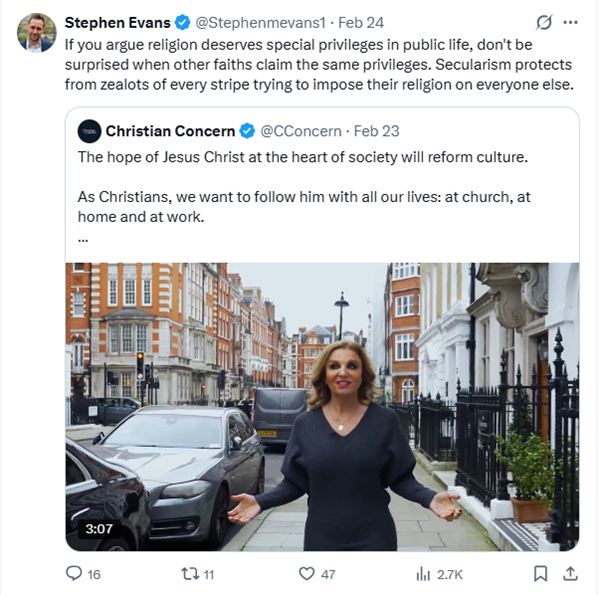
Responding to one of our early videos, the National Secular Society’s Stephen Evans claimed that this is all about privilege:
(source https://x.com/Stephenmevans1/status/2026312881382326340 )
The branding of Christian nations as being about special privileges is a savvy move from Stephen. It makes out that we are interested in Christians getting an easy ride at the expense of others, putting just about everyone off any such project.
So it deserves a brief response, particularly for Christians who may sympathise with it.
First, this is not a zero-sum game where institutional Christianity is great for Christians and bad for everyone else. Christianity is true. People following it is good for them. It is a privilege for atheists, Muslims, Sikhs and everyone else to live in a Christian nation with Christian neighbours. There will be more people showing kindness to them, being considerate, not stealing, not committing adultery, not giving their kids puberty blockers and even sharing the gospel of salvation with them.
Second, any basis for society unavoidably imposes its beliefs. Stephen himself wants secularism (institutionalised atheism) to rule out religion as a basis for societal decision making. However, Christianity may be unique among religions and worldviews for having learned across the centuries that heavy-handedly imposing its views is neither fruitful nor necessary. In my view, a Christian nation would have a lighter touch on these matters than any other religion or philosophy.
Finally, Christians built this nation. Schools, colleges and hospitals bearing Jesus’ name or those of saints do so because they were inspired by Christianity and seeking to honour Jesus Christ. When atheism gets around to building a flourishing nation somewhere, it may have earned some ‘privileges’ of its own. Until then, it will have to make do with the Communist USSR as its crowning achievement.
‘We don’t need privileges’
A related point I’ve heard from Christians unfortunately buys into this idea. It goes something like this:
“Christians don’t need special privileges. The Church should be in exile, it flourishes under persecution and this is the main way the gospel spreads.”
It’s a powerful story to tell and there’s some truth in it. There’s no doubt that God has used the blood of the martyrs as the seed of the Church. Jesus promised that the gates of Hell will not prevail against the Church. The Church needs nothing beyond what Jesus Christ has already given her.
But this idea is bearing a lot more weight in many Christians’ imaginations than seems warranted. The Church has been crushed over the centuries in the Middle East and Northern Africa – surely it should be thriving now?
Do we really believe this? Are we praying for our Christian brothers and sisters in North Korea and Nigeria to receive more persecution so that the gospel may flourish?
By contrast, although not everyone’s positive about the Emperor Constantine, committing the Roman Empire to Christianity certainly led to enormous numerical growth, institutions where Christian learning and civilisation in general flourished and, surely, a great number of people were saved.
I don’t know any serious Christian who thinks the Church needs institutional power. The point has always been that it’s good for everybody when whoever’s in charge follows God’s commandments.
Gospel-shaped Christian nations
Though there are signs of change, we are a long way from this being a reality. I don’t know all the details of what it would be like. But I believe with all my heart that such a nation would be full of life and love.
‘Hope for our Nation’ may be ending for now, but the meaning behind it must not. Will you continue to pray and work with us to bring love, justice, truth, freedom and hope to the United Kingdom and beyond?

References
[1] There are different readings of what exactly is implied by this phrase but even the mention of collective ‘nations’ rather than ‘everyone’ implies an interest in collective bodies.