On Tuesday 24 March, Andrea Williams and Christian Concern joined vindicated nurse Jennifer Melle and some of the Darlington Nurses for a meeting in Parliament attended by 15 parliamentarians, from across the political spectrum.
The meeting was organised by Carla Lockhart MP, and Andrea and the nurses were there to discuss how our policies can ensure that women get the single-sex spaces they deserve.
Andrea, Jennifer, and the Darlington Nurses were each able to deliver a speech at the roundtable discussion, the highlights of which are gathered below.

“Instead of treating me as the victim, I was treated like a criminal”
Jennifer Melle opened up about how she was deeply traumatised by what happened to her
“Today, I stand before you not because of clinical failure, misconduct, or negligence, but because I upheld my Christian beliefs, acted according to biological reality and truth, and tried to protect my own safety and dignity in the workplace.
In May 2024, I was the most senior nurse on a surgical ward, a biologically male convicted paedophile was brought in in chains for treatment.
The patient, who was over 6ft and had a beard, was serving time for sexual offences against children and wanted to identify as a woman.
During a clinical discussion with a doctor, I used the word “Mr”, based on the patient’s medical record and biological sex. The patient immediately became aggressive, lunging at me, and repeatedly shouted racial slurs, requiring security intervention.
Instead of treating me as the victim of abuse, I was treated like a criminal by Epsom and St Helier University Hospital Trust.
I was disciplined and investigated and received a written warning and was reported to the Nursing and Midwifery Council (NMC) as a “potential risk” for not using the patient’s preferred identity.
I did not always show it, but I was deeply traumatised by what had happened to me and I turned to Christian Concern and the Christian Legal Centre and launched legal action over how I had been treated.
I am a single mum and this had already turned my life upside down, but worse was to come.
When the story became public in March 2025, it was front page news. Suddenly, I was removed from duty, escorted from the premises in tears, and suspended under the pretext of a “potential data breach”, with no specifics given.
I believe, and still believe, that this was retaliation for speaking out, a punishment for whistleblowing.
My employer strengthened internal policy to classify “misgendering” as misconduct, while I was suspended.
From nine months, I lived under fear, anxiety, and the possibility of losing the job I loved. A disciplinary hearing was called over the ‘potential data breach’, and it looked certain I would be dismissed.
I want to express my deep gratitude for the cross‑party political support I received. MPs from across the political spectrum, especially Claire Coutinho and Carla Lockhart, and others, publicly called out the injustice of the case against me.
I also want to thank Christian Concern and the Christian Legal Centre. They stood by me when it seemed certain I would be dismissed. They provided legal, moral, and spiritual support at my lowest point.
In January 2026, the NHS Trust finally dropped the disciplinary case against me and reinstated me. Politicians and advocates helped ensure my employer recognised that continuing the case would be a grave injustice.
But let me be very clear: this is not over.
Today, as I speak to you, the Nursing and Midwifery Council still has two open investigations against me, one for “misgendering” the sex offender, and one for speaking publicly about what happened.
Both could drag on for up to three years.
Both could end my nursing career.
And both stem not from misconduct, but from my refusal to adopt compelled speech that contradicts my faith and biological reality.
At a meeting I had with Bridget Phillipson last month, I was told plainly that the NMC is “answerable to no one.”
From what I have experienced, that is true—and it should terrify every nurse in this country.
I stand here today to ask you, on behalf of myself, the Darlington nurses, Sandie Peggie, and countless others, for your help.
I am grateful to be back at work, but I am not free.
I am a marked woman and the sword still hangs over my head, and over many others.
No nurse should ever be forced to choose between:
- their Christian beliefs and their career,
- truth and obedience,
- personal safety and ideological compliance.
If the NHS is truly to serve the public, then Parliament must ensure its regulators, unions, and trusts serve truth, fairness, and the rule of law, not dangerous ideology.
Thank you.”
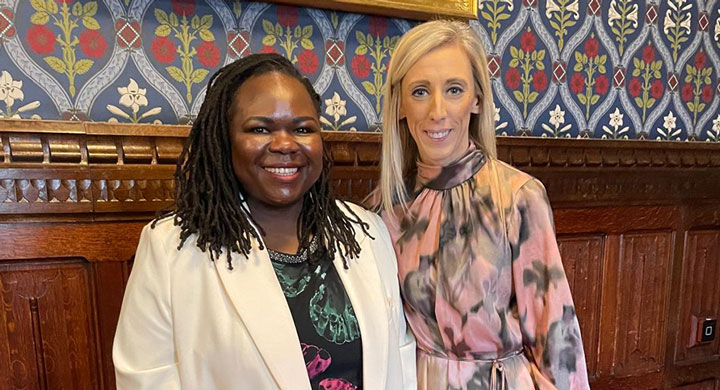
“Imagine your own daughter being told she must undress at work in front of a male colleague”
Darlington Nurse Bethany Hutchison asked MPs to imagine their own daughter, sister, or friend being told to undress in front of a male colleague
“Everything began when a biological male employee, identifying as a woman, was, without warning or consultation, granted access to the female changing room, the private place where women undress, store their belongings, and prepare for long shifts caring for vulnerable patients.
A widely used NHS policy stated clearly that any man who “identifies” as a woman must be allowed to use women’s spaces. No questions asked.
We raised concerns quietly at first. We expected reasonable conversations. We expected to be heard. After all, the NHS itself enforces strict rules on infection control, safeguarding, and privacy.
But nothing happened.
I realised I had to escalate matters when a colleague told me that after encountering the semi‑naked male in the changing rooms, she had suffered a panic attack that triggered memories of childhood abuse.
Still, there was complete inaction.
Following a senior management meeting, we were told we needed to be “educated,” to “broaden our mindset,” to “be more inclusive.” Managers even suggested that the male colleague himself should “educate” us, the very person whose presence was causing fear and distress among dozens of women.
We were afraid, but I knew we had to take a stand. With the help of the Christian Legal Centre, we launched legal action and went public with our story in the UK media. None of us had ever done anything like this before.
In response, management placed intimidating posters on the female changing room door declaring it an “inclusive changing space.”
Instead of asking the male colleague to find an alternative space, it was the female nurses, under the workplace policy, who were told that if we had a problem changing with a man, then we would need to change elsewhere.
We were given an office to use, one that opened directly onto a public corridor, and at first we had to leave our belongings on the floor. For 11 months we had to change in that office. Only during legal proceedings did we learn that the NHS had placed us at further risk by refusing to spend the money required to make the room compliant with fire safety regulations.
To understand how shocking this felt, imagine your own daughter, sister, or friend being told she must undress at work in front of a male colleague, and that she is the one who must adapt.
None of the major unions supported us or defended our rights as workers.
So, we formed our own union, a first of its kind, the Darlington Nursing Union, created simply to defend our basic rights and dignity as women.
Our journey since then has been extraordinary. We have met with some of the highest political leaders in the UK. But still, no one in authority was able, or willing, to simply resolve the issue.
Even after the UK’s Supreme Court issued a landmark ruling in April on a related case, vindicating our position, no institution was able to act.
And then, in January after two-and-a half years, something extraordinary happened.
We won.
The tribunal ruled in our favour.
Now we really need your help to ensure that the tribunal’s ruling in our case and clear Supreme Court ruling is turned into a policy becomes practice across the NHS: lawful, compassionate, and safe for everyone.
And I will now hand over to my colleague, Lisa, to say a bit more about that.”
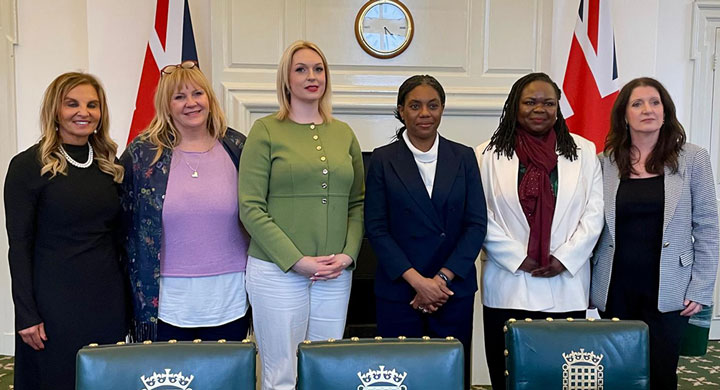
“I never thought I would have to risk so much to defend the dignity of my female colleagues”
Darlington Nurse Lisa Lockey said that she never thought she would have to fight so hard to defend the dignity of her female colleagues
“This isn’t about being “anti” anyone. It’s about basic workplace dignity and lawful safeguarding.
So why am I asking for your help? Because despite the Supreme Court’s ruling the NHS still hasn’t delivered a clear, system‑wide policy change that protects women’s single‑sex spaces at work.
NHS England has put its guidance under review, but on the ground, women are still being told to “broaden their mindset,” or to change in offices and cupboards while policies stay vague. That’s untenable.
Many of us felt so abandoned that we started our own union, a first of its kind the Darlington Nursing Union (DNU), dedicated to protecting women’s dignity across the NHS.
Working with lawyers at the Christian Legal Centre, we’ve produced a practical lawful policy in line with the Supreme Court ruling for every NHS Trust on single-sex spaces that protects the dignity of everyone.
Please take one, read it, and use your influence, with ministers, NHS England, and your local trusts, to make it part of an overhaul of unlawful policies across the NHS.
I have given over three decades to the NHS and my union because I believe in public service and making a difference to people’s lives. I never in a million years thought I would have to fight so hard and risk so much to defend the dignity of my female colleagues.
We truly appreciate your support and any help you can give to create lasting change on these issues, not just for us, but the whole medical profession.”
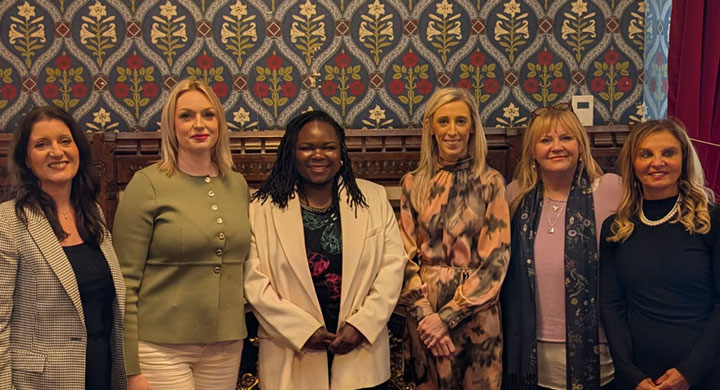
“We meet at a time when enduring principles of justice are being tested in profound ways”
Andrea Williams spoke about our constitutional foundations are being tested in profound ways
“We meet at a time when the constitutional foundations of this nation, rooted in the common law, shaped over centuries, and anchored in enduring principles of justice, are being tested in new and profound ways.
The United Kingdom has long been governed not merely by statute, but by a deep and settled legal inheritance – rooted in Magna Carta and shaped by the biblical understanding that there is a supreme lawgiver, God himself, above all human authority. Our legal tradition has given us foundational principles:
- the supremacy of law over power,
- the protection of belief and conscience,
- free speech and toleration,
- and the recognition of the inherent dignity of every individual.

From the Magna Carta onwards, our tradition has insisted that the state itself is subject to law, and that fundamental freedoms are not created by government or by individual will, but are recognised, protected, and upheld because they pre-exist the State. At the heart of this is the common law: the idea that law is grounded in reality, in a shared human order that makes space for disagreement, for conscience, and for toleration in both speech and action.
Parliament has historically legislated within that framework, carefully, incrementally, and with respect for objective reality and legal certainty.
I first qualified as a barrister in 1998, and I have served as Chief Executive of Christian Concern and the Christian Legal Centre since 2008. Each year we are contacted by around one thousand members of the public who are facing criminal or workplace sanction because of their Christian faith, or belief in biological reality, protection of life, or freedom of speech and conscience. Since 2017, a growing proportion of our cases have concerned transgender issues.
Christian parents Nigel and Sally Rowe were seeking to raise their children according to their belief that we are created male and female. Their young sons, aged just six and eight, were placed in classrooms where other children were being treated as the opposite sex, in a Church of England primary school. Their older son experienced confusion and distress. When they raised concerns, they were told that refusal to affirm gender identity would be treated as transphobic—and that such views would be taught out of pupils. They withdrew their children and brought judicial review proceedings.
At the time, they were met with hostility. Yet their case helped expose a much wider phenomenon: a rapid rise in gender confusion among children, social transitioning in schools, and referrals to gender identity services.
Alongside the Rowes, we have supported many others.
- Joshua Sutcliffe, a teacher, lost his teaching licence after saying “well done girls” to a group of girls, following a complaint about misgendering one girl in the class who was self identifying as a boy.
- Hannah – teacher, raised concerns about a 9-year-old transitioning – she was reported as a safeguarding risk
- Bernard Randall – school chaplain quietly raising the issue that you were free to question gender ideology
- Dr David Mackereth, an experienced NHS doctor, lost his role not for mistreating any patient, but for expressing, respectfully, that he could not use pronouns inconsistent with biological sex on a medical form.
At Christian Concern and the Christian Legal Centre, we will continue to stand with parents, professionals, and individuals who act with integrity and courage.
But we cannot do this alone.
When Bridget Phillipson met with Jennifer, she said it was not her role to issue guidance to the NHS but for Trusts to comply with the law.
But where there is confusion, leadership is required.
At the Christian Legal Centre, we have produced a policy, sent three times to the Secretary of State for Health. It is a workable solution.
I would urge you to take it to your party leaders and policy makers and ask them to adopt it.
There is a need:
- to restore clarity where there is confusion
- to protect conscience where it is under pressure
- to ensure access to changing spaces and toilets that reflect biological sex
- not to compel the use of pronouns
- for clarity in local councils and public institutions,
- for training manuals that make this clear
- for regulatory bodies to be held to legal account on this
It starts here.”