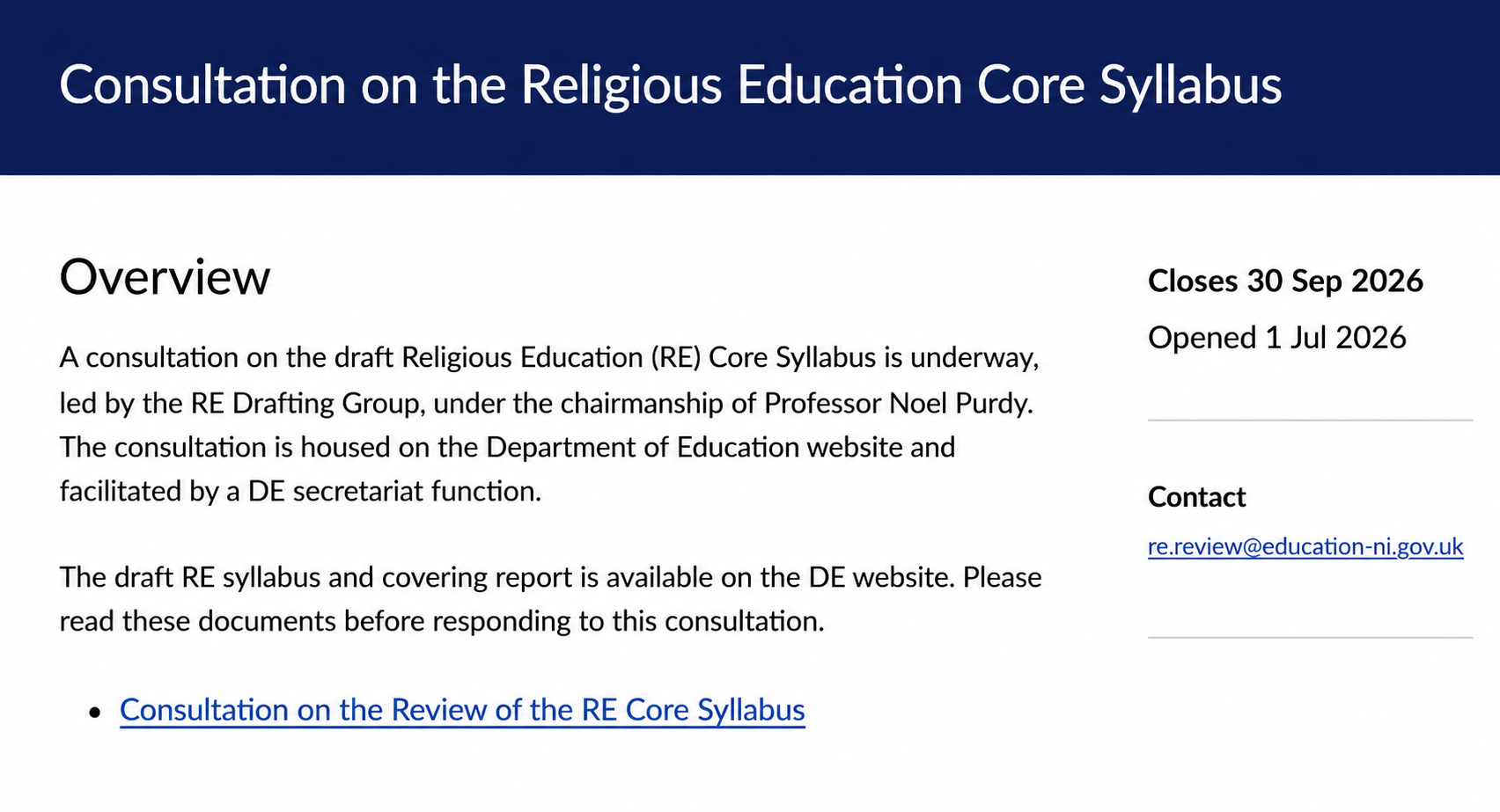
The consultation on Northern Ireland’s proposed new Religious Education syllabus presents Christians with a mixture of relief and concern.
Relief, because Christian politicians and community members have ensured that Christianity remains the “core element” and central focus of Religious Education throughout the school years.
There is concern, however, because the secular state philosophy now underpinning the syllabus reveals a continuing shift away from teaching Christian truth claims as truth, and moves towards a model of education built upon pluralism, relativism and the expectation that all worldviews should be approached through the same lens, even for young children at their most formative stages of life.
Thankful?
Christians should be thankful that, despite tremendous pressure following the Supreme Court ruling, Christianity has not been removed from its place at the heart of the curriculum.
We know that faithful Christians within the processes have fought hard for this. The syllabus recognises Christianity’s enduring role in shaping Northern Ireland’s culture, values, institutions and schools. It states clearly that Christianity remains the core element of learning.
Yet as we read the details, significant questions remain. What kind of Christianity will be taught? Should we be celebrating that primary schools will no longer exclusively teach Christianity in RE lessons?
Children will increasingly encounter Christianity, not as the truth basis that has shaped Northern Ireland and transformed countless lives through the hope found in Jesus Christ, but instead, they will encounter Christianity presented, as one worldview among many competing and equally platformed alternatives.
The Courts
Due to the UK Supreme Court judgment enforced on Northern Ireland, as has happened previously, the syllabus repeatedly emphasises that RE must be “objective, critical and pluralistic”.
Those words appear throughout the consultation documents and form the guiding framework for nearly every aspect of the proposed approach.
For many Christians seeking to fulfil the Great Commission in discipling their children, that should raise concern. This secular standard has become the normal international approach to educational provision under the case law of the European Court of Human Rights. In seeking to abide by the UK Supreme Court ruling, Northern Irish policymakers seem to have failed, in drafting this consultation document, to recognise and fully utilise the broad margin of appreciation afforded to states in matters of curriculum design and educational policy.
Truth
The Christian faith has always involved truth claims. Jesus did not declare that he was one possible way among many equally valid alternatives. He declared himself to be “the way, the truth and the life”. Throughout history, Christian education, which laid the foundation of Northern Ireland’s schools, has sought not merely to describe Christian beliefs but to teach them as truths worthy of belief and obedience. The new draft syllabus follows a different path, one that is becoming increasingly inevitable where the state provider of education calls the tune.
Children are increasingly encouraged to analyse, compare, critique and evaluate competing religious and non-religious worldviews. From a young age they are taught that beliefs are interpreted differently, that traditions develop and change, and that diverse perspectives should be explored through dialogue and comparison. They are taught to be doubtful and sceptical. Younger children need to be taught the truth as a foundation, from the trusted adults around them, so they can then effectively discern that which is untrue in matters of faith.
Multicultural
At Key Stage 2 and beyond, in the limited time available, pupils are expected to study not only Christianity but also Buddhism, Hinduism, Islam, Judaism, Sikhism and non-religious worldviews such as atheism, agnosticism or humanism. Some will celebrate this as multicultural progress, but many Christian parents will see it differently. Formerly, RE was exclusively Christian at primary level, in the perhaps 45 minutes per week assigned to the subject. This is a substantial change and will mean that children as young as 8 will be required to learn about humanism and Buddhism, with the “some people believe” approach.
The issue is not that older pupils should never learn about other faiths and worldviews. Understanding the beliefs of neighbours is important given the plural nature of modern society and the biblical injunction to love our neighbour. However, the deeper concern lies in the age at which increasingly pluralistic perspectives are introduced to children. The educational philosophy underpinning this approach is likely to diminish the level of support that Christian parents, in particular, can expect even from apparently Christian state schools.
Formation
The formation of our sons’ and daughters’ minds matters. The early years of education are not simply about passing on information. They are a time when identity is shaped, character is formed and belief encouraged.
Young children naturally trust the adults who teach them, taking on their confident Christian affirmations or their critical pluralism. There is always ‘indoctrination’ of one form or another; no method is neutral. When foundational Christian teaching is increasingly framed as merely one perspective among many, young children inevitably absorb the message that truth itself is flexible and negotiable, becoming indoctrinated and formed into relativism.
Citizenship
It is welcome that the consultation documents reveal a strong commitment to helping pupils navigate diversity, disagreement and competing perspectives. Respect for others is, of course, important and should be encouraged. Yet Christians should ask whether Religious Education is gradually being transformed from a subject once aimed predominantly at developing an understanding of Christianity, into a subject aimed at producing citizens who will be comfortable relativists in a pluralistic society. The direction of travel appears clear, and it is increasingly distant from the founding purposes of most of Northern Ireland’s schools, which was to train children to become citizens of the kingdom of God, learning to read the bible and praying to the Lord together at school.
Implementation
The review itself arose because previous arrangements were judged insufficiently “objective, critical and pluralistic” since the appeal from atheist parents. The solution offered by the drafting group is putting into the classroom a curriculum built around exactly those priorities. Christians should therefore pay close attention not simply to what is written in the syllabus, but to how it will be implemented should the content of the draft substantially remain after the consultation.
The Equality Impact Assessment indicates that further statutory guidance will be produced and that targeted professional development will help teachers deliver the syllabus in an objective, critical and pluralistic manner. What will this look like in schools? How will this training be implemented? It means much of the real impact of this kind of new curriculum will emerge later through guidance, training and classroom practice.
Will teachers feel free to present Christianity as truth? Will schools with a Christian ethos retain confidence in explicitly Christian teaching? Will children be able to hear and sing “Jesus is Lord”, or simply be told that “Christians believe Jesus is Lord”? Will headteachers start to water down the Christian legacy to be more inclusive? These questions matter.
Hope
At the same time, Christians should avoid despair. The consultation still recognises Christianity’s historic significance. Christianity remains the principal context for learning throughout much of the RE curriculum in the draft. Church representatives have remained involved throughout the review process and can remain involved in delivery of lessons in schools. Every opportunity and open door that remains should be taken advantage of. The consultation is therefore an important opportunity to consider how those in Northern Ireland will take action.
Parents, teachers, governors, church leaders and ordinary believers should take a few minutes to respond. As is always the case, if Christians remain silent, others will shape the future of Religious Education in Northern Ireland. Yet if Christians engage thoughtfully and respectfully, there remains an opportunity to strengthen the place of Christianity and to challenge assumptions that religious truth must always be reduced to competing opinions.
Challenge
Northern Ireland has a remarkable Christian heritage. The challenge now is whether future generations will merely study that heritage as a historical phenomenon, or whether schools will continue to present Christianity as the faith that has shaped communities, inspired service, transformed lives and offers enduring answers to humanity’s deepest questions.
The consultation is short. The consequences of the actions which result will be long lasting.
Please consider responding to the short online survey, and also the Equality Impact Assessment by utilising the form provided and emailing RE.Review@education-ni.gov.uk.