Northern Ireland is currently asking the public for views on its new RE syllabus.
Please read Head of Education Steve Beegoo’s article about the changes as you consider your response.
You can find the consultation and the documents associated here. You can also find the form for responding to the ‘religion’ aspect of the Equality Impact Assessment here. Please respond by 11.59am on Wednesday 30 September 2026.
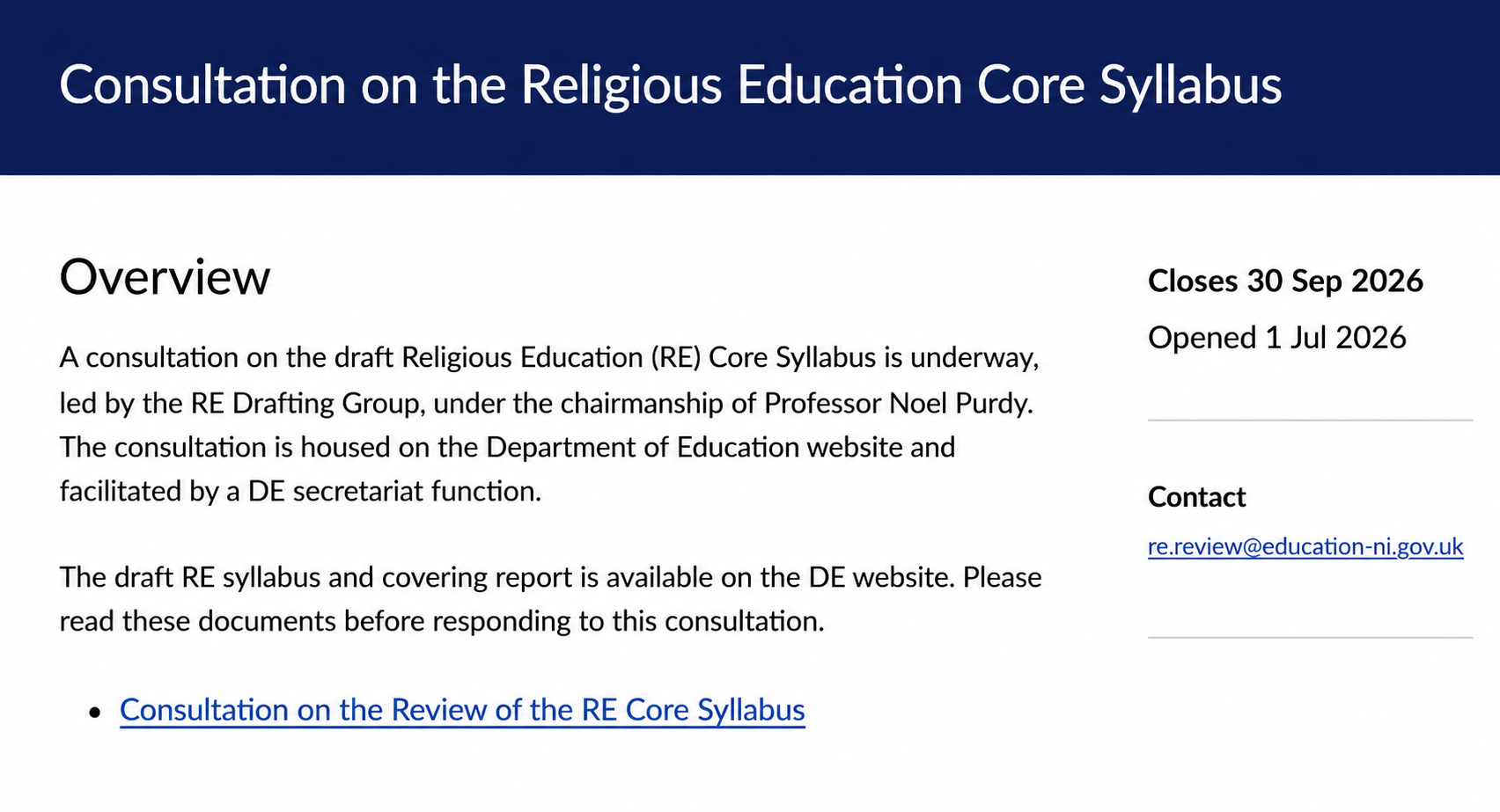
The Consultation
1) To what extent does the vision statement clearly capture the purpose, identity and distinctive contribution of the subject area?
We suggest you answer ‘Ineffectively’ and that you cover in the space provided:
- The vision rightly recognises Christianity’s historic and ongoing importance in Northern Ireland.
- The vision does not recognise the importance of teaching Christian truth, as truth, to younger children and should place greater emphasis on Christianity’s unique contribution to moral, cultural and civic life.
- The vision risks treating Christianity primarily as one ‘worldview’ among many rather than recognising its foundational role.
- Greater recognition should be given to the role Christian communities have had in shaping education and in forming the Christian culture that exists in Northern Ireland by the very way the schools have taught Religious Education in the past.
- The vision should better protect the freedom of schools with a Christian ethos to teach Christianity confidently.
2) To what extent do the organising categories for content appropriately reflect the key dimensions of learning within the subject?
We suggest you answer ‘Adequately’ and that you cover in the space provided:
- The categories provide a coherent structure for learning.
- Greater emphasis should be placed on understanding Christianity on its own terms up to Key Stage 2, before any comparative study. The exclusivity of teaching Christianity at this level should be maintained.
- The categories should more clearly reflect the importance of Christian belief, worship and discipleship. There is a risk that comparison across worldviews may dilute understanding of Christianity, and lead to a relativistic viewpoint.
- More attention should be given to the historical influence of Christianity in Northern Ireland and the continuing predominance of Christian worldview and practice among the majority of people living in Northern Ireland.
- The categories should distinguish more clearly between learning about Christianity and evaluating competing worldviews.
3) How well does the RE syllabus cover the most important content that pupils should learn in this subject? Consider whether the syllabus includes the knowledge, concepts, skills and disciplinary understanding that matter most.
We suggest you answer ‘Partially’ and that you cover in the space provided:
- The syllabus includes significant Christian content, which is welcome.
- More depth on biblical teaching and the person of Jesus Christ would strengthen the syllabus.
- The balance between Christianity and non-religious worldviews should reflect demographic realities in Northern Ireland. The exclusivity of teaching Christianity at primary level should be maintained.
- Pupils need a secure understanding of Christianity before extensive comparison with other perspectives.
- Critical thinking is valuable but should not come at the expense of substantive Christian knowledge.
- The syllabus should ensure Christianity remains the primary framework through which learning is developed.
4) Is content appropriately sequenced across the Foundation Stage, Key Stage 1, Key Stage 2, Key Stage 3 and Key Stage 4?
We suggest you answer ‘Poorly’ and that you cover in the space provided:
- Younger children should be allowed to establish a secure understanding of Christianity before encountering extensive worldview comparison. The exclusivity of teaching Christianity at primary level should be maintained. The introduction of multiple worldviews in primary years should be reconsidered.
- Greater emphasis on age-appropriate Christian formation would strengthen sequencing.
- Comparative and critical approaches are more appropriate at later stages of education.
- The sequencing should reflect children’s developmental capacity to evaluate competing truth claims.
5) Do you have any other comments regarding the RE syllabus?
We suggest that you cover in the space provided:
- Christianity should remain the clear and substantial core of Religious Education. And the exclusivity of teaching Christianity at primary level should be maintained.
- The syllabus should avoid presenting all truth claims as equally valid.
- Schools with a Christian ethos should retain freedom to teach Christianity as being true, confidently.
- Parents should have confidence that Christian teaching will not be marginalised.
- Future guidance and teacher training should respect the distinctive contribution of Christianity.
- The implementation of the syllabus should be monitored to ensure Christianity remains genuinely central rather than merely nominally so.
Equality Impact Assessment Response
Should you be willing to respond to the EQIA questions, after adding your details, please consider providing the following points and emailing to RE.Review@education-ni.gov.uk :
1) Are there any data issues in relation to Section 75 categories that the Department needs to consider?
- Section 75 requires due regard to equality of opportunity between people of different religious beliefs. The Department should therefore obtain evidence from practising Christian families rather than assume that equal exposure to content produces equal educational or religious impact.
- The EQIA should distinguish between Protestant, Catholic, other Christian, other religious and non-religious families. Broad categories may conceal materially different expectations concerning confessional teaching, academic study and parental responsibility.
- Data should be planned to be gathered directly from parents about whether they believe Christianity is represented accurately, substantially and on its own terms, particularly at Foundation Stage and Key Stages 1 and 2.
- The available data do not appear to assess the combined effect of religious belief, age and dependants, including how Christian parents experience the relativistic approach during their children’s formative years.
2) Are there any adverse impacts in relation to Section 75 equality groups that the Department needs to consider?
- Christian pupils may experience significant disadvantage if central Christian truth claims are routinely presented as merely subjective opinions, while pluralism or non-religious assumptions are treated as the neutral framework.
- Younger pupils may not yet have the developmental knowledge needed to compare competing worldviews fairly. Premature comparison could weaken their opportunity to acquire a secure and coherent understanding of their own religious tradition.
- Christian parents may lose confidence that schools respect their beliefs if Christianity is inaccurately simplified, disproportionately qualified or principally approached through disagreement and internal diversity as directed by the draft.
- Under Section 75, formally identical treatment is not sufficient without examining differential impact. The Department should assess whether implementation places a particular burden upon pupils and parents of Christian belief.
3) What action do you think could be taken to reduce or eliminate any adverse impacts.
- Require substantial, knowledge-rich teaching of Christianity before extensive comparative study, especially in the primary years.
- Produce guidance requiring Christianity and every other worldview to be represented accurately, respectfully and through recognised sources and adherents, without implying that all truth claims are equally valid.
- Include practising Christians from different traditions, parents and Christian-ethos schools in developing teaching materials, exemplification and professional learning.
- To meet Section 75 duties, monitor pupil and parent experience by religious belief, age and dependant status, publish findings, and revise materials where differential adverse impacts emerge.
4) Are there any other comments you would like to make about this EQIA?
- Objectivity should mean fair and accurate treatment, not requiring teachers to treat religious truth as inherently relative.
- Respectful study of other beliefs can coexist with a genuinely substantial and confident presentation of Christianity as the syllabus’s stated core.
- The EQIA should examine implementation, teacher training and classroom resources, not merely the syllabus wording.
- Protecting Christian pupils’ equal opportunity to understand their faith deeply would support, rather than undermine, Section 75’s objectives of equality and good relations.