Every law reflects a moral vision. In this resource, Tim Dieppe goes into detail on why neutrality is impossible, and provides a Christian examination of law, justice, human rights, and Biblical principles.
Can you legislate morality? Should you legislate morality? What kinds of laws should governments seek to legislate? What is a Christian view on what kinds of laws we ought to have?
These are the questions I will be seeking to answer in this article.
Before we get into that, it is worth reminding ourselves that there is no neutral perspective on this, or indeed on any other question. As C.S. Lewis famously wrote:
“There is no neutral ground in the universe. Every square inch, every split second is claimed by God and counterclaimed by Satan.”[1]
God is real and he made the universe. Anything we do or say glorifies God or is opposed to him. There is no neutrality – any attempt to be neutral denies the reality of God and tips the scales away from what is good, beautiful and true – away from God.
Not only is there no neutral worldview, there is no neutral education, no neutral artwork, in fact no neutral perspective on anything at all. The myth of secular neutrality is prevalent in our age and needs to be resisted. This point applies to governments and laws as much as it does to anything else as we shall see.
What are laws for?
If you were to ask people on the street: “What are laws for?”, you would get a variety of answers. How would you answer the question? I have asked this question to multiple audiences over the years, and answers consistently fit into one of the following categories:
- To punish crime. One purpose of laws is to set out punishments for various crimes.
- To protect people from harm. Some laws exist to protect people from harm. Think of speed regulations, or food regulations, or indeed laws stating that things like stealing from someone or assaulting someone is not allowed.
- To protect society. This is similar to the above. Protecting society from harmful influences like extreme pornography or drugs by outlawing them.
- To protect the environment. Laws about pollution, air quality, water contamination are there to protect the environment from harm.
- To encourage practices that benefit society. It’s not all negative prevention. There are some laws which encourage positive behaviour such as tax breaks for pension investments or tax benefits for marriage.
- To redistribute wealth. Taxation laws are part of laws. One aim of taxation can be to redistribute wealth from the rich to the poor.
- To raise taxes to fund state operations. This is the primary function of taxation laws.
I think that covers all the purposes of laws. Let me know if you think of something else! My question then is which of these purposes of law is morally neutral?
Which crimes the state should punish and what the punishments should be are clearly moral questions. What harms laws should protect society from is also a moral question, as is to what extent the state should protect society from certain harms. Should the state act to protect the environment is clearly a moral question, and if so, what laws should be enforced? Clearly another moral question. What practices should the state encourage through laws? That is another moral question. Should the state engage in wealth distribution and if so, to what extent? These are also moral questions. The questions of what rates and types of taxes the state should impose are also moral questions.
To legislate, therefore, is to legislate morality! There are no morally neutral laws. Legislating morality is unavoidable. You can’t not legislate morality. The question then becomes: “Whose morality shall we legislate?”

From where do we get our morals?
Since all laws enforce some kind of morality, the question then becomes what is the source of our morals? The source of our laws is our morality. And I argue that the source of our morals is our god. This is true because the source of your morals determines what is right and what is wrong. This is therefore an ultimate authority. The source of your morals determines what is just and fair. The source of your morals establishes what are your ultimate concerns and values. Therefore, in every culture, the source of their laws, is the source of their morals, which is the god of that society.
Some might object to ask, ‘what if the source of law is human reason?’
Well, then human reason is the god of that society.
Or if we say that the source of law is the will of the people in a democratic society, then we invoke the Latin proverb: Vox populi, vox Dei – the voice of the people is the voice of God. It is unavoidable however you look at it. The source of your morality is your god.
It follows that law in every culture is religious in origin. A decision to change a law is a decision to change the moral concerns of a nation. This is thus a decision to change the source of morality or the god or religion of that nation. Any change in law amounts to an explicit or implicit change in religion in some way. This is also because, as discussed earlier, there is no neutrality in law. Either a law is in conformity with God’s moral values, or it is not.
In this sense then, no disestablishment of religion is possible. Change is always to another religion – whether explicitly stated or recognised or not. And, in passing, we should note that most religions are intolerant of rival religions.
Danny Kruger MP, put it well in his speech in the House of Commons last year:
“All politics is religious, and in abandoning one religion we simply create a space for others to move into.”
What about human rights
Some will immediately object: ‘What about human rights?’
So, let’s consider human rights. First, let’s recognise that human rights laws are an attempt to legislate morality. That is their purpose, as it is with all laws. While Christians would agree in principle with many or all expressions of human rights, the question still arises as to where such rights come from? Who grants these rights? Rights are only legitimate if they are conferred by the necessary authority. If the rights are granted by the government, then the government is taking the role of God in conferring rights to people. Does God grant rights to people? It seems to me that the emphasis in the Bible is on duties of humans rather than rights. You have a duty to love your neighbour, rather than a right to be loved by your neighbour, for example.
Human rights are, ultimately, an imperfect human moral code. While much good has come from them, our society today comes close to deifying them as the ultimate source of morality. Sir Roger Scruton saw clearly:
“European society is rapidly jettisoning its Christian heritage and has found nothing to put in the place of it save the religion of ‘human rights’.”
Human rights have taken the role of religion.
There are further questions to ask about human rights. What happens when rights conflict? People demand the right to express their religion, the right to die, the right to have an abortion, the right to bear arms, the right to family, a right not to be offended, a right to change gender, a right to choose my pronouns, a right to free speech etc. All these rights cannot coexist at the same time. I fear that we have taught a whole generation about rights in such a way that we have lost track of our duties. Dwight Eisenhower, in his first Inaugural Address in 1953 perceptively said:
“A people that values its privileges above its principles soon loses both.”
This, it seems to me, is precisely where Western culture is today.
What about Biblical law?
Since we are talking about legislating morality, we need to take a look at Biblical law. One thing Biblical law does is, of course, legislate morality. This is Biblical morality. As such it sets a standard of righteousness that is a guide for everyone about how laws can function.
The psalmist writes:
“The law of the LORD is perfect, reviving the soul;
the testimony of the LORD is sure, making wise the simple;
the precepts of the LORD are right, rejoicing the heart;
the commandment of the LORD is pure, enlightening the eyes;the fear of the LORD is clean, enduring for ever;
the rules of the LORD are true, and righteous altogether” – Psalm 19:7-9
Consider what high regard the psalmist has for Biblical law! It is described as perfect, sure, right, pure, clean, and righteous. This law revives the soul and causes the heart to rejoice! This law is altogether righteous.
In Deuteronomy, there is an implication that these laws are the best laws in the world:
“And what great nation is there, that has statutes and rules so righteous as all this law that I set before you today?”- Deuteronomy 4:8
The author points out that no other nation’s laws are as righteous as the Biblical law. By implication, their laws would be improved if they applied Biblical laws. In fact, the prophets denounced the surrounding nations for their violations of Biblical moral law. It is simply assumed that they know that their immoral practices are wrong.
The New Testament explains that one function of Biblical law is identifying sin. Paul writes:
What then shall we say? That the law is sin? By no means! Yet if it had not been for the law, I would not have known sin. For I would not have known what it is to covet if the law had not said, “You shall not covet.”- Romans 7:7
Without Biblical law we would not know what sin is. Natural law can get so far, but it can’t really show us what is sin and what is not. Similarly with conscience. Here is Paul again:
“For by works of the law no human being will be justified in his sight, since through the law comes knowledge of sin.” – Romans 3:20
Through the law comes knowledge of sin. Precisely. But that is not the only function of Biblical law.
We learn also that law restrains evil:
“Now we know that the law is good, if one uses it lawfully, understanding this, that the law is not laid down for the just but for the lawless and disobedient, for the ungodly and sinners, for the unholy and profane, for those who strike their fathers and mothers, for murderers, the sexually immoral, men who practise homosexuality, enslavers, liars, perjurers, and whatever else is contrary to sound doctrine, in accordance with the gospel of the glory of the blessed God with which I have been entrusted.” – 1 Timothy 1:8-11
In an important sense, the law is for the lawless, to show them that they are disobeying the law, and if necessary to punish them for it. Notice that Paul includes “whatever else is contrary to sound doctrine” as a catch all here – leaving open the possibility of other laws targeted at restraining evil. Paul also explains that all this is in “accordance with the gospel,” since the gospel includes explaining that certain things are sinful and that sin has consequences, for which the death of Jesus provided the remedy.
An emphasis of Biblical law is equality under the law. Everyone from the king to the peasant is expected to abide by the same laws, this also includes immigrants.
“There shall be one law for the native and for the stranger who sojourns among you.”- Exodus 12:49
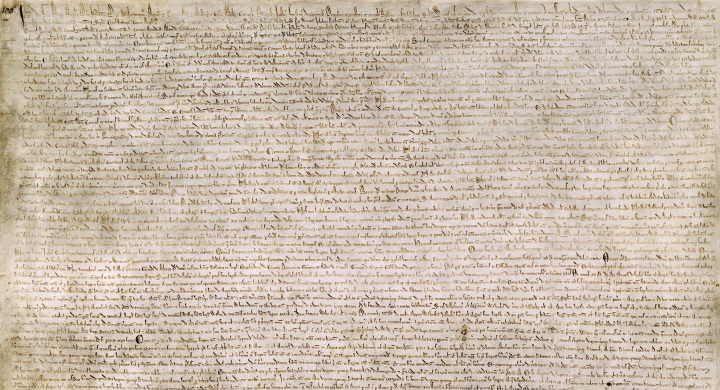
This Biblical principle stands behind the concept of one law for all. Equal justice for everyone which is a foundation of English law since English law was based on Biblical ideas. Magna Carta in 1215 was drafted by then Archbishop of Canterbury, Stephen Langton. It states:
“No freeman is to be taken or imprisoned or disseised of his free tenement or of his liberties or free customs, or outlawed or exiled or in any way ruined, nor will we go against such a man or send against him save by lawful judgement of his peers or by the law of the land. To no-one will we sell or deny of delay right or justice.”- Magna Carta, 1215
No one can be imprisoned without lawful judgement by the law of the land. That’s the principle, and it is based on the Bible. There cannot be parallel legal systems like sharia courts, or two-tier justice as we are starting to see in Britain.
Jesus, of course, endorsed Biblical law, explaining:
“Do not think that I have come to abolish the Law or the Prophets; I have not come to abolish them but to fulfil them. For truly, I say to you, until heaven and earth pass away, not an iota, not a dot, will pass from the Law until all is accomplished. Therefore whoever relaxes one of the least of these commandments and teaches others to do the same will be called least in the kingdom of heaven, but whoever does them and teaches them will be called great in the kingdom of heaven. For I tell you, unless your righteousness exceeds that of the scribes and Pharisees, you will never enter the kingdom of heaven.” – Matthew 5:17-20
He could hardly have been stronger in his support for Biblical law! Christians of previous generations such as Alfred the Great and Sir William Blackstone were quite right to try to base English laws on Biblical law.
Objections
So, we have reached a conclusion. All laws enforce some morality. If we are not enforcing God’s law, then we are enforcing someone else’s law. There are no neutral laws. Laws contrary to God’s revealed law stand in rebellion against God. Laws in conformity with Biblical standards of righteousness are best for any nation.
So far, so good. But there are some objections to these ideas which require a response. Let us consider some of these and how we might respond to them.
- ‘Don’t impose your faith’
This common objection was passionately articulated by Tim Farron MP in his resignation statement as leader of the Liberal Democrats in 2017:
“There are Christians in politics who take the view that they should impose the tenets of faith on society, but I have not taken that approach because I disagree with it – it’s not liberal and it is counterproductive when it comes to advancing the gospel.” – Tim Farron, Resignation Statement, June 2017
Readers may remember that Farron came under intense pressure about his Christian faith when he became leader of the Liberal Democrats, and sadly he denied that homosexual practice was sinful. He later repented and resigned as leader of the party. In his resignation statement he argued that Christian values should not be imposed on society. In context he means Biblical values on things like marriage and sexual ethics.
It is noteworthy that on more than one occasion, Farron voted in favour of same-sex ‘marriage’ in Parliament. One wonders how he squared that with his Christian belief that marriage is between a man and a woman? Can you imagine this happening the other way round? Imagine someone who believes that two men should be able to be married saying that he’d vote against same-sex marriage because he wouldn’t want to impose that view on society? Such a person would be right that changing the law on marriage is imposing a view of marriage on society. But would anyone take the view that therefore they shouldn’t vote to change the law?
The point really is that all laws impose some values on society. Once the law changed to allow same-sex ‘marriage’, suddenly this became the state-endorsed, and enforced view of the state. Everyone is expected to accept that two men can be ‘married’. Felix Ngole was expelled from university for openly stating on Facebook that he disagreed with same-sex marriage. Richard Page was struck off as a magistrate for suggesting that children do best with a mum and a dad. Such things would never have happened had the laws around family, sexual ethics and marriage not changed. Laws impose.
Another example might be abortion laws. Can you imagine someone who believes that abortion is morally fine saying that they wouldn’t vote to make abortion easier because they wouldn’t want to impose their view on society? Surely not? But legalised abortion imposes death upon a child who is given no say in the matter.
Or consider assisted suicide. We expect politicians to vote according to their moral values, knowing that the law, whether it changes or not, is imposing values on society. If assisted suicide remains illegal, then the law says it is wrong to help someone to commit suicide and so prevents people from doing this. If the law were to change, then this would suddenly be allowed, and some people would take advantage of this against the wishes of close relatives or friends. Medics who counsel against suicide could suddenly find themselves falling foul of the law.
So, once again, there is no neutrality. All laws impose some values. The question is which values are being imposed?
- ‘You can’t legislate morality!’
Oh, but you can. In fact, you can’t avoid it. All laws legislate some morality. Whether by allowing something or disallowing it.
Those who object that you can’t legislate morality are usually objecting to some specific legislative proposal such as tightening laws on abortion or pornography. What they really mean is that they want to impose their morality on society. For example, if pornography is unconstrained in law then it damages more people and makes it harder for everyone to object to. That is an imposition, like it or not.
Take abortion buffer zones as another example. Buffer zones impose on people because they restrict what can be said, or even prayed, in those areas. That is imposing morality. But the other side will argue that removing buffer zones imposes on people who don’t want to see or hear talk about abortion near an abortion clinic. They are right. Either way, morality is being imposed.
Another example could be gendering. Some transgender identifying people want others to have to recognise their acquired gender. That is an imposition. It would force others to support their gender identification. On the other hand, if people are allowed to gender people according to their biological sex this is an imposition on transgender identifying people. Once again, either way some morality is being imposed.
- ‘No one should force their morals on anyone else!’
This objection is very similar to the one about imposing your faith. Is it really wrong to force punishment of murderers by criminalising murder? In fact, the objection is self-refuting. By trying to stop you forcing your morals on anyone else, they are actually forcing their morals on you!
Christian apologist J.P. Moreland tells a story which relates to this. He was discussing Christianity with some students in a student’s dorm room. The student argued that “no one should force their views on other people since everything is relative.” Moreland realised that he needed to refute this student’s ethical relativism. To illustrate the point, J.P. Moreland moved to leave the room, and on his way out he picked up the student’s stereo and started out of the door with it. The student objected: “Hey, what are you doing?” Moreland responded: “I’m leaving the room with your stereo.” “You can’t do that!”, objected the student. Moreland said, “I happen to think it is permissible to steal stereos if it will help a person’s religious devotions, and I myself could use a stereo to listen to Christian music in my morning devotions. Now I would never try to force you to accept my moral beliefs in this regard because, as you said, everything is relative and we shouldn’t force our ideas on others. But surely you aren’t going to force on me your belief that it is wrong to steal your stereo, are you?” The point was made, exposing the obvious contradictions in moral relativism. That student later gave his life to Christ.[2]
The point is that some morality is forced on people by laws. And some form of morality ought to be forced on people by laws. The question is which morality is being forced?
- ‘Legislating morality is unenforceable’
The argument here is that you can’t force people to be good. That is correct, as far as it goes, but it still makes sense to have laws to criminalise murder, theft, drugs, prostitution, rape etc. Enforceability is not the main point of whether to criminalise something or not. Should we legalise theft because we can’t enforce most thefts? Not all laws or all criminal acts are enforceable, but the fact that the law criminalises them does act as a disincentive and a deterrent. It also sends a clear message that society disapproves of that behaviour. Legalising something, by contrast, sends a clear message that society approves of that behaviour, strongly implying that society thinks it is not morally wrong. Legalising same-sex marriage changed public attitudes towards same-sex relationships. Legalising abortion sent a very strong message to society that abortion is morally OK. Thus, laws make a big difference in society, whether they are enforceable or not.
- ‘Laws can’t change hearts’
This is true, of course – laws can’t change hearts. Does that mean we shouldn’t criminalise murder or rape? Hardly! While it is true, that laws can’t change hearts, laws do still have a very significant effect on individuals and society. While laws can’t change hearts, they can restrain evil. Laws also do change practice. Think of changes in the law on smoking in public places in the UK. Or smoking in workplaces. Or seatbelts in cars. Behaviour changes because of laws.
Laws also change attitudes. We all agree that slavery is wrong, but most people in most societies in history would have disagreed. The reason we all think slavery is wrong today is primarily because it has been illegal for over 200 years in the UK. Attitudes towards smoking in public places have also changed because the law changed. Attitudes towards same-sex relationships changed with legalisation and changed again with redefining marriage to allow same-sex couples to marry. While laws can’t change hearts, then, they can and do change society.
- ‘You can’t criminalise sin’
This objection says that it would be wrong to criminalise all types of sin. Notice that is a moral judgment call. I agree though. Not all sins should be criminalised. Some sins are crimes, and others are not. Sins of the mind are never criminalised in the Bible. This includes sins of unbelief, pride, envy, greed, selfishness, lust, and covetousness. They are heinous sins, but not crimes. Sins that affect others, such as theft, adultery, assault etc, are crimes in Biblical law. So, we can differentiate between sins that are crimes and sins that are not.
Worship of Yahweh was not enforced on aliens and strangers in Biblical law. They were not required to offer sacrifices or participate in festivals. Nevertheless, when it came to crimes, there was one law for all. The same criminal law would apply to Israelites as to aliens and strangers. There are important principles to take away from this.
- ‘Anything consensual is OK’
This objection argues that as long as I don’t hurt anyone, the government should leave me alone. Anything consensual should not be a crime. This is another moral argument. How do you know that ‘anything consensual is OK?’ How do you define hurt?
Taken to its logical conclusion such a position would legitimise all sorts of destructive behaviours that damage society and are harmful to those who engage in them. Think of drugs, prostitution, paedophilia, gambling, for example. Should the government really step away from making any of these things crimes because they are consensual?
Prior to a change in the law in 2020, several men who killed women claimed a defence of consensual rough sex. This defence was successful in 6 of 14 killings which went to trial. Campaigners argued that this so called ‘Fifty Shades of Grey defence’ normalised violence against women in sex. At least 60 UK women have been killed during what was described as consensual rough sex.
This ‘rough sex defence’ was finally outlawed after a successful campaign through the Domestic Abuse Act 2021. This is surely how the law should be? Surely no-one can consent to being killed?
This example goes to show the bankruptcy of this objection. It is simply not true that anything consensual is OK. While I do tend to agree in principle with limited government, it is still true that some consensual activities should be outlawed.
- ‘In a pluralistic society there are no common values to legislate’
This is a self-defeating objection. Pluralism in this sense claims that we can have a society with no favoured ideology or worldview. But pluralism is an ideology itself, so this concept contradicts itself.
More to the point, pluralism, like other ideologies, seeks to impose its morality on society. It claims that all cultures are equal and that all religions are equal. In extreme forms it will claim that there are no moral absolutes. I once had a conversation with Bob Geldof in which he claimed: “There are no moral absolutes.” I responded by asking when he thought it was morally OK to rape someone? After pausing to reflect, he said that he did not think it was ever morally right to rape. I pointed out that there was one moral absolute right there. One could also use the example of torturing children, and there are many other examples too. The question then becomes, where do these moral absolutes come from?
The fact is that all cultures are not equal, and neither are all religions. Some cultures are objectively better than others. For example, other things being equal, a culture that prohibits education of women is objectively worse than one that encourages education of women. Or a culture that is racist, is worse than one that is not. For more criticisms of cultural relativism see my article: What’s wrong with multiculturalism?[3]
Ultimately, pluralism is inherently unstable. No society can be rooted in more than one ultimate concern. The different commitments and values will clash at some point. This is what we are starting to see in the UK with segregation of our society by religion in some places, and clashes over how the state should educate our children.
- ‘Religion should be kept private’
In our increasingly secular society, the argument is made that religion should be kept private. That religious beliefs have no place in politics. This might sound plausible initially, until you realise what it really means. If you can’t appeal to a particular worldview in politics, then the state has become anti that worldview. If you can’t appeal to God as the source of morality, what source are you appealing to for your morality? If religious belief cannot be appealed to, then the state has endorsed naturalism as the only acceptable worldview. In the end this is actually oppressive.
If there is no transcendent source of morality, then there is no real basis for challenging unjust exercise of state authority. You have effectively made the state God. You can’t appeal to any other God. The state sets the moral standard, determining what is right and wrong. Therefore, the state is God. This is statism.
The key point, once again, is that there is no neutrality. Secularism is not a neutral position, it is actually an anti-Christian position. State imposed secularism will lead to a reduction in religious freedom. And reduction in religious freedom leads to reductions in freedom generally. Freedom of religion is sometimes called the first freedom for this reason. No, religion should not be kept private. People must be able to appeal to a transcendent source of morality to criticise the governing authorities.
Policy implications
So now we get to where the rubber hits the road. We have realised that we can’t avoid legislating morality. All laws enforce some morality. Surely Biblical morality is the best morality to legislate for any nation? It is, after all, Christians who legislated to outlaw paedophilia, for example, as well as bestiality and other sexual deviations. British laws were based on Biblical law.
It is worth considering the example of abortion laws. Abortion was illegal in this country until exemptions were made in 1967. In Northern Ireland it remained illegal until Westminster imposed its morality on Northern Ireland in 2019, forcing the decriminalisation of abortion.
Prior to this, pro-life campaigners in Northern Ireland ran billboard adverts saying: “100,000 people are alive today because of our laws on abortion. Why change that?”[4] Complaints were made to the Advertising Standards Authority (ASA) about these adverts. The ASA looked into it and concluded that “the evidence indicated that there was a reasonable probability that around 100,000 people were alive in Northern Ireland today who would have otherwise been aborted had it been legal to do so.”
The complaints backfired and only served to draw more attention to this remarkable statistic. Criminalising abortion saves lives. That’s the blunt truth. Ideally abortion should be illegal, with perhaps some rare exceptions for a danger to the mother’s life.
We have legislated to make divorce easier and to undermine the value of marriage in various ways, including the artificial concept of same-sex ‘marriage’. This has resulted in now almost half of births being to non-married parents, and all the costly effects of single-parent families on society.
Much more could be said about the kinds of laws we should have in an ideal world and the difference Christians have made to our society in shaping its laws. Some people foolishly suggest that we should prioritise the economy over morality. It has even been suggested that family breakdown benefits the economy short term since a single family now requires two homes! But the longer-term effects are catastrophic. In the end immorality costs money. Is having money really more important than having morals? As Proverbs says:
“Righteousness exalts a nation, but sin is a reproach to any people.” – Proverbs 14:34
Money without morality is materialistic madness. We have everything to live with, but nothing to live by.

When law was based on Christianity
For much of British history, it has been assumed and recognised that our laws are based on Christian values. For example, Chief Justice, Sir Matthew Hale, said in 1676:
“Christianity is parcel of the laws of England; and therefore to reproach the Christian religion is to speak in subversion of the law.”
If this wasn’t clear enough, eminent lawyer and politician Sir William Blackstone said in 1769:
“Christianity is a part of the laws of England.”[5]
Many other lawyers endorsed this view over the centuries.[6] England saw itself as a Christian country with laws that were derived from Christianity. The Christian religion was considered fundamental to our legal system.
This continued to be the case right up to the twentieth century. A pivotal case in 1932 established the principle of legal negligence. The case concerned a woman who had purchased a ginger beer from a café. The bottle was made of dark opaque glass, and after consuming about half the contents, she poured the remainder into a tumbler whereupon the decomposed remains of a snail floated out which caused her to have shock and gastro-enteritis. Mrs Donoghue was not party to any contract so she issued proceedings against the manufacturer, which eventually reached the House of Lords – then the highest court in the land.
The key paragraph of the judgment drawn up by Lord Atkin reads as follows:
“The rule that you are to love your neighbour becomes in law, you must not injure your neighbour; and the lawyer’s question, Who is my neighbour? receives a restricted reply. You must take reasonable care to avoid acts or omissions which you can reasonably foresee would be likely to injure your neighbour. Who, then, in law is my neighbour? The answer seems to be – persons who are so closely and directly affected by my act that I ought reasonably to have them in contemplation as being so affected when I am directing my mind to the acts or omissions which are called in question.”[7]
This judgment set an important precedent in law. Notice that it was based on the Christian principle of loving your neighbour, and cited and assumed knowledge of the lawyer’s question to Jesus in Luke, “Who is my neighbour?” (Luke 10:29). The judgment is reasoning about what it means to love your neighbour since that is a Christian principle and the law is based on Christianity.
Lord Denning was described by Margaret Thatcher as “probably the greatest English judge of modern times”.[8] He said in 1997:
“It is I suggest to you, a most significant thing that a great judge should draw his principles of law, or rather his principles of justice, from the Christian commandment of love. I do not know where else he is to find them. … The common law of England has been moulded for centuries by Judges who have been brought up in the Christian faith. The precepts of religion, consciously or unconsciously, have been their guide in the administration of justice.”[9]
Sadly, this is no longer the case. Many contemporary judges have not been brought up in the Christian faith. They do not even respect or understand the Christian faith. I suspect that the reference to the lawyer’s question in Lord Akin’s judgment above would be lost on many of today’s judges. Christian Concern has sometimes had to explain the basics of the Christian faith in court.
Most shockingly, in 2011, Lord Justice Munby expressly denied that Christianity is part of the laws of England, or even that this is a Christian country:
“We sit as secular judges serving a multi-cultural community of many faiths. We are sworn (we quote the judicial oath) to “do right to all manner of people after the laws and usages of this realm, without fear or favour, affection or ill will.” But the laws and usages of the realm do not include Christianity, in whatever form. The aphorism that ‘Christianity is part of the common law of England’ is mere rhetoric; at least since the decision of the House of Lords in Bowman v Secular Society Limited [1917] AC 406 it has been impossible to contend that it is law.”[10]

Christians who legislated morality
William Carey (1761-1834) is often described as the father of modern missions.[11] He founded the Baptist Missionary Society and travelled to be a missionary in India. He translated the Bible into several Indian languages.
When he observed the Hindu practice of Sati – burning widows alive at their husband’s funeral, he was horrified. Far from considering that this is an ancient cultural practice which should be respected, or that it was a religious practice and freedom of religion ought to be allowed, Carey campaigned to have the practice outlawed. For Carey, even if voluntary: “a woman’s life was not her own, not her husband’s. It was God’s. And the Creator had not given the right to violence his gift of life.” After 25 years of campaigning, the practice was finally outlawed in 1825.
Carey also campaigned against polygamy, female infanticide, child marriage, euthanasia, and burning lepers alive. He saw the value and importance of legislating morality.
William Wilberforce was the leading campaigner for the abolition of slavery across the British Empire. He based his arguments on the immorality of treating human beings as slaves. He also campaigned to abolish the national lottery on moral grounds. The lottery was finally abolished in 1826, only to be reinstated years later in 1994. He, and many other Christians at the time, saw the value of changing laws to change the morality of the nation.
Wilberforce explained his views on legislating morality in the following quote:
“The most effectual way of preventing greater crimes is by punishing the smaller, and by endeavouring to repress that general spirit of licentiousness, which is the parent of every vice. I know that by regulating the external conduct we do not at first change the hearts of men, but even they are ultimately to be wrought upon by these means, and we should at least so far remove the obtrusiveness of the temptation, that it may not provoke the appetite, which might otherwise be dormant and inactive.”[12]
You see how he understood that legislation doesn’t at first change hearts, but that hearts are likely to be impacted in due course by legislation.
Dr Martin Luther King Jr. was a Baptist minister and a prominent leader of the American civil rights movement until his assassination in 1968. He commented on the need to legislate morality as follows:
“Now the other myth that gets around is the idea that legislation cannot really solve the problem and that it has no great role to play in this period of social change because you’ve got to change the heart and you can’t change the heart through legislation. You can’t legislate morals. The job must be done through education and religion. Well, there’s half‐truth involved here. Certainly, if the problem is to be solved then in the final sense, hearts must be changed. Religion and education must play a great role in changing the heart. But we must go on to say that while it may be true that morality cannot be legislated, behaviour can be regulated. It may be true that the law cannot change the heart but it can restrain the heartless. It may be true that the law cannot make a man love me but it can keep him from lynching me and I think that is pretty important, also.”[13]
One can hardly put it better.
Conclusion
The plain fact is that all laws enforce some morality. To legislate is to legislate morality. In every culture, the source of law is the god of that society. If it is not God’s law, then whose law is it?
As Isaiah says:
“Woe to those who make unjust laws, to those who issue oppressive decrees.” – (Isaiah 10:1)
I conclude with this from Amos:
“Hate evil, love good; maintain justice in the courts.” – Amos 5:15
References
[1] C.S. Lewis, “Christianity and Culture”, in Essay Collection.
[2] https://sermoncentral.com/sermon-illustrations/10127/j-p-moreland-in-his-book-apologetic-by-rodney-buchanan.
[3] Dieppe, Tim, The Challenge of Islam, (Wilberforce Publications 2025), 115-128. https://christianconcern.com/resource/whats-wrong-with-multiculturalism/.
[4] https://www.express.co.uk/news/politics/835802/anti-abortion-movements-campaign-billboard-complaint.
[5] Blackstone, William, Commentaries on the Laws of England, (1765-1769), IV.4.
https://lonang.com/library/reference/blackstone-commentaries-law-england/bla-404/.
[6] Banner, Stuart. “When Christianity Was Part of the Common Law.” Law and History Review 16, no. 1 (1998): 27–62. https://doi.org/10.2307/744320.
[7] Lord Atkin (Donoghue v Stephenson (1932) A.C. 562, 580.
https://www.lawteacher.net/cases/donoghue-v-stevenson.php.
[8] Burrell, Ian (6 March 1999), “Lord Denning, the century’s greatest judge, dies at 100”, The Independent.
[9] Lord Denning, The Influence of Religion on Law, 1997.
[10] Brown, Andrew, (28 Feb 201), “The Law of England is not Christian, The Guardian.
https://www.theguardian.com/commentisfree/andrewbrown/2011/feb/28/christianity-gay-rights-english-law.
[11] A good biography is: Carey, S. Pearce (1993), William Carey (London: Wakeman Trust; tr. from 1923, Hodder & Stoughton, London).
[12] Hague, William (2008). William Wilberforce, Harper Perennial, 105.
[13] Address at Western Michigan University, 18 December 1963: https://wmich.edu/sites/default/files/attachments/MLK.pdf.