The Employment Tribunal has today released a landmark judgment ruling that an NHS Trust harassed and directly discriminated against a Christian nurse for wearing a cross at work.
Supported by the Christian Legal Centre, Mary Onuoha, was told by the tribunal that she had been victimised by Croydon Health Services NHS Trust following the grievance she raised about the discrimination she experienced. It ruled that this had breached her human rights and created a “humiliating, hostile and threatening environment” for her.
The outcome of the case develops a wider legal principle that employers cannot discriminate against employees for reasonable manifestations of faith in the workplace.
Although it isn’t essential for Christians to wear a cross, for some, wearing the cross is an important (and harmless) way to manifest their faith and show that they follow Jesus. Now, thanks to this ruling, the freedom to wear it unashamedly as a way of manifesting their faith has been protected.
Campaign against her cross
In June 2020, Mrs Onuoha had been forced out of her job as an NHS theatre practitioner at Croydon University Hospital in South London following what she described as a two-year campaign waged against her by superiors and NHS bosses.
Growing up in Nigeria, Mrs Onuoha was determined to become a nurse after one of her brothers tragically died from measles due to a lack of medical provision. Coming to the UK in 1988 and fulfilling her ambition, she worked at Croydon University Hospital for 19 years. Each day she wore the cross around her neck without any complaints or health and safety concerns from colleagues or patients.
From 2015, however, a succession of line managers asked Mrs Onuoha to either remove her cross , conceal it, or face “escalation.” Each time Mrs Onuoha politely declined the requests, explaining that her necklace is a symbol of her deeply held Christian faith and that she had worn it at work for many years. The issue escalated in August 2018 when bosses at Croydon Health Services NHS Trust ordered her to remove the cross saying it was a breach of the Trust’s Dress Code and Uniform Policy and therefore a health risk to her and to patients.
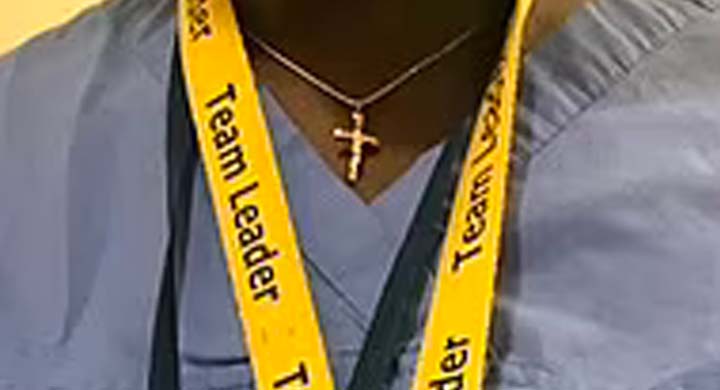
After taking legal action, during the full hearing in October, the Trust had argued that wearing the cross necklace was an infection risk. However, Employment Judge Dyal and two lay members, Mrs Foster-Norman and Ms Forecast, have now ruled that: “Applying common sense, it is clear to us that the infection risk posed by a necklace of the sorts the Claimant used to wear, when worn by a responsible clinician such as the Claimant, who complied with handwashing protocol, was very low.”
The Tribunal also stated that the rejection of Mary’s grievance was “offensive and intimidating. It failed to properly grapple with the complexity of the issues. No real thought seems to have been given to whether it was really appropriate to discipline the Claimant for doing something that in fact many others in the workforce (including more senior colleagues who worked just as closely with patients) were doing unchallenged. Equally, no real thought was given to the Claimant’s point that others were wearing religious apparel in clinical areas and that she should be treated equally to them.”
The Tribunal has also found that Croydon Health Services NHS Trust constructively dismissed Mrs Onuoha “without reasonable and proper cause” and that the dismissal was unfair and discriminatory.
Furthermore, it has ruled that the dress code policy was “applied in an arbitrary way and in a way that was not proportionate” and that there was “no cogent explanation” why plain rings, neckties, kalava bracelets, hijabs and turbans were permitted but a cross necklace was not (paras 270-271 of judgment.)
One of the most concerning parts of Mrs Onuoha’s case was how she reported being harassed for wearing the cross necklace by a senior manager while caring for a patient under general anaesthetic in the operating theatre.
On this point the Tribunal concluded that interrupting the surgery while a patient was on the table was “high-handed. She literally interrupted surgery in order to address the issue. This was to treat the matter as if it was an emergency, but on any view it was not,” and that that conduct created “an offensive, hostile and intimidating environment.”
The Tribunal rejected the Trust’s argument that its objection to the necklace had nothing to do with Mrs Onuoha’s Christian beliefs. It accepted the expert evidence of theologian Dr Martin Parsons, and on that basis, specifically found that “the Cross is a symbol of Christianity” and wearing a cross has many centuries of tradition behind it.
The judgment notes that “wearing of the cross is not and should not be simply as a fashion accessory” and “stopping Christians from displaying the cross has been a feature of wider persecution campaigns” in some parts of the world. The Tribunal has also acknowledged that “there is biblical teaching imploring Christians to be open about their faith and not to hide it.”
Responding to the outcome, Mrs Onuoha was delighted and relieved that she had finally received justice.
‘Justice has been delivered’
Andrea Williams, chief executive of the Christian Legal Centre, said: “We are delighted that the Tribunal have ruled in Mary’s favour and delivered justice in this case. Shirley Chaplin, who also fought for the freedom to wear a cross necklace 10 years ago has also now been vindicated.
“From the beginning this case has been about the high-handed attack from the NHS bureaucracy on the right of a devoted and industrious nurse to wear a cross – the worldwide, recognised and cherished symbol of the Christian faith. It is very uplifting to see the Tribunal acknowledge this truth.
“It was astonishing that an experienced nurse, during a pandemic, was forced to choose between her faith and the profession she loves.
“Any employer will now have to think very carefully before restricting wearing of crosses in the workplace. You can only do that on specific and cogent health and safety grounds. It is not enough to apply general labels such as ‘infection risk’ or ‘health and safety’.
“The judgment makes it clear that Mary’s ordeal resulted in large part from the NHS managers’ misunderstanding of the Department of Health guidance on uniforms for its staff. The result has been a campaign of harassment against a devoted, experienced, and highly professional nurse, who was in effect hounded out of the NHS. I hope Sajid Javid pays attention. It would be easy to amend the guidance to clarify that the wearing of crosses by medical staff must be permitted.
“Mary’s whole life has been dedicated to caring for others and her love for Jesus. It has been a privilege to stand with her in this long fight for justice, and we are very pleased with the outcome.”
Find out more about Mary Onuoha