County Durham and Darlington NHS Foundation Trust has finally changed its staff changing-room policy after a three-year legal battle with the Darlington nurses in which female nurses were harassed and discriminated against for wanting a single-sex place to undress at work.
The Trust’s revised Uniform and Dress Code Policy now states:
“In accordance with UK Supreme Court ruling (2025), staff must use changing spaces according to their biological sex. Alternative unisex changing spaces are provided for staff who choose not to use an alternative facility.”
The change brings the Trust’s written policy into line with the law and the judgment secured by seven nurses at Darlington Memorial Hospital.
It represents a complete reversal of the position the Trust defended throughout the case. Despite repeated warnings, including from the Royal College of Nursing, the Trust continued to operate a policy which permitted a biologically male employee who identified as a woman to use a changing room shared by hundreds of female staff.
The Trust maintained that position after the UK Supreme Court confirmed in April 2025 that the words “woman” and “sex” in the Equality Act 2010 refer to biological sex. It also resisted calls for change as national guidance was developed to reflect the ruling.
Supported from the beginning of their ordeal by the Christian Legal Centre, the change comes only after the nurses won their employment tribunal case, the Trust apologised and paid them £187,000 in damages.
The Trust’s own legal costs were reported to have reached £603,000 by June 2026. The known public and legal costs therefore already exceed £1.2 million, with the overall bill continuing to rise.
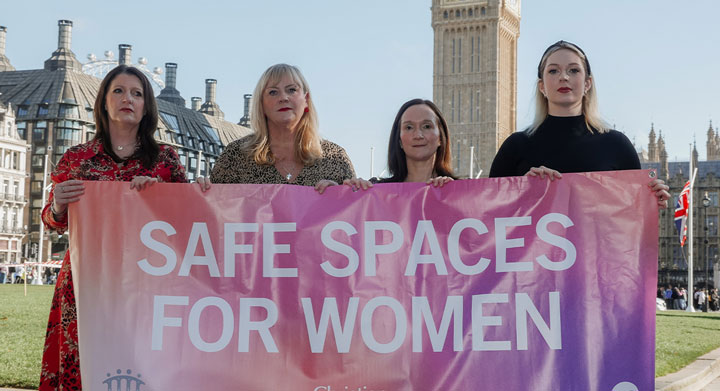
Three years of warnings ignored
The dispute began in 2023 after female nurses raised concerns about having to undress in the presence of a biologically male colleague, known as “Rose”, in the female staff changing room.
Staff wearing uniforms were required to change at the hospital, meaning the nurses could not simply avoid the facilities. Around 300 women were reported to use the changing room. Twenty-six members of staff ultimately signed a formal letter raising concerns.
The nurses discovered an NHS ‘Transitioning in the Workplace’ policy, used across the NHS, which said male staff could do this and any female member of staff who didn’t like it would have to change elsewhere.
Rather than provide a suitable alternative facility for the trans-identifying employee, the Trust told the women who objected that they should find somewhere else to change.
Evidence later disclosed showed that senior figures within the Trust knew its policy was outdated. The former Equality, Diversity and Inclusion lead admitted in internal correspondence that the policy needed updating and that some of its language was inconsistent with case law. Nevertheless, the nurses were described as “cisgender female colleagues” and were expected to “compromise” and “be tolerant”.
An internal email from the Trust’s then Executive Director of Nursing, Noel Scanlon, described the situation as “entirely self-inflicted politically correct nonsense” and questioned why the majority of female staff were being asked to make alternative arrangements instead of management addressing the conduct and facilities involved.
Women intimidated after speaking out
When the nurses formally complained, they say the process was turned against them.
All 26 signatories were sent counter-grievance letters accusing them of discrimination and harassment and warning that disciplinary action could follow. Tribunal evidence described international nurses fearing that they could lose their jobs, visas and right to remain in the United Kingdom. One nurse reportedly said she would rather change in the hospital car park than risk losing her employment.
The tribunal also heard evidence that a domestic abuse survivor became distressed during an HR meeting after saying that she felt unsafe and had been stared at while changing. She later told colleagues she had felt pressured to abandon her account because she was terrified of losing her job.
Nurses described investigation meetings as hostile and intimidating. Some disputed the accuracy of official notes, while the Trust’s own quality-assurance review found that the investigation lacked clarity and rigour and did not adequately examine the women’s safeguarding and sex-based concerns.
The Trust’s Head of HR was also confronted in evidence with an internal record in which the nurses’ concerns were described as “noise in the system”. The tribunal heard that no risk assessment had been undertaken.
Pregnant nurse subjected to intimate comments
The tribunal heard evidence relayed by lead claimant Bethany Hutchison concerning a pregnant colleague who encountered Rose in the changing room.
According to the account, while the nurse had her back turned, Rose said: “You do not look as big as this from behind,” before allegedly asking whether she had “those large pregnancy breasts”.
Other witness evidence described women delaying entering the room, pretending to make telephone calls or changing in toilets and shower cubicles to avoid undressing in Rose’s presence. A retired nurse said concerns about Rose’s presence and behaviour in the changing room had existed as early as 2021.
While the tribunal did not uphold the nurses’ separate allegations about Rose’s personal conduct, it found that the Trust’s policy and its handling of their concerns violated their dignity and created a hostile, humiliating and degrading environment.
Forced into inadequate facilities
After the nurses took legal action and went public with their story, under the policy they were told they needed to use a ‘temporary’ converted office to change in. Rose continued to use the female changing room for 11 months.
The converted office opened onto a public corridor and clinical area. The room had no proper lockers and was used for meetings, training and storage. Senior NHS England officials later described the provision as “completely inadequate”.
Tribunal evidence also revealed that necessary fire-safety work, estimated to cost between £7,500 and £9,000, was not approved. A senior Trust director admitted that the organisation had not considered the “risk, health, safety or wellbeing” of the nurses who had spoken out.
Four of the nurses were subsequently reported to the Nursing and Midwifery Council by members of the public after speaking publicly about the case, exposing them to the additional strain of possible professional disciplinary proceedings. They continue to face investigation.
Tribunal found harassment and discrimination
Despite the Supreme Court ruling, EHRC Code of Practice interim guidance and the Royal College of Nursing clearly making the Trust’s policy unlawful, the Trust refused to change its position or give in to the nurses.
Following a three-week employment tribunal, in January 2026, the employment tribunal ruled that the Trust had harassed the nurses and subjected them to indirect sex discrimination.
The tribunal found that requiring them to share a changing room with a biological male trans woman had violated their dignity and created a “hostile, humiliating and degrading environment”. It also found that the Trust had failed to take their concerns seriously or properly assess the impact of its policy on women.
In June 2026, the Trust paid the seven nurses £187,000 in damages and issued a formal apology, acknowledging that it had failed to provide them with a safe and respectful working environment and had not adequately considered their concerns.
Despite that judgment and apology, it has taken until October 2026 for the Trust’s written Uniform and Dress Code Policy to state expressly that staff changing spaces must be used according to biological sex.
‘We should never have had to fight for this’
Bethany Hutchison, President of the Darlington Nursing Union and lead claimant in the case, said:
“This short sentence in a policy has taken women three years of fear, humiliation and extraordinary personal sacrifice to secure.
“We were nurses asking for the most basic protection: somewhere private and safe to undress at work, away from members of the opposite sex. Instead of listening, the Trust told us to compromise, broaden our mindset and be more inclusive. We were forced out of our own changing room, placed in inadequate facilities, threatened with disciplinary action and made to fear for our jobs and professional careers.
“Vulnerable colleagues were put under intolerable pressure. International nurses feared losing their visas. Women who had experienced domestic abuse were left distressed and afraid. Four of us were reported to our professional regulator simply for speaking publicly about what was happening.
“Throughout it all, the Trust defended a policy it had been warned was unlawful. Even after the Supreme Court clarified the law, it refused to change course. It took a full tribunal judgment, an apology, damages and an enormous bill before the Trust finally wrote biological reality into its policy.
“We welcome this change because it will protect women across the Trust, but it should never have required a three-year legal battle. No nurse should ever again be treated as we were for asking for dignity, privacy and safety.”
Andrea Williams, chief executive of the Christian Legal Centre, which has supported the nurses, said:
“The Trust’s new policy is a complete vindication of the Darlington nurses and everything they have fought for.
“In one clear sentence, the Trust has now accepted the position that Bethany and her colleagues maintained from the beginning: single-sex changing rooms are based on biological sex, and suitable alternatives should be provided for anyone who does not wish to use them.
“Yet this elementary and lawful solution came only after years of institutional intransigence. The Trust ignored the women, disregarded internal warnings, pursued them through hostile processes and spent vast sums of public money defending a policy that exposed female staff to discrimination and harassment.
“The nurses were portrayed as the problem when the real problem was a policy that erased their rights. Their courage has now forced one of the country’s largest NHS trusts to recognise biological reality and protect single-sex spaces in practice.
“There must now be accountability for how this was allowed to happen, for the public money spent, and for the severe personal and professional harm inflicted on dedicated nurses who were telling the truth. Every NHS trust should read this policy change and act immediately. Women should not have to litigate hospital by hospital to secure rights already guaranteed by law.”