Christian social worker Felix Ngole has today won his case before the Employment Appeal Tribunal (EAT) in London, challenging a ruling that he was lawfully denied employment due to his Christian beliefs on marriage and sexuality.
Mr Ngole had a conditional job offer withdrawn by mental health charity Touchstone Leeds following concerns raised about Felix’s past public statements debating Biblical teaching on marriage and sexuality. The charity claimed that service users might discover his beliefs online and suffer negative mental health consequences.
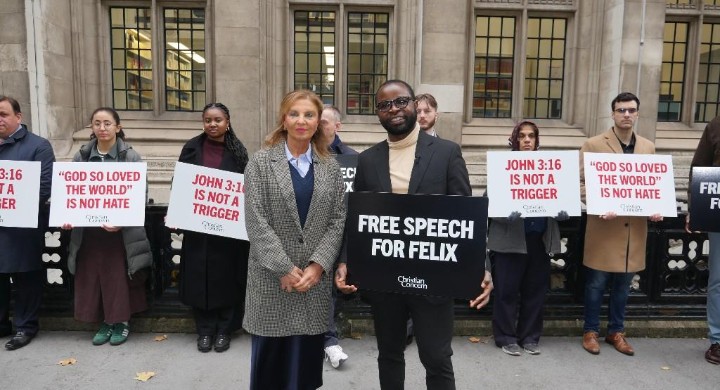
In a significant win for Christian freedom and free speech, the EAT has ruled that this would be discriminating against Mr Ngole’s beliefs in a manner that is “not capable of justification”.
Andrea Minichiello Williams, chief executive of the Christian Legal Centre which is backing Mr Ngole’s case, said:
“The ruling makes clear what should always have been obvious – there can be no excuse for discriminating Christians in the workplace because members of the public might discover their protected beliefs online.”
Today’s judgment rules that the reasoning of the Employment Tribunal (ET) was legally flawed in other important respects.
However, it has directed the ET to analyse key issues again.
Mr Ngole intends to appeal parts of today’s ruling to the Court of Appeal with the aid of the Christian Legal Centre.
Background
In 2019, Mr Ngole won a landmark free speech case at the Court of Appeal against the University of Sheffield in 2019, supported by the Christian Legal Centre. He had been expelled from the university and been considered ‘unfit to practise’ because of Facebook comments he had made upholding Biblical sexual ethics.
The Court of Appeal held that: “The mere expression of religious views about sin does not necessarily connote discrimination.” It also recognised that Mr Ngole had never been shown to have acted in a discriminatory fashion.
After qualifying as a social worker, Mr Ngole successfully applied for the role at Touchstone Leeds. However, the charity rescinded its offer after discovering Felix’s past public statements affirming and debating Biblical teaching on marriage, which it claimed were incompatible with its values and posed a risk to LGBTQI+ service users.
Previous Employment Tribunal ruling
Again, with help from the Christian Legal Centre, Mr Ngole took his case to the Employment Tribunal. Despite acknowledging that Felix’s views were rooted in his Christian faith, the ET ruled that Touchstone’s decision was justified due to concerns about reputational damage and the mental health impact on service users who might discover his beliefs online.
Employment Judge Jonathan Brain ruled that Christian social worker Felix Ngole was discriminated against when his job offer was withdrawn due to his expression of religious beliefs.
However, the original judge in a confused ruling surprisingly then concluded that Touchstone Support Leeds was justified in not reinstating the job offer, citing ‘safeguarding concerns’ for LGBTQI+ service users.
The ruling stated that Felix’s orthodox Christian views on sexuality were a “material reason” for the withdrawal, and that Touchstone had “well-founded concerns” that his beliefs could negatively impact the mental health of service users.
In a striking moment during the hearing, Touchstone’s Head of Operations, Dave Pickard, an LGBTQI+ activist, claimed that even quoting John 3:16 could be “triggering” for service users. He further suggested that expressing disagreement with same-sex marriage or stating there are only two genders “could lead to death.”
In a disturbing development, Judge Brain concluded that Touchstone’s actions were proportionate, and that the balance of rights favoured the organisation’s duty to protect its service users over Mr Ngole’s right to employment in this context.
During the ET hearing, a lay panel member, Mr Mohammad Taj, was recused due to a “real possibility of bias.” Mr Taj, a former President of the TUC, had a documented history of strong advocacy for LGBTQI+ rights.
The appeal
Mr Ngole’s legal team argued at the Employment Appeal Tribunal that the ruling set a dangerous precedent, effectively barring Christians who hold traditional views on marriage from working in professions that serve LGBTQI+ individuals.
The appeal raised critical questions about the limits of freedom of speech, Christian expression, and equality law in the workplace.
The appeal challenged several aspects of the original ruling, including:
- The finding that Felix’s beliefs were not a protected manifestation of religion, despite being clearly rooted in Christian doctrine.
- The reliance on speculative harm and reputational risk as grounds for denying employment.
- The Tribunal’s endorsement of the idea that merely holding conservative Christian views could deter service users and justify exclusion from employment.
- The Tribunal’s acceptance of Minority Stress Theory as justification for discrimination, despite expert evidence questioning its scientific validity. (Minority Stress Theory argues that people who are minorities experience disproportionate distress when they encounter ideas which are adverse to their beliefs.
Leading up to the ET hearing, Touchstone lawyers sought to justify the actions of the NHS provider against Mr Ngole by submitting quasi evidence that individuals from LGBT backgrounds tend to suffer disproportionately from mental health problems in comparison to others.
Felix and his lawyers asked for the evidence to be removed arguing that the evidence painted a false picture of the issue.
Refusing to, Felix’s lawyers urgently sourced and submitted expert evidence on ‘minority stress theory’ by Reverend Dr Paul Sullins, which saw the theory analysed and ruled upon in a UK court for the first time.
Ex post facto justification
Today’s EAT ruling confirmed that Felix’s belief in Christian marriage could not be capable of justifying the need for a second interview, which had led to the refusal to reinstate the job offer.
It seems that the ET and now the EAT have engaged in ex post facto justification of what then happened at that interview and the refusal to reinstate the job offer.
The so-called need for the second interview only arose after Touchstone discovered the BBC and Guardian coverage and sought “assurances” in response to those articles. The record clearly showed Felix was the best candidate at the point the offer was made, and that the second interview was therefore an intrusive step taken only after the media articles were found.
Thus, any alleged “poor performance” or “hostile reaction” in the second meeting is beside the point: if the second interview was itself unjustified, it cannot then be relied on to justify withdrawing or refusing to reinstate the offer. Felix notes that the EAT itself identified that the ET’s reasoning on the job-offer decision was “elided” and “conflated” with the separate issue of service users coming across the historic posts and said the Tribunal did not properly analyse whether any “assurances” rationale was genuinely severable from his protected beliefs.
Untenable to allow discrimination against Christians
Felix said: “I am pleased to see the Employment Appeal Tribunal recognise that I should not have been refused this job solely because people might discover my mainstream Christian beliefs online.
“However, I am frustrated that the case has been sent back to the Employment Tribunal. I have supported vulnerable individuals from all backgrounds throughout my professional life, and I have never sought to impose my beliefs on anyone.”
Felix confirmed that he intends to pursue a further appeal to the Court of Appeal on the aspects of the decision with which he disagrees, and he looks forward to the Court providing clarity on the proper protection of freedom of religion and expression in the workplace.
Andrea Williams, Chief Executive of the Christian Legal Centre, said: “We will continue to support Felix as he seeks full justice.
“Felix should not have been asked to come back for a second interview and should have won the original trial and subsequent appeal outright – Felix had the job withdrawn and was given a hard time in the second interview for one reason only – his views on Christian Marriage which his employer found offensive.”
“Prolonging this case simply adds to the mistreatment of Felix. Hasn’t he been through enough already?
“No one should be penalised for affirming Biblical marriage – a lifelong union of a man and a woman.
“The courts need to send the clear message: Christian beliefs are welcome in this society and no employer can mistreat an employee because of their Biblical beliefs.”
Find out more about Felix Ngole