Do Christians have the freedom to live consistently with their beliefs in public life? Uzochi Nwaubani discusses the issues at the heart of Felix Ngole’s appeal.
As I sat in Court 72, observing Felix Ngole’s Court of Appeal hearing, I was struck by how much is at stake in this case.
The case means a lot to Felix and his wife, Pepsy. But the issues before the court could greatly affect every Christian who wishes to live openly and consistently with their faith.
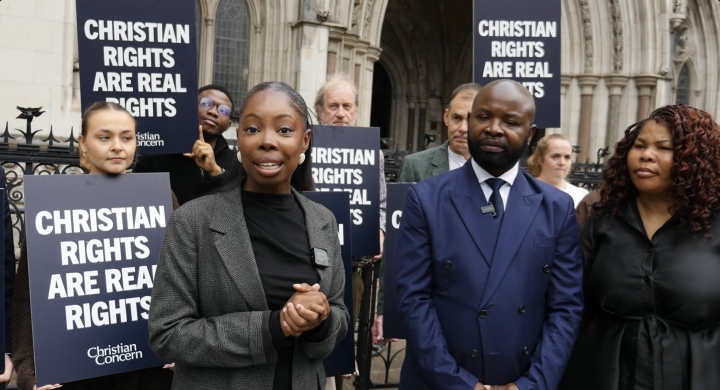
Can Christians be penalised when others discover their beliefs?
At its heart, Felix’s case concerns whether Christians can be penalised, not because of misconduct, but because others may discover and disagree with their Christian beliefs.
Felix had not mistreated service users. He never got the chance, nor would he. Speaking to him for even a moment shows you his clear heart to serve and care for people. His previous Court of Appeal case made abundantly clear that he would not behave in a discriminatory way.
Touchstone, his would-be employer, claims to have a different concern. Their case has been that Felix’s publicly expressed Christian views (known only because of his previous case) create a risk that service users might learn of those beliefs and react negatively. As a result, they withdrew their job offer.
If Touchstone’s position is upheld, the implications extend far beyond Felix. It would affect teachers, healthcare workers, social workers, and many others whose employers, colleagues or service users may object to lawful expressions of biblical belief.
Is religious freedom mostly limited to beliefs?
One of the most concerning aspects of the hearing was Touchstone’s approach to religious discrimination law.
Touchstone was represented by Katherine Apps KC – an experienced and prominent Silk.
Apps appeared to argue that the law protects religious belief whilst it remains in a Christian’s mind, but that protection becomes much weaker once those beliefs are expressed publicly. However, Touchstone claims that protection for sexual orientation extends not only to what a person thinks, but to how they live and express that aspect of their identity.
This reasoning is fundamentally flawed. It would apply different standards to different protected characteristics, creating a hierarchy of rights rather than balancing competing rights equally. We have warned for years that institutions have been acting as though such a hierarchy exists but it would be another thing altogether to enshrine this belief in a Court of Appeal judgment.
Touchstone claims that sexual orientation attracts protection both as an internal belief and in its outward expression, whereas religious belief appears to receive meaningful protection only whilst it remains private. How can religious freedom genuinely be protected if Christians are free to hold beliefs privately, but not to live consistently with them publicly?
Christianity is not simply a private set of thoughts. Belief and conduct are inseparable. James writes that “faith by itself, if it does not have works, is dead” (James 2:17). Paul speaks of “faith working through love” (Galatians 5:6), whilst Romans 12:2 teaches that transformed thinking leads to transformed living.
What Christians believe affects how they live.
This is not just a theological point. Even modern psychology recognises that beliefs influence behaviour. For example, Cognitive Behavioural Therapy is built upon the understanding that thoughts and beliefs shape actions. To suggest that religious belief can be protected whilst its expression receives diminished protection ignores both Christian teaching and a basic understanding of human behaviour.

Can you share Bible verses in the workplace?
Another striking argument heard in the case was about the sharing of Bible verses in the workplace.
Apps suggested that sharing a Bible verse could amount to proselytism and that proselytism in the workplace is not protected in law, nor permitted.
If true, the implications for Christians would be seismic.
There is an obvious difference between coercing somebody into adopting a belief and respectfully sharing one’s faith. If merely quoting Scripture or expressing a Christian viewpoint can be characterised as unlawful proselytism, then many Christians may reasonably wonder whether they are free to speak about their faith at all.
Christians should not be expected to leave their faith at the door when they enter their workplace. And, in any case, no one else does. Ordinary workplace conversations routinely involve the best ways to solve problems. Some people will draw on self-help books or quote from fiction to illustrate a point. Why shouldn’t Christians be able to refer to Jesus’ teaching or a proverb in a similar way, when relevant?
Encouragingly, the judges appeared alive to the implications of these arguments. At one point, Lady Justice Laing challenged counsel on whether it was genuinely a rule of law in the United Kingdom that simply referring to or sharing a Bible verse could be characterised as objectionable proselytism. She also questioned whether there is, in fact, a legal right not to be “triggered” by another person’s lawful beliefs. The fact that such a question needed to be asked demonstrates just how extreme Touchstone’s position is.
Society’s commitment to freedom of religion and freedom of expression inevitably means that people will encounter beliefs and opinions with which they disagree. The law cannot guarantee a right never to be offended, challenged, or confronted by opposing viewpoints. Rather, it must strike a fair balance between competing rights.
Extreme, but dangerous
Whilst Christians can take encouragement from the judges’ questions, we should not overlook a sobering reality.
The arguments advanced during this hearing were not speculations being discussed in an academic seminar. They were being advanced seriously before a senior court by a high profile, experienced lawyer. They may be extreme positions, but the consequences of a bad legal judgment in this case would be severe.
Many Christians are unaware of how contested religious freedom has become. The hearing demonstrated that ideas once considered self-evidently inconsistent with freedom of religion are now being presented as legitimate legal arguments. Even if those arguments ultimately fail, their very existence reveals how much pressure is being placed upon the ability of Christians to live out their faith publicly.
The consequences will not stop with us
We now await the court’s decision. Bruno Quintavalle was a fearless and excellent advocate for Felix in court. We pray that the judges will uphold justice and rule decisively in Felix’s favour.
Whatever the outcome, Felix’s case serves as an important reminder that religious freedom cannot be taken for granted.
Can Christians express beliefs outside the workplace without fear? Must they leave their faith at the door when they go to work? Are Christians free to participate fully in public life?
Following the hearing, Felix made a powerful point during his television interview: justice cannot be remortgaged to our children. If we fail to address these issues today, the consequences will not stop with us. The principles being debated in court will shape the freedoms available to future generations of Christians.
Find out more about Felix Ngole