Our Chief Executive Andrea Williams writes about an entire church community facing criminalisation for their street ministry. This piece was originally published in Christian Today
In Colchester, one of Britain’s oldest recorded settlements, an entire church community is facing the possibility of being criminalised for their street ministry.
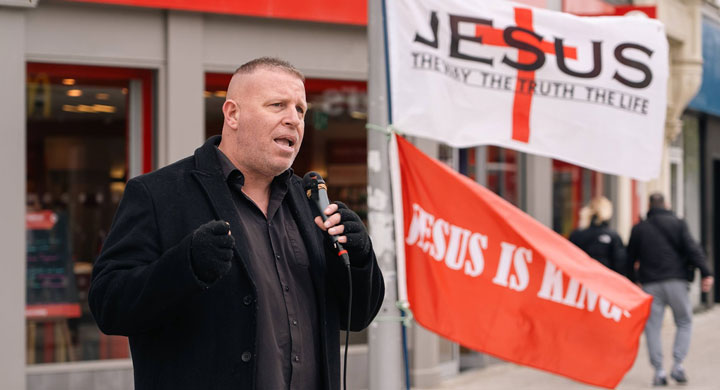
The church, Bread of Life Community Church in Clacton-on-Sea, has been issued a Community Protection Notice that risks criminalising the entire church, regardless of their personal involvement, for preaching the gospel in nearby Colchester town centre.
Over the last decade, we have defended hundreds of church ministries and street preachers who have been censored for their outreach ministries.
And the frequency of these cases is only increasing.
The message is clear: authorities, both in Colchester and beyond, are curtailing the sort of Christianity that might disrupt our complacent culture.
And the gospel has always been disruptive.
A Christianity without evangelism?
Whether it is preaching the gospel, providing food to the homeless, or simply offering educational resources to those interested in Christianity, church ministries that reach into the heart of local communities are vital to the spread of the gospel.
Jesus calls us to be disciples who go out and make more disciples.
You cannot have Christianity without evangelism.
And you cannot have evangelism without going to where the people are.
But by this kind of action, there is a real danger that councils will seek to confine this kind of public proclamation of our faith to within the walls of the church.
In Colchester, it started with claims that the church was being too noisy. But the public space protection order in place does not ban amplification. Council wardens were enforcing rules on this church’s ministry that didn’t even exist.
Many preachers have to deal with these kinds of tensions. But this case has gone one step further by restricting the very message of the gospel.
The church is accused of using ‘religious messaging’, particularly mentioning ‘hell’, that could cause ‘harassment, alarm and distress’.
All their outreach activity is livestreamed and recorded. Anyone is free to look through these records. They will not see a church that is aggressive or harassing. They will see a very typical street outreach ministry focusing on the gospel, salvation by faith, the uniqueness of Jesus, the authority of Scripture and personal testimony.
Heaven and hell are mentioned in this gospel context. And of course, people often react strongly to the message of the gospel – sin and redemption, salvation for our sins and rescue from hell.
The council is greatly overstepping its authority in seeking to control the gospel message of eternal salvation; of life-giving hope. This is the gospel and it belongs on our streets.

Sharing truths about eternal destiny is an act of love
But even if the church were causing alarm, we must understand that not all ‘alarm’ is ‘harassment’.
Sometimes the truth, especially the truth about our state as sinners deserving God’s judgement, distresses and alarms people. If the gospel is true, people have every right to be alarmed by it.
Christians cannot claim to love others and yet not tell them the truth of the gospel – even if that truth might offend or distress them.
As the renowned magician and staunch atheist Penn Jillette said: “If you believe that there’s a heaven and a hell, and people could be going to hell or not getting eternal life, and you think that it’s not really worth telling them this because it would make it socially awkward … how much do you have to hate somebody to not proselytise? How much do you have to hate somebody to believe everlasting life is possible and not tell them that?”
But the kind of alarm this evangelism might cause is very different to inciting panic or creating undue and dangerous alarm in a public area.
The glory of the gospel is that this urgent message never ends with alarm: through Christ’s death on the cross, we can offer people a solution to this problem – a way of salvation and a restored relationship with God.
Alarm over sin that then leads to biblical repentance, salvation and lasting life-giving change can only be beneficial, both to the individual and to the community.
Word and action must go hand in hand
Proclaiming the word of the gospel goes alongside living out the gospel.
Bread of Life does this by helping people with practical needs, such as clothes and food.
Councils and local government love these aspects of churches’ ministries. They need to understand that our actions and our beliefs go hand in hand.
If we only have actions, without the life-giving message of repentance and salvation in the gospel, the Church is promoting the social gospel – no gospel at all.
But if all we do is speak the gospel, without allowing those truths to permeate every area of our life and service – motivating us to serve the needy, both with physical and spiritual assistance – we are nothing more than intellectual ‘Christians’ who are willing to speak for truth, but not to live for it.
As James so clearly warns: “So also, faith by itself, if it does not have works is dead. But someone will say, “You have faith and I have works.” Show me your faith apart from your works, and I will show you my faith by my works… You see that a person is justified by works and not by faith alone… For as the body apart from the spirit is dead, so also faith apart from works is dead” (James 2:17-18, 24, 26).
Many street outreach initiatives combine ministry to the needy and the homeless (such as offering free hot meals or compassionate support) with sharing the message of Christianity.
Similarly, pro-life groups, often Christian-led, are often the first to provide practical support to women in crisis pregnancies.
They are proving their words through their actions.
And this is why it is so important that we defend the ministries targeted by restrictions in public places.
Bringing hope to those who need it, both on the streets and in our communities, is a beautiful picture of the multi-faceted nature of the Christian life and the change that our salvation works in us.
Which truly brings people hope – Islam or Christianity?
Yet, while Christian street preachers and outreach ministries are increasingly being restricted and censored, Islam is being ushered in to take the place of Christianity in the public sphere.
In 2021, the Adhan (the Islamic Call to Prayer) was broadcast from Tower Bridge to mark the end of Ramadan.
In March this year, the Trafalgar Square Iftar saw the mass ritualistic Islamic prayers in public, which many have rightly called an act of Islamist domination.
From Iftars being held in Cathedrals to our King issuing a Ramadan message whilst simultaneously neglecting to offer an Easter message, the warning is clear: Islam is welcome in our public spaces, but Christianity is not.
But only one of these religions offers true hope and the salvation and redemption that our broken nation so desperately needs … and it’s not Islam.
Who really pays the price for our silence?
The gospel is what our nation needs the most.
Our politicians may not like it and the public may be offended.
But the fact remains: only the true gospel and genuine repentance will bring restoration, both on an individual and a national level.
When the gospel is criminalised and silenced in public, those who pay the price are the ones who need this hope the most.
Silencing the gospel doesn’t protect people from offence – it just builds yet another barrier to people finding the hope of salvation in Jesus Christ.
In trying to ‘protect the public’ from ‘religious messaging’, our authorities are actually further trapping them in a web of sin and hopelessness while withholding the only solution.
Christ is the only answer to the brokenness and division wreaking havoc in our nation.
And only when we, individually and as a nation, recognise our sin and our rejection of God’s laws, and come in repentance to seek his forgiveness, will we see the healing and restoration we so deeply desire.