Paul Huxley reviews Queered Out, a new resource that presents stories of Christians reflecting on same-sex attraction, discipleship and life in Christ.
What would you say if a friend at church told you they’d been struggling with same-sex desires?
I hope you’d show love and kindness to them, honoured that they would feel able to share that with you. But what then?
You could celebrate and encourage them to pursue an LGB identity. That’s what the World would do. It would call any other approach ‘conversion therapy’ and shun you. It might even try to put you in jail.
Well-meaning Christians might take another approach. Something like “This is your ‘thorn in the flesh’. Don’t expect anything to change about those feelings, but you can bring glory to God by living in celibacy”.
This is a good deal better – God really cares what we do with our bodies. Avoiding physical sin and inappropriate relationships really is important.
But this view has many problems of its own. It assumes a ‘born gay’ or ‘once gay, always gay’ myth that is not supported by science or scripture. It treats those feelings as if they are completely different from any other struggles Christians may face. It leaves their internal lives, filled with thoughts and desires, completely untouched. And it doesn’t really address the reason for your friend sharing their struggle: their need for help and support.
Where this view prevails, it can feel like a Christian has deep urges and desires that will forever rage within them. The whole of the rest of their life will be an exercise of willpower to push those feelings down and resist serious sin.
Both of these approaches could easily seem exhausting. A true Christian will be frustrated by the ‘affirmation-only’ advice, with God convicting them through Word and Spirit. And the prospect of a lifetime facing strong, deep desires for ungodly relationships, without any prospect of progress is daunting.
Queered Out
Queered Out, a new resource from Desert Stream, a Christian ministry in the US, is for people who feel like that.
It’s a series of 8 videos, freely available online, that radically demonstrates that there is another way. Progress can be made. Thoughts and feelings can change.
This ought not to be shocking. It is what we believe and expect about every other struggle against sin Christians may face. We don’t expect to reach a perfected state where desire or temptation to sin never touches us – not in this lifetime. We do expect to see development and maturity though.
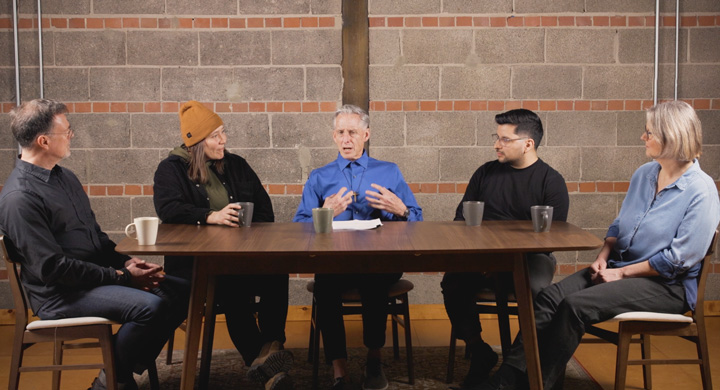
The videos feature discussions around a table with people who have faced same-sex attractions. They do not feel ‘performed’ – there are moments of genuine laughter and occasional pauses while the participants gather their thoughts. But when those thoughts have been gathered, they are often highly insightful.
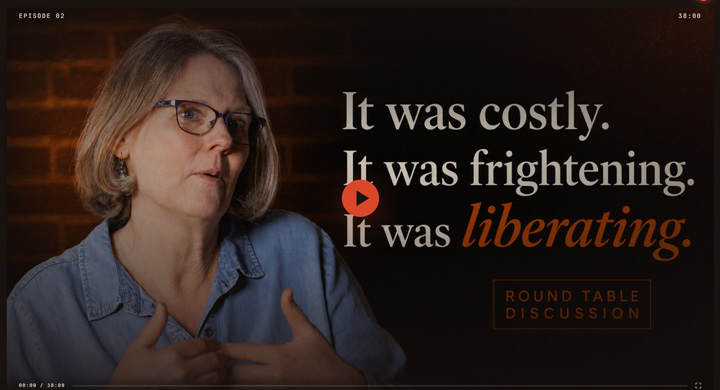
The videos are displayed through an attractive interface which also has an FAQ and links to other resources
After the discussion, each episode features stories and testimonies relating to those themes. Some of the stories are deeply moving. They are not cookie cutter testimonies where simplistic answers were given to surface-level problems, with people’s lives being immediately and drastically transformed. The men and women sharing them reflect seriously on how patterns of sin became embedded in their lives and how, over time, they’ve progressed in their Christian walks.
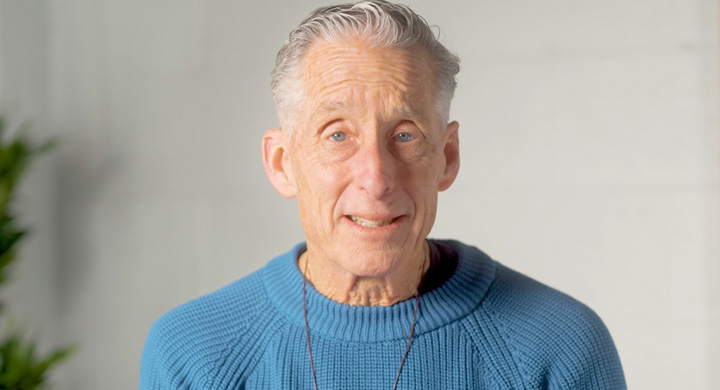
Finally, the leader of Desert Stream, Andrew Comiskey, wraps up each video with a short thought and exhortation. These are helpful in summing up and crystallising the main points covered through the discussion and testimonies.
What helped them, then?
Although the videos are presented as a course, and each video has a general theme, quite a lot is left to the viewer to piece together rather than given as a step-by-step guide.
Perspective
Most important is the need to put sexual feelings, of whatever nature, into perspective. Without for a moment denying their significance, they are utterly secondary to a Christian’s identity as a beloved child of God. This is one of those truths that is obviously true and frequently stated but much less applied than it might be.
Everything else comes from this. Without God as the blazing sun at the centre of the solar system of our lives, we’ll be pulled in every other direction and nothing will be in order. God’s grace puts everything in perspective and is the warmth and sunshine that brings us life.
Going deeper
This security allows these men and women to go deeper. If they feel or act a certain way, their inclination is to ask ‘why?’ This is hard to do if you fear the answer. There is a keen awareness of what psychologists might call defence mechanisms – ways that our instinctive thoughts and behaviours mask deeper unmet needs.
Evangelicals are sometimes wary of this kind of investigation into thoughts and feelings. Sometimes that could be for theological reasons – ‘morbid introspection’ is a problem for some. But I think that English and middle class sensibilities are often driving this sentiment more than prayerful conviction. And the idea that it is dangerous to pursue these kinds of investigations into our feelings may itself be a defence mechanism!

Vulnerability
The other side of that coin is the need for vulnerability – to be truly known by other people. Healthy relationships with others that go beyond surface level have been crucial in many of these people’s lives. In some of their stories, that came from exposure – people discovering secret sins and this kind of vulnerability forced upon them through circumstances. In other cases, people needed to intentionally pursue deeper relationships and community in which this vulnerability could take place.
This is the pattern of death and resurrection working its way out within discipleship. As we admit real and embarrassing faults, a little bit of us feels like it’s dying. But if we bring it before God, it is as if a bit more of our true Christian identity in Christ is raised to life in us.
Male and female as gift
Up to this point, the advice could apply to just about any pattern of sin or temptation. But for these matters of sexuality and gender, a central plank seems to be the recognition that your male or female-ness is a gift, to be embraced by being used for others.
There are two important parts to this. First, your identity as a man or a woman is made central. It’s how God really made you and intended you to be. It is a given and it is secure, no matter how masculine or feminine you feel compared to others.
Second, you, as a man or a woman, are meant to be a gift to others. So much goes wrong, in every area of life, when our thoughts about other people are “what can I get out of them?” How many marriages have been broken by men or women declaring that they have emotional or sexual needs, and either demanding that their spouse meets them (in unloving or abusive ways) or finding ways to meet those ‘needs’ outside the marriage bed?
One of those places would be pornography, which gets a simple, short critique in episode 4. Sexual identity struggles very often come along with pornography problems.
Finally, there is a great sense of realism among the participants about what change will be like. Many of them are now married – i.e. to members of the opposite sex – but have not necessarily overcome all desires and temptation. And they realise that even if they have changed desires, others won’t necessarily accept them. One man shares about an early date with a woman, who didn’t feel able to continue in a romantic relationship, knowing his past. She is not at all blamed for those feelings and it is treated as a further opportunity to bring his struggle before the gracious and compassionate Lord.

Is it Catholic?
Protestants like me will notice occasional references to Catholicism within the videos, which I need to quickly address.
I don’t believe that any point made in the video is unique to Roman Catholic Christianity. There are references to Pope John Paul II’s Theology of the Body. There is a reference to the Eucharist, which for Catholics will take on a different meaning to Reformed Christians like me. But I don’t spot any claims or advice within the material that is at odds with evangelical Christianity.
The Living Waters groups referenced in the videos grew within a charismatic/evangelical context and the Christians in the video seem to include both Protestants and Catholics. I would encourage people to watch the videos with an open mind and to always consider whether what is being said lines up with Scripture.
Is this ‘conversion therapy’?
‘Conversion therapy’ is a catch-all term used by pro-LGBT activists to scaremonger about any attempt to bring feelings of sex and gender in line with a person’s God-given status as a man or a woman.
But it seems from the videos that Desert Stream would want to distance themselves in particular from the notion that they are encouraging people to suppress or push down people’s true identity or feelings.
These men and women do not look like people who are living double lives, pushing down their true selves and living in some kind of ‘ex-gay falsehood’ that others might assume. They appear exceptionally open, emotionally mature and … well, whole, undivided.
I believe that’s the result of them consistently committing, in relationship with others, to putting off the old self and putting on the new. It’s the intentional movement towards noticing what is really happening in their own hearts and bringing it all to an all-gracious God.
A huge number of people in the Church are hurting sexually. I think this is useful for all of them, even if the examples used mostly refer to same-sex desires.
But even those who are not struggling in this way have much to learn here; because at the heart of this approach is simply good, God-centred, grace-filled discipleship. Who couldn’t use more of that?
Useful for anybody
Christie says in one of the Queered Out videos:
“If the church isn’t going to offer hope to the wounded, what are we here for? … We’ve normalized this thing because of, frankly, the pain and the challenge of laying same-sex attraction before the cross. I think that that invitation of laying it all down is so hard and so healing for everyone.
“But it is everyone … You can’t ask the same sex attractive person to do something that you’re not asking everybody else to do. Since we’ve just stopped asking everybody else to do it, we’re just going to go ahead and leave the same sex attracted.”
That’s why Queered Out could be useful for anybody. I would love to see it applied specifically to heterosexual patterns of desires and sins someday.
But in the meantime, Andrew Comiskey is speaking at Restoring Sexual Integrity on 26 September – a day conference in partnership with Christian Concern.
I genuinely believe this will be a day where UK Christians will be empowered to address sexual brokenness in their own lives and learn how to better care for their Christian brothers and sisters.
And that means stronger marriages, healthier families, thriving children, grace-filled church and a holy, happy nation.