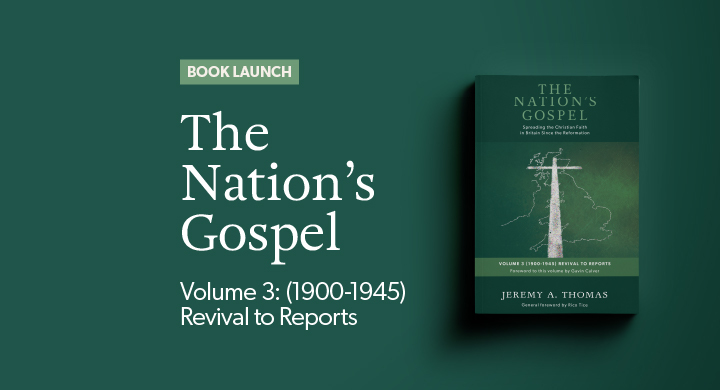
Head of Public Policy Tim Dieppe endorses Wilberforce Publications’ new book, The Nation’s Gospel Volume 3: Revival to Reports
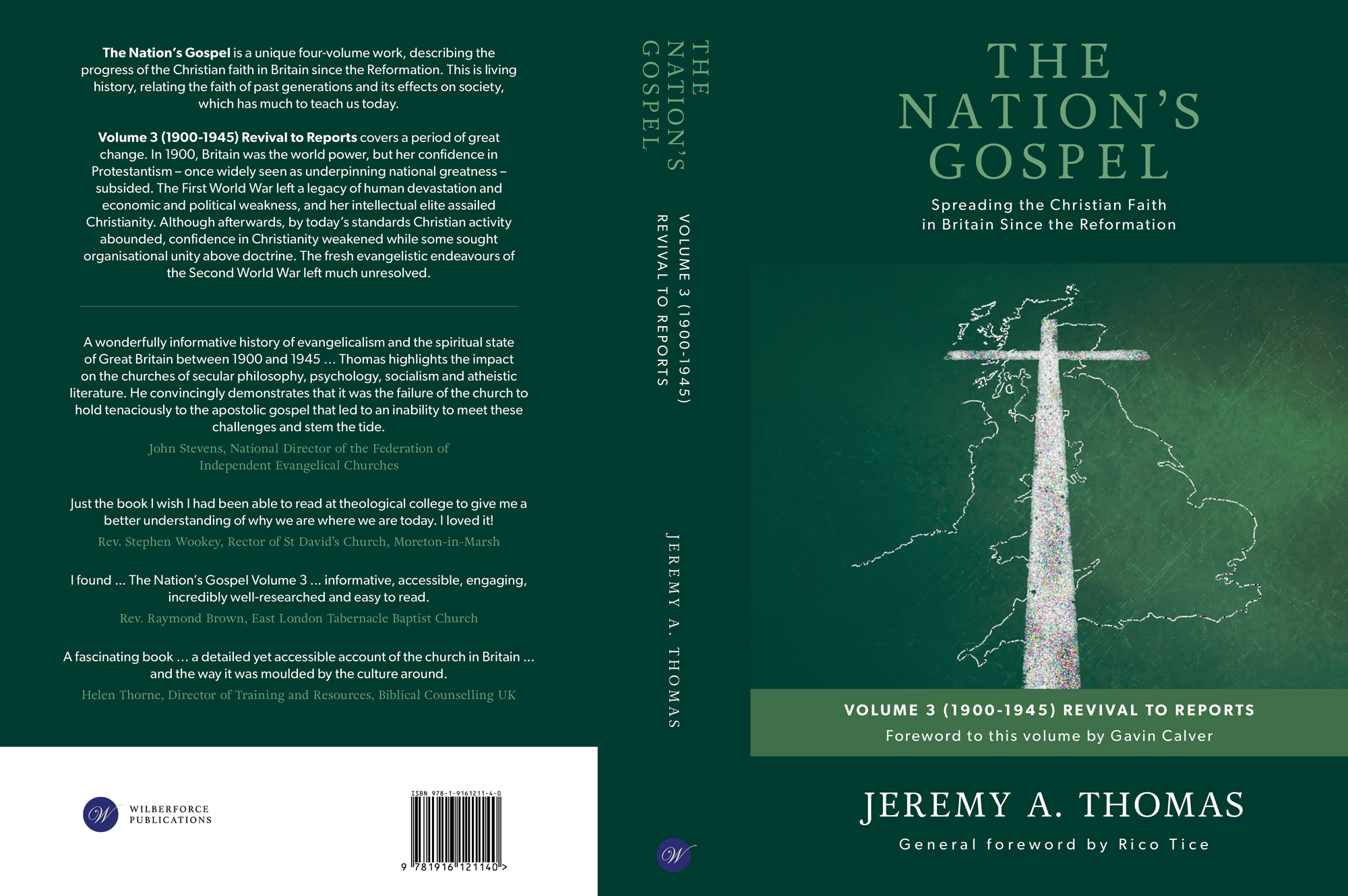
Wilberforce Publications has this week published the third volume of Jeremy Thomas’ monumental history of evangelism in Britain.
Volume 3 of The Nation’s Gospel is subtitled Revival to Reports, and covers the years 1900-1945.
This period includes the Welsh revivals and the first and second world wars. Jeremy Thomas chronicles how the church responded and sought to evangelise through these events.
Some of the leading characters of the time that are discussed in the book include Smith Wigglesworth, G.K. Chesterton, William Booth, Gipsy Smith, Martyn Lloyd-Jones, C.S. Lewis, and Archbishops of Canterbury Cosmo Long and William Temple.
Against this, we saw the influence of unashamed atheists such as George Bernard Shaw, Bertrand Russell, H.G. Wells and Virginia Woolf, who made disbelief in God somewhat fashionable in the period, and served to undermine confidence in Christianity.
Britain’s confidence in Protestantism – once widely seen as underpinning its national greatness – subsided during this period. This happened despite the fact that at the dawn of the century, there had been a rich heritage of evangelistic methodologies, institutions and resources to evangelise the nation. Indeed, it was felt that since the first 50 years of the Christian era there had not been so many consecrated men and women toiling for the salvation of others.
One would have thought that the wake of World War One, which saw such devastation and death, evidencing the fragility of human life, would present a golden opportunity for evangelism. Yet sadly, as Jeremy explains, the Church largely failed to capitalise on this opportunity. The same applies to World War Two, with some notable exceptions such as C.S. Lewis.
The primary problem was the loss of confidence in the gospel, and disbelief in penal substitutionary atonement which is central to the gospel message. The institutional Church instead opted for a social gospel, seeing that as bringing God’s kingdom on earth. But this lacked the power and the conviction of the true gospel and led to declining church attendance.
Gavin Calver in his foreword writes:
“I wish I had this series when I was studying for the ministry over twenty years ago; I would have got off to a far better start!
Well-written and carefully researched, in this book Jeremy Thomas takes us back to a season in the church that holds many profound lessons for today, from facing doctrinal confusion and fragmentation, to focusing on younger generations; from the use of new technology in reaching the lost, to the need to accept decline in attendance and influence; from the sense that people’s interest in things of faith was declining, to the distraction from evangelism posed by major world disruption (war then, and global pandemic now); from sexual morality being the key moral battleground, through to personal pleasure and leisure becoming increasingly important.
It really is incredible to see quite how much there is for us to learn from history in all we face today.”
John Stevens, National Director of FIEC says in his commendation:
“History tends to repeat itself, and today we are living in a period of renewed gospel decline as the Church faces the onslaughts of post-modernism and liberal progressivism. Revival to Reports (1900-1945) will challenge evangelicals to learn from the mistakes that were made, and the faithfulness displayed by a remnant.
This book should encourage us, as we remember that our forebears faced very similar intellectual and social challenges in their generation, and challenge us not to be taken in by any strategy other than to believe, defend and proclaim the Biblical gospel. This history teaches us that all other options will end in spiritual ruin.”
The book contains a wealth of detail with over 3,000 footnotes, a timeline, a people index and a general index. It will stand as a reference work on church history of that period for decades to come.
The book is available on Amazon or at Equipping the Church for £25 – incredibly good value for over 700 pages of illuminating history. It would make a great Christmas present for your church leader or pastor.