Richard Lalchan was at Mission of God 2026. Here, he shares his takeaways from a day when delegates were called to think Christianly about family, marriage and the crisis of culture
In Acts, soon after Christ ascended the apostles and disciples are described as being of ‘one accord’.
That feeling of being in a room with many different people but being of one accord is how I felt going into Mission of God 2026, the conference co-hosted by Christian Concern and Ezra Centre. I had numerous conversations with fellow attendees who were relieved to be in the presence of like-minded Christians, with their own churches simply not awake to the crisis of culture.
Contending for the family in the public space
Our chief executive Andrea Williams kicked off the day with a reality check. She set the scene by sharing some of the cases the Christian Legal Centre has been working on this year. This included the harrowing news, which had only just broken, that the Darlington Nurses had received a death threat.
A death threat for what? For basically wanting biological females only to change in the female changing rooms. And the police? Instead of acting, they sat on it for a week before finally arresting the culprit.
Andrea described this as “the end stage of a culture that no longer can uphold Genesis 1. Truth: male and female.”
It’s not rocket science.
I loved the way Andrea makes it real by bringing things back personally to her family. This is the reality of life: Living with elderly parents, children and grandchildren.
Decisions by the state, the laws that are enacted, be it abortion, equality laws, the upcoming conversion therapy bill; all have real consequences for how we can honour God, preventing us from following his commands for our own families.
She then followed this by giving a fascinating whistle stop tour of the legal landscape in the UK as it affects families. From the Matrimonial Causes Act 1857, which transferred jurisdiction over divorce from the church to the civil courts, all the way to amending the Divorce, Dissolution and Separation Act to include no-fault divorce.
A beautiful, God honouring institution has now been reduced to a ‘functional relationship’. How sad.
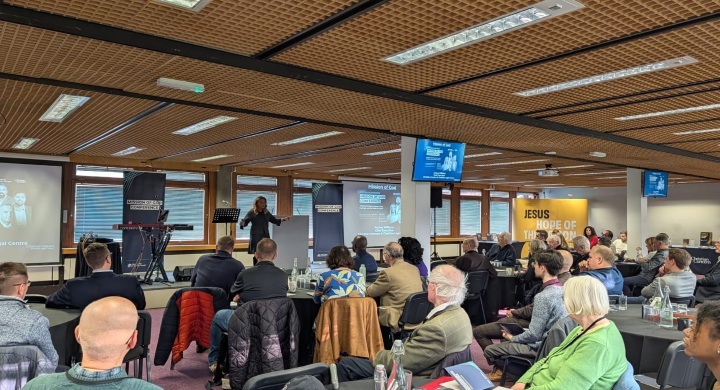
We also heard from Felix & Pepsy Ngole about how their family has been impacted from their on-going discrimination case.
The family: fortress against state tyranny
After this reality check, Rev. Dr Joe Boot took a more philosophical view. He opened with a poignant question: How many couples in your wedding photos are still together today?
It’s a sobering question as the reality of the breakdown of marriage hits home. As a child of divorced Christian parents myself, I know that all too well.
Boot took us through that powerful and often minimised ‘manifesto of the family’ from Ephesians 5:15 – 6:4, outlining the vital role of marriage to God’s plan. Human history begins with a wedding in the garden of Eden, and it ends with the marriage Supper of the Lamb as relayed in Revelation.
He dealt with how philosophical views, usually driven by academia, have affected marriage and the family over the years. Evolution and Marxism are key to this as they attempt to destroy the biblical family, seeing it as a hindrance to progressive and evolutionary new structures.
Marx was explicit about the linking of the earthly family with the divine, stating:
“…once the earthly family is discovered to be the secret of the holy family, the former must then itself be destroyed in theory and in practice.”
As Boot surmised, “If you get rid of the earthly family, you get rid of God.”
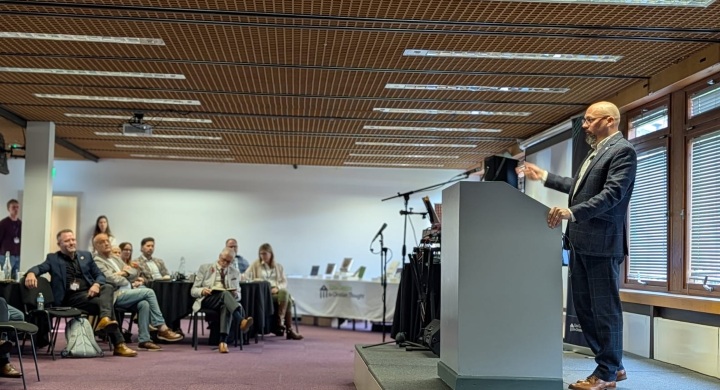
Then of course, without God, you need a saviour, and that’s where the State rushes in to ‘help’ the problem it created.
The purpose of the family, Boot said, is to fill the earth with the image of God. We are image-bearers of God and through the cultural mandate we have a responsibility to make this happen.
He showed how the church has been asleep at the wheel whilst queer theory and LGBT activism were pushed onto society. Pornography, which he described as ‘prostitution with a camera’ was allowed to infect young people’s minds, creating a wave of men avoiding any sense of responsibility.
“Fatherlessness is the biggest source of failure in the spiritual life of the church” he declared, and churches overlook biblical commands of adultery, lacking any sense of implementing church discipline. Everyone suffers.
Each family has ‘great powers’ in society which the state seeks to capture. These are:
Control of children, through getting them into state nurseries as soon as possible, away from parents.
Control of property, by asset stripping the family-making it harder to own your own home.
Control of inheritance, by making it increasingly difficult to pass on property to children.
Boot explained the cost of family breakdown. In financial terms it’s £50 billion, as a staggering 6 in 10 lone parents are supported by the state.
From a society where the church funded welfare and education, often through families, we now have a society where the church has largely abdicated its responsibility to the state.
“The church must empower the family to recover its ministry of education and welfare,” Boot said as he closed out with that powerful declaration from Joshua 24:15:
“As for me and my house, we will serve the Lord.”
Biblical freedom and the family: The key to prosperity?
After lunch Professor Graeme Leach opened our minds to the role economics has played in history. As the Chief Executive of Macronomics and the former member of the IEA Shadow Monetary Policy Committee, he spoke with an expertise not often found among Christians when talking about economics.
He explained that economics had been understood as moral philosophy until 250 years ago when Adam Smith wrote Wealth of Nations. Leach wants to:
a) help it get back to being a moral discipline, and
b) get the Bible back in the economic conversation.
At creation there were two institutions, he said: the family, and the free market. A loving God set up the free market economy. We, as humans, tend to blame the system rather than the sinners running the system. We can see that, through all the anti-capitalist marches down the years and the hatred of big business and wealth, promulgated through the media. The world doesn’t see the Fall and the impact it had on God’s economic system.
He directed our thoughts to the wife of noble character of Proverbs 31. She is very clearly a shrewd businesswoman using the free market to provide food for her family. She is greatly to be praised.
Graeme gave a biblical framework for an economy to flourish. This, much like Boot’s ‘great powers’ included:
1) Property rights,
2) Minimal taxation and
3) Voluntary welfare.
The government currently controls each of these areas, affecting our families directly. The problem of growth in the UK, Graeme said, is not due to less State, but to too much State.
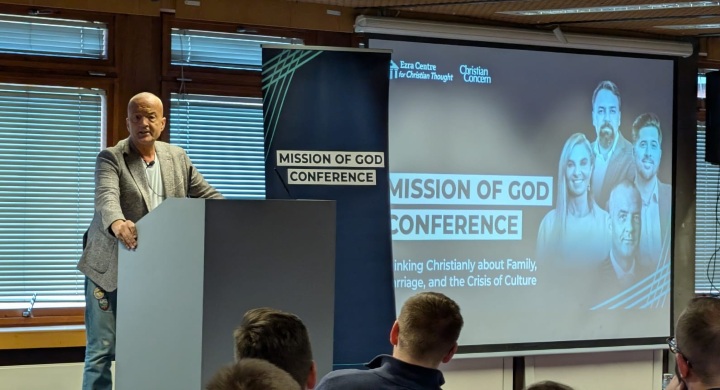
He made the excellent point that there are no Robin Hoods in the Bible. Robin Hood is a thief; stealing from the rich to give to the poor.
That doesn’t mean we shouldn’t help the poor. Graeme reminded us that “God’s heart for the poor is unequivocal, but he wants us to do it.” Not the state. Its role is defence, law and order and justice, as implied in Romans 13. The rest is up to us.
Building faithful families in a faithless culture
To see us out, Nate Wright, Canadian Director of the Ezra Institute, led us in reading from Psalm 127: “Unless the Lord builds the house, they labour in vain who build it”.
He subtitled his talk, ‘The House and the Arrows’, showing that family is woven into every movement of God’s story.
Creation → Fall → Redemption → Restoration
He explained that God’s command to Adam in Creation was to tame the untamed rest of the world. The already tamed Garden of Eden was as an example to Adam. Taming the rest was a big task which is why Adam needed help. The world shaping task is a familial project, and this continues from one generation to the next.
The curse of the Fall made this worse. But the command to fill the earth and subdue it was still there, echoed in the great commission.
In a fascinating section Nate showed how Kate and Mallory Millet’s radical feminism and their fight against the patriarchy took queer theory mainstream. Their aim was revolution against the family, seeing it as “Patriarchy’s chief institution.”
To smash the patriarchy, the family needs to be destroyed.
Wright, like Graeme Leach, referenced Proverbs 31, but he highlighted verse 3 which says: “Do not give your strength to women…” The Millets wouldn’t agree.
He then gave us three exhortations for Christian households.
1) Marry for mission – marry someone who is about the mission. And speaking to the men: “You don’t become a responsible man by spending five years playing video games and watching porn.” Ouch! And to the women: “Don’t allow culture to say that marriage and bringing up children is detrimental to your life.”
2) Welcome children – Raise families, have kids, love the Lord. The Bible says a full quiver is a blessing.
3) Educate and enculturate – 85% of Christian children are lost to the world from college age. Ask the question, who is educating your kids?
Nate encouraged us to think about Christian schools and home education co-ops that are training up children in the way of the Lord. There is hope with seeing more of these popping up. As a side note, our Education Revolution conference is a good opportunity to learn more about this.
His final act was to encourage us to go further. To build a legacy that outlives us. Forget about a 5-year plan. Try a 500-year plan! Don’t just think about the children you are raising, but about their children, and their children. What impact will they have long after you’re gone?
Conclusion
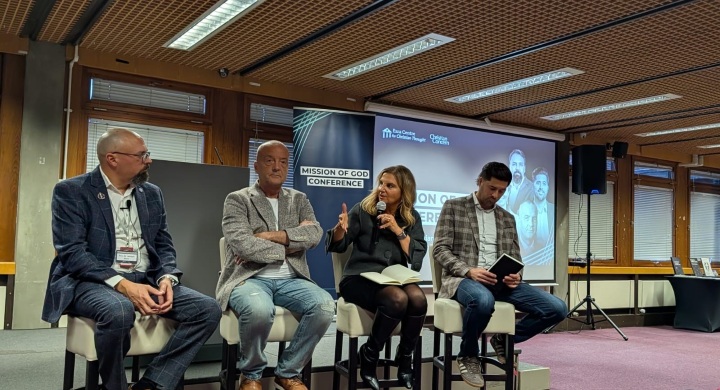
The day ended with a question and answers panel with some vibrant questions asked by participants. The atmosphere was one of positivity, with a dose of frustration in wanting the church to wake up.
The fact we were all together with one accord was an inspiration to help us all, in our own small way to tackle the current crisis in our culture.
At the end of the day Jesus is the Hope of our nation. Marriage and the family empower the church to fulfil its mission to disciple the nations.