After speaking at Restoring Sexual Integrity, Andrew Comiskey writes on misconceptions about so-called ‘conversion therapy’ and the freedom for people to seek support
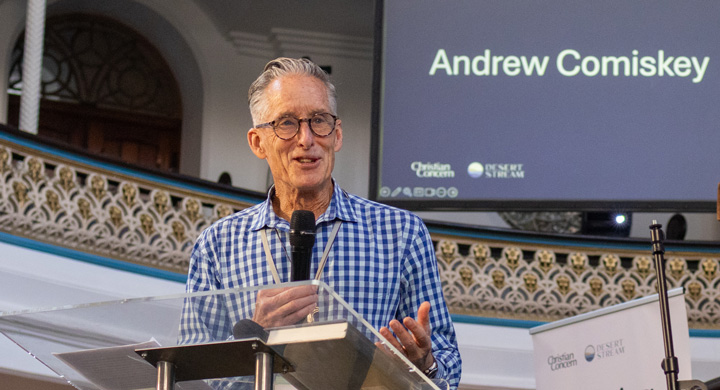
I delighted in every minute of Desert Stream Ministries’ partnership with Christian Concern last month; our gathering at Westminster Chapel combined the courage of our convictions with deep compassion. We can’t talk about the good gift of our sexuality without owning our broken edges that have hurt us and others.
How gracious our God to always offer us Himself—Christ Crucified and Raised—to reclaim more of the gift we are becoming. We all drank deeply from His wellspring that day. Honestly, I left refreshed and expectant; spending Saturday with Jesus and friends beats football and beer.
We need renewal because the battle is on. I’d love to address the fight for freedom that persons with same-sex desires face in the public square. In particular, I’d like to express why we must ensure that Christians in the UK are free to secure good therapeutic help in pursuing sexual integration. ‘Conversion therapy’ soundbites have demonised and endangered the kind of sound care we need. I say that as a struggler: sound psychotherapy was essential for my finding the narrow way through homosexuality and onto more solid ground.
Can people change?
One deception driving bans on clinical and pastoral care for persons seeking sexual identity change, is that change is impossible.
Psychologist Laura Haynes cites a study of LGBT+ adults in which the majority experienced a shift in their sexual attractions and identities. (Katz-Wise, S. and Hyde J., Sexual Fluidity and Related Attitudes and Beliefs among Young Adults with a Same-Gender Orientation. Archives of Sexual Behavior, Nov. 7th 2014.)
The belief that sexual identity is immutable and sourced in genetics has been long disproved. According to Dr Haynes, ‘The American Psychological Association’s Handbook of Sexuality and Psychology (2014) says there is no gay gene, sexual attraction and dis-identifying with one’s sex are not simply biologically determined, and that there are always psychological causes.’
Yet this false assumption persists: sexual identity is set in stone, unmovable. Then demonise any caregiver who accompanies a person seeking change as a quack at best, coercive and abusive at worst. Activists make false, incendiary accusations against ‘conversion’ therapists for employing inhumane techniques like electro-shock treatments or by shaming clients into traditional sex roles. A therapist anywhere would lose professional status if (s)he imposed that on anyone.
What therapists actually do
Instead, let’s consider what sound therapists actually do: they come alongside of persons who for reasons of conscience want to grow beyond same-sex attraction or sexual dis-identification.
Dr Joe Nicolosi is especially mindful of the non-negotiable need for the client, not the therapist, to direct where he or she wants to go in therapy. Son of the late Joseph Nicolosi, who was the chief architect and proponent of reparative therapy for men which posits same-sex attraction as a symptom of a profound drive to repair wounds and emotional deficits, Dr Joe says: ‘Like my father, I’ve an iron-clad conviction that a client has a right to choose his own direction in therapy. One should be able to explore the pursuit of his or her values as (s)he sees fit… persons have the right to align their sexuality with their values.’
This value-clash over whether or not persons should be able to pursue help for achieving their sexual and relational goals is what is really at stake in the battle over reparative or ‘conversion therapy’. Let’s be clear: this fight involves the faulty belief that persons shouldn’t be free to align their sexual identifications with their values.
A clash of values
Shouldn’t be free to do so…Who is doing the moralizing here? No-one is imposing change-friendly therapy on a person who seeks ‘gay’ or ‘trans’-identification. But activists, driven by faulty assumptions about what is best for others, are seeking to eradicate what for some persons is the only way they desire to work out their sexuality. These are at once philosophical, moral and spiritual values. And they will not be taken away from persons who hold them most dear. These values govern one’s concept of what it means to be a whole human being.
The US Supreme Court made a landmark decision last March (Chiles v. Salazar) to rule in favour of a Christian counsellor on the grounds that she has a right ‘to think and speak freely’ in a therapeutic setting. By an 8-1 vote, America’s highest court judged the therapeutic ban in her state as ‘viewpoint discrimination’ and struck it down.
This should apply to all persons with a Judeo-Christian mindset who believe that they have a right to explore the psychological ‘stuff’ required to relate meaningfully and lovingly and faithfully with the opposite sex. Any barriers to doing so, including same-sex desires, childhood trauma, and rejection of one’s own body, are good ground for therapy.
The demonising of both Christian clients and caregivers who contend for such therapy suggests a spiritual battle.
What motivates persons to demonise others who want to make peace with their biological gender or to grow beyond the domination of same-sex desires? Why cannot one group allow another to secure happiness as they define it?
Perhaps some LGBT+ warriors are uncertain of their position; knowing the strength of the Judeo-Christian view and conflicted by guilt over it, they must work that much harder to destroy the source of their conflict. So rather than give someone a choice to live that truth, they remove that choice and make it a lie.
J. Budziszewski writes:
‘To relieve the sting of guilt, we entomb it in nacre (mother-of-pearl) until it seems beautiful to us…every movement to excuse a moral wrong becomes a movement to condone it, and every movement to condone a moral wrong becomes a movement to extend it’
(What We Can’t Not Know; Dallas: Spence 2003, p. 198.)
We who commit to a change process hold up a mirror to those who refuse that process; in that reflection they may see their own disappointments, guilt, or the threat of non-being.
Doubtless, we must exercise care and sensitivity in upholding our right to change and to secure the help we need to change. We can assume that some activists were once children who suffered their own version of abuse.
Therapist Robert Wazo makes this link between how bullied ones have become political bullies today. LGBT activists “are doing to others what was done to them: marginalizing, ostracizing, bullying and rejecting. We are destined to project onto others behaviours and feelings that we have not dealt with.”
Compassion and conviction
So, we who advocate for change—and who need advocates to change—must approach our own goals with quiet compassion. Change is real, change is good, change takes time. Change is hard. For that reason, we do well to combine unflagging conviction with utter humility.
Dr Julie Hamilton urges ‘therapists to not overstate the potential for change’ in any specified area so that clients have a realistic view of a process with built–in limits.
What we can do is make a way for persons like me to have access to professional healers. I have sought such help a few times (sexual integration, the lifetime plan!). Finding caregivers who understood my history and the battle for masculine sexual integrity helped me immensely.
We should never insist that another seek the therapeutic help we desire; that is coercive, ineffective, and justifies the charge that Christians impose their values on others. However, we as Christians must awaken to this real threat of discrimination—legislation that wants to dissolve the truth that change in sexual desire and identity is possible and good for those who seek it. We must witness to this truth in whatever realm of influence we possess.