Paul Huxley imagines how the Apostle Paul would fare under Labour’s Draft Conversion Practices Bill…
Officer: “Could you please state your name for the purposes of the recording?”
Paul: “Paul, formerly known as Saul of Tarsus.”
Officer: “And … Paul … do you understand why we’re interviewing you under caution today?”
Paul: “You mentioned something about ‘conversion’? I am the apostle to the Gentiles, set apart for the gospel of God. But as far as I understood, there is no law against preaching that people need to call on the name of the Lord.”
Officer: “Let me explain then. A young gentleman says that you caused him serious harm…”
Paul: “Oh, you’re not talking about Eutychus are you? I thought that was all cleared up – he was raised to life again after all.”
Officer: “No, not Eutychus. You see, we’ve received a complaint that you have been engaging in abusive conversion practices. This is a very serious allegation and I should inform you that, if found guilty, you could be given a prison sentence of up to five years.”
Paul: “Abusive…conversion practices? But the gospel is the power of God for salvation to everyone who believes, to the Jew first and also to the Greek.”
Officer: “The complaint is not about your letter to the Romans. It concerns another of your ‘epistles’, I believe, to the church in Corinth.”

Paul: “That was quite a long time ago, but I stand by everything I wrote – I mean Peter says they’re part of Holy Scripture. How could they possibly be called abusive conversion practices?”
Officer: “Well, let me take you to chapter 6 in your letter, verse 9 – I’ve got a copy for you here.”
Paul: “Who split my letter into chapters? I never authorised that.”
Officer: “It’s standard police procedures, sir. It makes it easier for us to refer to the evidence. As I was saying, could you read out chapter 6, verses 9 to 11 for us?”
Or do you not know that the unrighteous will not inherit the kingdom of God? Do not be deceived: neither the sexually immoral, nor idolaters, nor adulterers, nor men who practise homosexuality, nor thieves, nor the greedy, nor drunkards, nor revilers, nor swindlers will inherit the kingdom of God. And such were some of you. But you were washed, you were sanctified, you were justified in the name of the Lord Jesus Christ and by the Spirit of our God…
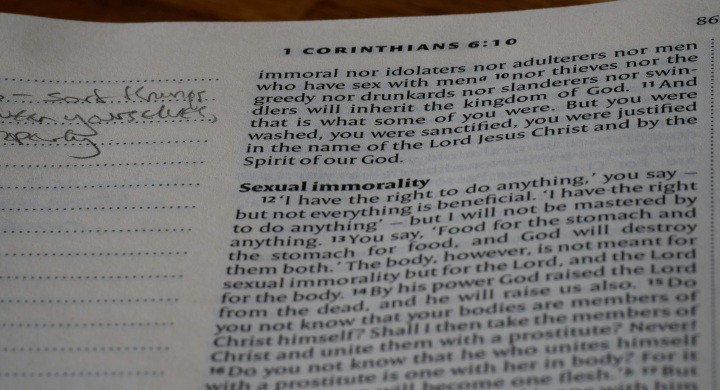
Paul: “…I don’t see the problem.”
Officer: “Well, tell me…when you were writing verse 11 – ‘and such were some of you…’, were you intending that the Christians in Corinth embrace an identity rooted in Jesus Christ?”
Paul: “Yes…”
Officer: “And moments earlier, you referenced men who practise homosexuality … in other words, the gay community?”
Paul: “You could use that term, I suppose…”
Officer: “So you were indeed intending to cause an individual to believe that they have or do not have a sexual orientation or a particular orientation.”
Paul: “Well … yes, I’m saying that lots of these Christians have been transformed into the likeness of Jesus Christ … I’m reminding them of their new identity lest they fall back into their old ways. That’s not a conversion practice.”
Officer: “Let me hand you a copy of the Conversion Practices Act and ask you to look at the definition of a conversion practice under section 1, subsection 2.”
Conversion practice means (subject to subsection 3) any conduct carried out by a person towards an individual with the intention of (a) causing the individual—(i) to have or not to have, (ii) to believe that they have or do not have, a sexual orientation or a particular sexual orientation …
Paul: “Oh it does say that! Who drafted that? And people complain that my letters are hard to read!”
Officer: “If we could stick to the point, Paul … as you have already admitted, you have indeed committed a conversion practice. Our job is now to assess whether it was an abusive one.”
Paul: “Well, I must be in the clear there … I mean, I only wrote a letter. I know the word of God is a two-edged sword…”
Officer: “Oh, so you wrote Hebrews too? Ah … never mind that. Let’s get back on track. In determining whether a conversion practice is ‘abusive’ or not, we are asked to take into consideration ‘the use of controlling or coercive words or behaviour’ and the use of ‘psychological or emotional pressure.’ Could I now draw your attention to verse 9, where you implicitly say that members of the LGBTQ+ community will not inherit the kingdom of God. Do you recognise that someone could see this as emotional pressure to conform to your heteronormative standards?”
Paul: “They’re not my standards … they’re there throughout the Holy Scriptures from Genesis 1 onwards and upheld by the Lord Jesus Christ himself!”
Officer: “Nevertheless sir, the young gentleman in question says that he felt emotionally pressured. And there’s more evidence – take a look at chapter 5:
I am writing to you not to associate with anyone who bears the name of brother if he is guilty of sexual immorality or greed, or is an idolater, reviler, drunkard, or swindler—not even to eat with such a one. For what have I to do with judging outsiders? Is it not those inside the church whom you are to judge? God judges those outside. “Purge the evil person from among you.
Officer: “You see, this is a textbook case of spiritual abuse. As a self-proclaimed ‘apostle’…”
Paul: “Not self-proclaimed, haven’t you read Galatians?”
Officer: “OK, OK. As a … spiritual leader, you should be acutely aware of the uneven power dynamic between you and the ordinary members of a church. Your words have an extra power over people. You can’t go telling people to cast people out for loving who they want to…”
Paul: “One man in Corinth was sleeping with his mother-in-law!”

Officer: “Love is love, Paul. And it seems to me that there is a strong prospect of a successful prosecution based on the evidence we have before us.”
Paul: “Well, hold on. I’m reading on here and it says this is only an offence if I’ve caused serious harm to someone’s mental or physical health? Or serious alarm or distress?”
Officer: “Well, the young man in question is suffering from serious anxiety and depression because of your conversion practices. He realised his faith community in Corinth was no longer a safe space and was forced to join a Nicolaitan church where he could be properly affirmed. But even this wasn’t enough – he still bears the mental scars to this day.”
Paul: “So… he didn’t follow any of my advice or do any of the things I told him to – and you’re saying that I’m now responsible for whatever negative emotions he now feels?”
Officer: “That’s for a jury to decide, Paul. I think we have what we need from this interview – we’re going to pass the case on to the Laurel Prosecution Services but there’s more than enough evidence here for them to put together a case.”
Paul: “And what happens to me in the meantime?”
Officer: “Well, we’re going to have to notify the Charity Commission, which will want to look into your church’s charitable status. We’ll let the leaders of the synagogues know too as they will need to know the risk of letting people associated with your ministry in – this is just basic safeguarding.”
Paul: “But as a Roman citizen … don’t I have human rights that are being breached by all this?”
Officer: “Well, we are still subject to the European Caesar of Human Rights. You could appeal to him, I suppose. But he doesn’t hear a lot of cases, so you might find yourself locked up until the end of your life.”
Paul: “But I already am. For preaching another King: Jesus. The glory we have in Christ is not worth comparing with the sufferings of this present time. But when we receive his salvation, we put to death the old man and put on the new self. And I now call on you likewise to repent and believe on the Lord Jesus Christ and receive the free gift of eternal life – or face the judgement of God.”
Officer: “Are you trying to convert me?”
Paul: “Guilty as charged.”
Key resources
- Read our guide on the conversion practices bill and respond to the call for evidence by Monday 16 November
- Join our email list