Tim Dieppe, Head of Public Policy, comments on the recent ruling to allow a judicial review into the ONS guidance on the question of sex in this year’s census.
In case you hadn’t realised, the definition of ‘sex’ is now a matter of considerable controversy. For most of human history it has been a straightforward matter of biology. Today, transgender activists want it to be defined as perceived identity. They have made great inroads to this effect, but faced a significant set-back in court this week.
The Census sex question
The Office for National Statistics (ONS) is responsible for the nationwide census which takes place every ten years. For more than 200 years, there has been a question in the Census asking: “What is your sex?” This year, for the first time, there will be an additional voluntary question on the Census asking about gender identity. This will help to obtain reliable statistics on how many people identify as having a different gender to their biological sex.
How many ‘sexes’?
So far it is relatively simple. There is biological sex, and there is gender identity. That is two types of ‘sex’. Hence the need for two questions. But there is a third ‘sex’ – legal sex. Legal sex is your biological sex as recognised at birth on your birth certificate, unless you have had this changed with a Gender Recognition Certificate (GRC). Sadly, in law we now permit the fiction of re-writing birth certificates, which is a re-writing of history and a perpetuation of falsehood. So now in law your legal ‘sex’ can differ from your biological sex.
Gender self-identification not allowed in law
Just last year, the UK government became the first country in the world to scrap plans for gender self-identification. This came after a long public consultation and was a major set-back for transgender activists. It means that in order to change your legal gender you are still required to obtain a Gender Recognition Certificate (GRC). To do this you need to show that you have lived according to your acquired gender for two years and get two doctors’ signatures. This is the only way to change your legal gender. This was a welcome decision by the government and shows that they recognise the significant implications of allowing self-identification.
So, which ‘sex’ is it?
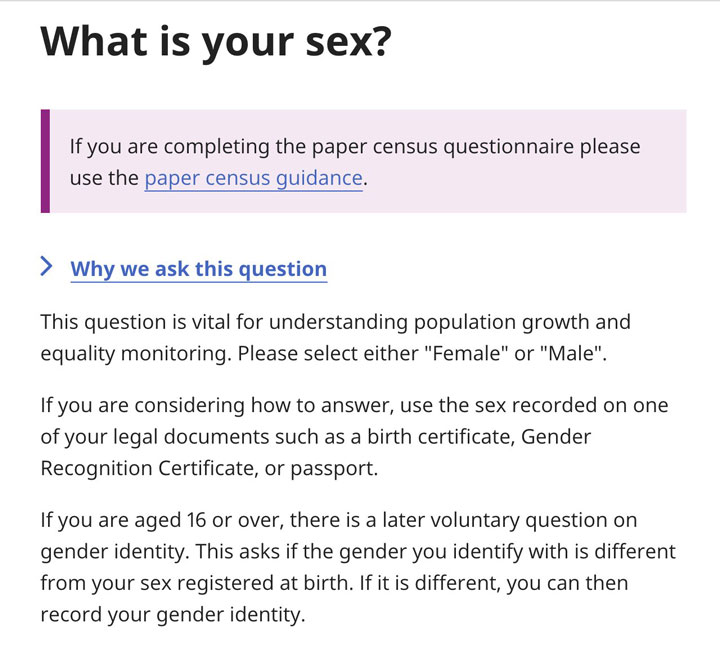
The ONS had been clear that the ‘sex’ question on the census was not referring to identities. It was to be answered according to your legal sex. But then the ONS made a subtle change to its guidance on the ‘sex’ question. Just weeks before the launch of the census, it guided people that they could answer the ‘sex’ question according to what is recorded on legal documents such as a passport. Now we get to another fiction in our legal system. Documents such as passports do not require a Gender Recognition Certificate to change the ‘sex’. They therefore do not necessarily record your legal sex. In allowing people to respond to the ‘sex’ question with what is recorded on legal documents, rather than just on birth certificates, the ONS was allowing gender identity to be used in the answer.
Legal challenge
Campaign group Fair Play for Women rightly objected to this change by the ONS. The Census is held up as the gold standard for official statistics and relied on for accurate data about the population. It is very important that the ‘sex’ question is clearly answered according to legal sex, not just gender identification. Ideally it would be biological sex, but in law we have permitted the fiction of changing birth certificates, so this is not possible until that changes.
Fair Play for Women put the ONS on notice that it would seek an urgent judicial review of the guidance for the ‘sex’ question. Nevertheless, the ONS went ahead and launched its online census ahead of time even though it knew its guidance was open to question. Fair Play for Women sought permission for a judicial review and this permission hearing was held on Tuesday.
ONS forced to change guidance
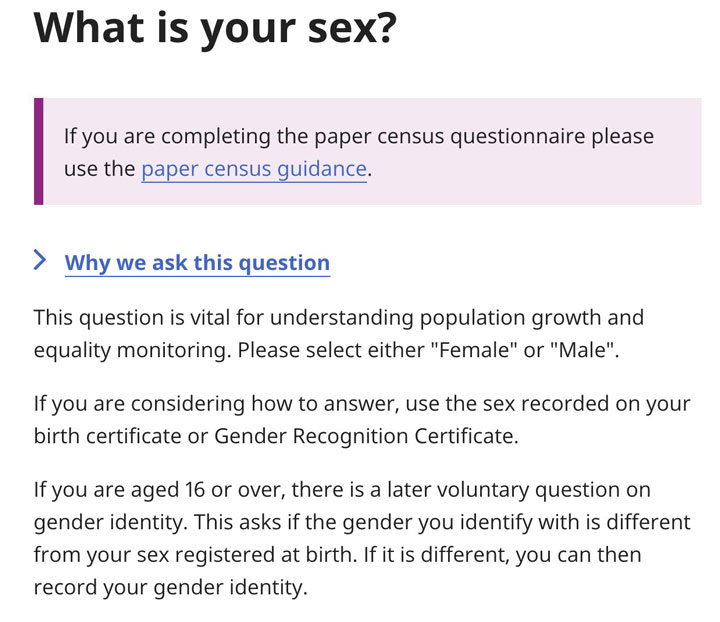
At the hearing, the judge not only granted a full judicial review, which will be heard next week, but also ordered the ONS to change its guidance on the ‘sex’ question to say that individuals should only respond with the answer on their birth certificate or gender recognition certificate. In other words, he made clear that the ONS was wrong to allow people to answer this question with anything other than their legal sex. The judge said that he was satisfied that Fair Play for Women’s challenge to the guidance was “more likely than not to succeed.”
The census takes place on 21 March, but because the ONS put out the online survey ahead of time, some three million people have already completed it. It is not clear whether there will be any change or advice given to those three million people about their responses.
Meanwhile the online guidance has changed on the ONS website.
Before:
After:
Fair Play For Women was quoted in The Telegraph saying:
“This [ruling] is a warning to the all the public authorities that you can’t just decide for yourselves what sex is. Sex has a meaning, it’s important and it has a meaning to women and girls. If we can’t define it then it undermines women’s rights.
“This is a line in the sand to say that sex means sex, it’s not the same as gender identity.”
Stonewall Champions
The influence of Stonewall is clear in the change that the ONS made to the guidance. A Freedom of Information request found that the ONS has been a member of Stonewall since 2006 and is a Stonewall Diversity Champion. Prior to this week’s ruling, Stonewall welcomed the “clear and inclusive guidance on how to answer the Census question.” The ONS was defended by the Government Legal Department which is also a Stonewall Diversity Champion. The Cabinet Office intervened as an interested party and, you guessed it, the Cabinet Office is also a Stonewall Diversity Champion. Stonewall is a political lobbying organisation. It should not have such influence in government organisations.
Perhaps, given Stonewall’s influence, it was no surprise to see the ONS attempting to re-define sex on the Census. Sir James Eadie QC, barrister for the ONS claimed in court that sex is “an umbrella term.” He argued that there could be a range of possible conceptions of sex. This is Stonewall dogma that sex is something of a spectrum and not binary or linked to biology. It is most concerning that a government entity would attempt to argue this in court.
Sex on the Census matters
The national census forms the basis for all sorts of policy decisions. It is important data and by far the most accurate survey of the population. With the government having made clear that it is not going to allow gender self-identification, it is not for the ONS to decide that it will allow some forms of self-identification.
This case fires a warning shot to government institutions. Stonewall champions or not, the message is to handle ‘sex’ with care. There is a legal definition of sex and that is what should be used in government data on the subject. We will be following the full judicial review set for Thursday 18 March – next week – with interest.