Public Policy Researcher Carys Moseley comments on the recent election results and the continued rise of political Islam
The results of the local council elections in England have signalled a momentous and historic defeat for the Labour Party. Both the Green Party and Reform UK took many English council seats from Labour. The Greens gained control over three councils in London and got a mayor elected in Hackney. Over a hundred Muslim pro-Gaza independent councillors were also elected.
The Green and independent surge was the result of long-term campaigning by The Muslim Vote (TMV), an Islamic supremacist outfit. The collapse of Labour and the mass switch of hardline Muslim voters towards the Greens and independents has caused what may well turn out to be a once-in-a-lifetime political change.
Whilst all this has understandably attracted a lot of concern, what is missing from the existing commentary is the underlying motivation – the Islamisation of British politics from below.
My purpose here is to expose this as the real reason for what has been going on.
Pact between Greens and sectarian Muslim leaders
The Policy Exchange authors claim that there has been an electoral pact between The Muslim Vote, Zac Polanski the leader of the Green Party and Your Party. The allegation is that they would not stand in the same seats.
In fact, very few Muslims were elected as Green councillors, yet TMV endorsed the Greens as a party and the Greens were happy to thank them. This therefore inflates the number of councillors elected who were effectively endorsed by TMV.
25-year plan to change the political map of the UK
These election results are the consequence of a long-term campaign by The Muslim Vote, an Islamic supremacist outfit. The Muslim Vote’s leaders say that they have a 25-year plan to change the political map of the UK, spanning five general elections, which started in 2024.
TMV member organisations met on 14 June 2024 to discuss their general election strategy, which they deem essential for the future of the Islamic community in the UK. Supporting organisations include the Muslim Association of Britain, MEND, Islam21c, the Islam Channel and Prevent Watch among others.
TMV aim to be ‘kingmakers’ in elections, presumably by providing the swing votes.
TMV leader wants to redraw the world to be ordered according to Islam
Muhammad Jalal, one of the TMV leaders, makes their agenda clear:
“We want ultimately to design a world built on Islamic principles…where we are able to design history and…we are able to order the world.”
See this video from 17:05.
Clearly this exhibits a mindset of Islamic supremacism over non-Muslims.
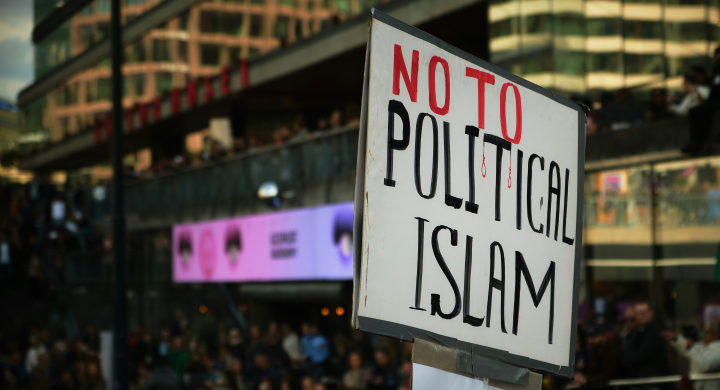
Allies of The Muslim Vote
A movement like this doesn’t just happen because people talk in a room. Just after the elections, Policy Exchange released the second part of its report. It reveals evidence of TMV’s allies. Cur8, the investment arm of Islamic Finance Guru, is a key funder of TMV. They have three goals: economic empowerment, ummah strength “so that Muslims regain credibility on the global stage”, and ‘affinity to Islam and Muslims’. This is what they say about this third goal:
“We will help usher in a day when Islam is honoured how it should be and Muslims are looked up to with respect. When non-Muslims are warm to the promise of our great faith. When everyday folk find the light of Islam in their thousands.”
These words are a progressive-sounding paraphrase of Sura 110 of the Qu’ran, which is about the Muslim conquest of Mecca and domination of non-Muslims. It naturally relates to the infamous Sura 9: 29:
“Fight against those who (1) believe not in Allah, (2) nor in the Last Day, (3) nor forbid that which has been forbidden by Allah and His Messenger (4) and those who acknowledge not the religion of truth (i.e. Islam) among the people of the Scripture (Jews and Christians), until they pay the Jizyah with willing submission, and feel themselves subdued.”
A more visible ally has been the Councillor Pledge for Palestine, run by the Palestine Solidarity Campaign. This has shamelessly got local councillors and candidates to sign its pledge for Palestinian issues, even though local councils have no powers to deal with foreign policy. The wording is as follows:
“(1) uphold the rights of the Palestinian people, (2) stand up to Israel for its crimes of genocide and apartheid, and (3) ensure their councils are not complicit, including through divestment of pension funds from complicit companies.”
In practical terms the targeting of pension funds means the PSC is here targeting councils as employers. This is Islam-friendly infiltration of local authority finances. It’s highly unlikely to stop with Palestinian issues. Over the next few years, I think we can assume new campaigns will be crafted to bully councils into investing financially in Islam-friendly causes.
Another highly aggressive ally of TMV is the Palestine Youth Movement, which has led the ‘Siege for Labour’ campaign – ‘laying siege’ to politicians’ offices in the cause of Gaza. Whilst this is not the only organisation that has led ‘sieges’, its support of a campaign targeting elections long-term is troubling. For numerous MPs have already had their offices targeted for not voting exactly as these sorts of campaigns demand that they do, libelling them as ‘baby killers’ and complicit in genocide.
Independent tactics exploiting the system
Splitting votes between the Greens and Muslim independents has been an effective strategy for TMV. Not being in a registered political party has helped the rise of the Muslim independents, as they will have escaped some of the political accountability that comes with being part of one. For example, the recent Rycroft Review did not address foreign funding, influence and interference via independent politicians.
They appear to be part of a network that is linked to mosques, and partly underground. Some of this would be because of the large number of exposés of TMV during the 2024 general election. This may also explain why the TMV website contained no new demands for the 2026 elections, just summaries for each policy of interest.
There is absolutely no positive evidence whatsoever that TMV has really retreated from its Islamic supremacism.
Why is Green politics attractive to Islamic sectarian leaders?
It’s not obvious that Islamic sectarians, indeed supremacists, would want to co-operate with the Greens. Many do not. However, the Green Party looks like it could be attractive for the more cynical among sectarian Islamic leaders to manipulate for several reasons.
- Its support of the Boycott, Divestment and Sanctions movement against Israel. Its leader Zac Polanski said last October that the UK should stop sharing intelligence with Israel.
- Its call for state funding of political parties to curb reliance on large donations. This would allow Islamic political parties and agendas to get state funding.
- Its war on cars. Taken to the extreme, this could eventually mean only taxi drivers have cars. Taxi drivers are key at upholding the networks of Islamic honour culture.Reducing reliance on cars may prove a problem for women being free to move around as they wish without ‘community pressure’.
- Its housing policy, attack on council tax and call for a land value tax. Council tax is based on property. The Greens want to end the Right to Buy scheme for council homes and introduce rent controls for councils. Promoting social housing effectively keeps clan networks intact within electoral wards, perpetuating bloc voting.
- The Greens have long been the party of depopulation, with their fundamental support for abortion up until birth. This helps clear the ground for the growth of Islam.
- The Greens’ embrace of gender self-ID. The evidence is clear: Muslim lobby groups have stood by over the last ten years and done absolutely nothing to fight this tendency or defend single-sex based services. This may be because many of them want women and girls to be intimidated out of public spaces altogether, in line with Islamic codes of behaviour.
Back to human nature
At the deeper level of fundamental worldview, green philosophy may appeal to Islamic sectarians as a parallel post-Christian worldview that helps weaken potential opponents especially among younger voters.
Greens say they are all about saving the planet. Theirs is the siren call ‘Back to nature’. Historically this has long resonated with neo-pagans, and fits with the belief some of them hold that paganism, however expressed locally, was the original religion of the human race. Neo-pagans tend to argue that paganism is a natural religion, arising from and fitting with human nature, not a religion based on claims to divine revelation like Judaism and Christianity.
Islam teaches the doctrine of fitrah, that everybody is born with the natural disposition to worship of Allah. Conversion to Islam is therefore ‘reversion’, hence why Muslims call converts ‘reverts’.
For both paganism and Islam then, Judaism and Christianity have gotten in the way of human beings’ supposedly harmonious relationship with nature.
In truth, neo-pagan movements – especially those embraced by some Greens – are very different from Islam when it comes down to much basic morality. However, Islamic leaders may have concluded that they have enough in common structurally to come together as an anti-Christian movement.
Calling out Islamisation
Writing in the Spectator, Jawad Iqbal said of the May local elections, ‘the special relationship between Muslims and Labour is over’. That’s a diplomatic way of putting it.
The English local election results have had the effect of rubbing Labour’s nose in Islamisation, though whether Labour politicians will ever admit that remains to be seen. It is regrettable that none of the commentators weighing in on these elections have spelt this out.
Indeed the word ‘Islamisation’ must be one of the most taboo words in British if not western politics. As Christians we need to talk about it openly given it has always had a direct impact on Christian countries, churches and individuals. We censor such talk at our own peril.