Tim Dieppe comments on the new government-appointed adviser to establish a definition of Islamophobia.
Last month, the government appointed Imam Qari Asim to lead a process for establishing a definition of Islamophobia. The government had previously announced that, while it would not be accepting the All-Party Parliamentary Group (APPG) on British Muslims proposed definition of Islamophobia, it would instead appoint two advisers to propose an alternative definition. The government says that the appointment of a second adviser will follow in due course.
In the last hours of Theresa May’s administration
The timing and manner of the appointment look like Theresa May’s administration was desperate to make this appointment on its last full day in office, even though the second adviser has not yet been decided. This leaves the new Boris Johnson administration with an appointment which cannot easily be repealed.
Indeed, the appointment may also have been a deliberate parting shot at the new prime minister, given that Qari Asim has been a vocal critic of Boris Johnson. Johnson said last year that wearing the burqa made people resemble “bank robbers” and “letter boxes,” but he also made clear that he did not think the burqa should be banned even though it has been banned in many other countries.
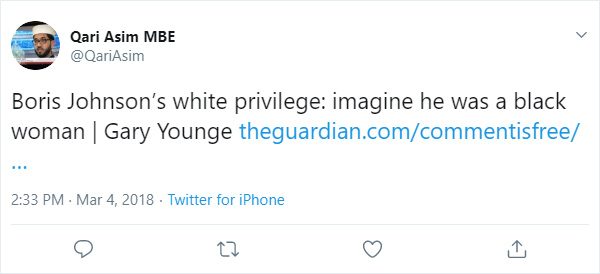
Qari Asim argued that Johnson’s comments “legitimised the hatred that exists towards Muslim women” and “fanned the flames of Islamophobia.” Asim has also tweeted an article from The Guardian saying: “Boris Johnson’s white privilege: imagine he was a black woman.” I think it is fair to conclude that Asim is not a fan of Boris Johnson, and it is likely that Theresa May and those in her administration were aware of this when they rushed the appointment through in the last few hours of their government.
Earlier this year, it was reported that Asim had expressed support for Pakistani radical cleric Khadim Rizvi. Rizvi supported the death penalty for Asia Bibi who was falsely accused of insulting Muhammad. Asim posted a statement on his Facebook page in 2017 in solidarity with the cleric whose organisation was behind protests in Islamabad which were marred by violence. In response to the report, Asim took the post down and claimed that he had not intended to endorse Rizvi. He later signed a letter calling on the government to offer asylum to Asia Bibi.
Qari Asim wants an Islamic blasphemy law
Asim gave a talk at a workshop organised by The Centre for Muslim-Christian Studies last year on ‘Law of the Land and Islam.’ I was present at the event, and the PowerPoint slides and an audio recording of his talk are available online.
In his talk, Asim argued the case for Muslims to obey the law of the land most of the time. But he also made clear how he would like the law to accommodate Islamic ideas. For example, he would like to see polygamy legalised, and inheritance to favour male heirs in line with sharia principles. He also supports Islamic finance with its radical view that interest should be banned. See my criticism of Islamic finance here.
Asim then went on to discuss areas of current law that “really challenge Muslims.” Here, he highlighted same-sex marriage, blasphemy, and honour of the prophet. In relation to blasphemy and honour of the prophet, Asim claimed that “Muslims cherish freedom of speech,” but then went on to argue:
“As we can have exceptions to the freedom of speech on the basis of some words or actions being offensive or distasteful, then if this is something that is distasteful to Muslims, or they find it offensive, … then whether we can have that exception or not.”
In other words, Asim would like to ban speech which is distasteful or offensive to Muslims, particularly any criticism of Muhammad. In the Q&A I pressed him on whether it would make a difference if the criticism of Muhammad was actually true (e.g. that he led military campaigns or discriminated against women). His reply was evasive.
Asim has previously argued that all depictions of Muhammad are harem or forbidden in Islam. This would include medieval images which have been regarded as masterpieces. Once again this is a strict interpretation of Islamic law which not all Muslims would agree with.
Backdoor blasphemy law
I was one of the signatories to an open letter to the Home Secretary in May this year which expressed concerns about the proposed definition of Islamophobia. The letter stated:
“We are concerned that allegations of Islamophobia will be, indeed already are being, used to effectively shield Islamic beliefs and even extremists from criticism, and that formalising this definition will result in it being employed effectively as something of a backdoor blasphemy law.”
Qari Asim would support an explicit Islamic blasphemy law, let alone a backdoor approach. He is likely to push for a definition of Islamophobia which will restrict free speech and regard any criticism of Muhammad as Islamophobic.
Does not bode well for free speech
The appointment of Qari Asim to advise on a definition of Islamophobia does not bode well for the protection of free speech in the UK. As I have argued before, the government would be better to use the term ‘anti-Muslim’ rather than ‘Islamophobia’ as this more clearly expresses discrimination against Muslims rather than criticism of Islam. The new administration under Boris Johnson should revisit the process and this appointment if they care about protecting free speech.