Can you imagine a world in which merely believing the Bible could get you fired? Tim Dieppe discusses the case of Felix Ngole and how that dystopian reality may be closer than we think.
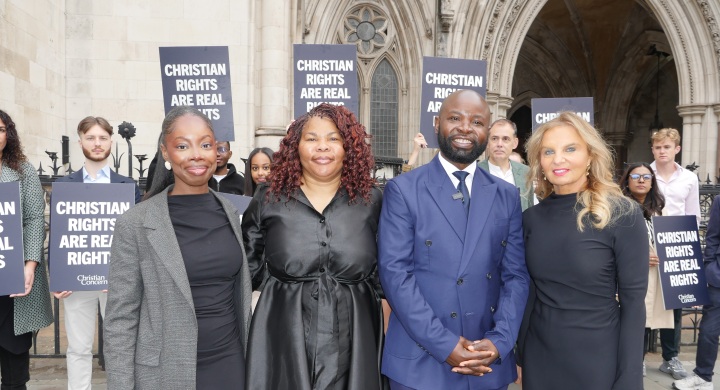
The extraordinary case of Felix Ngole continues this week with a second appearance in the Court of Appeal due to his expression of his Christian beliefs. Felix is thought to be the first person ever to have fought two separate cases in the Court of Appeal over Christian freedoms.
Court found Felix does not discriminate
Felix was vindicated in a landmark Court of Appeal judgment in 2019, when the court ruled that Sheffield University was wrong to expel him from a social work course for expressing his Christian beliefs about sexual ethics on social media. He bravely returned to the university, completed the course, and qualified as a social worker.
The Court of Appeal in 2019 ruled that “mere expression of religious views about sin does not necessarily connote discrimination.” It further found that in relation to Felix himself that: “there was positive evidence” that he had “never discriminated on such grounds”, and that he was “not likely to do so in the future (because as he explained, the Bible prohibited him from discriminating against anybody).”
One would have thought that this would make Felix a model employee! What other social work job applicant has had a Court of Appeal judgment saying that they do not discriminate?
Job offer withdrawn
Felix then applied for his “dream job” at mental health charity Touchstone Leeds. He was found to be the best candidate and was offered the job. The charity then found media articles about his earlier case and withdrew the offer. After Felix challenged the decision, it asked him in for a second interview to seek “assurances” in response to these articles, and afterwards they refused to reinstate the offer.
One might have thought that on learning he had been vindicated in a previous Court of Appeal judgment, Touchstone would have second thoughts about discriminating against him for his Christian beliefs. But no. Touchstone dug its heels in, and the case went to court.
Holding Christian beliefs should be a bar to employment
The case was heard in the Employment Tribunal (ET) in April 2024. Touchstone argued in court that Felix’s Christian beliefs could cause service users to commit suicide. They even argued that Mother Teresa would be unsuitable to work at Touchstone because of her orthodox Christian beliefs on human sexuality. Touchstone’s Head of Operations suggested that John 3:16 could be “triggering” for some service users. Clearly, for Touchstone, holding Christian beliefs should be a bar to employment. These are novel arguments not made in court before. It is an application of minority stress theory which claims that LGBTQ+ identifying people suffer more stress because they are a minority. The veracity of this theory was tested in court.
Discrimination proven
The ET, in a somewhat contradictory ruling, found that Felix had been discriminated against by the withdrawal of the job offer, but that Touchstone was still justified in not reinstating the job after the “second interview”.
The case then went to the Employment Appeal Tribunal (EAT), where it was heard in October 2025, with judgment given in February 2026. The EAT found that important parts of the ET’s reasoning were flawed, but instead of ruling that Felix had been unlawfully discriminated against, it referred the case back to the ET for reconsideration.
Felix, with the help of the Christian Legal Centre, is appealing the decision of the EAT and the case will be heard in the Court of Appeal this week. He is asking the Court of Appeal to rule that direct discrimination has already been established and that the case should not therefore be referred back to the ET.
Can employers discriminate against Christians?
This is a vitally important case for Christian freedoms. The case now rests on whether employers are entitled to subject Christians to additional vetting because of their Christian beliefs. Should an employer discover that you are a Christian, is the employer entitled to require an additional interview, demand assurances from you about your beliefs, or even refuse you employment because of your Christian beliefs?
This, then, is really about whether employers can discriminate against you because of your Christian beliefs. Requiring an extra interview, or extra assurances, is discriminatory after all. Arguing that people may be at risk of suicide if they find out you are a Christian is a whole other level of discriminatory thinking. It amounts to claiming that Christian belief is a dangerous thought crime.
I hope Felix wins in the Court of Appeal a second time! Once again, a lot hangs on his case.
Find out more about Felix Ngole