On Thursday 22 October, a church in Essex will appear in court to challenge an unprecedented use of public-order powers against the public ministry of an entire church.
Bread of Life Community Church, which is being supported by the Christian Legal Centre, is appealing against a Community Protection Notice (CPN) issued by Colchester City Council in March 2026 following complaints about its weekly outreach in Colchester city centre.
The appeal is listed for a two day hearing, and begins from 10am on Thursday 22 October at Southend Magistrates’ Court, with day two listed for Chelmsford Magistrates’ Court on 29 October.
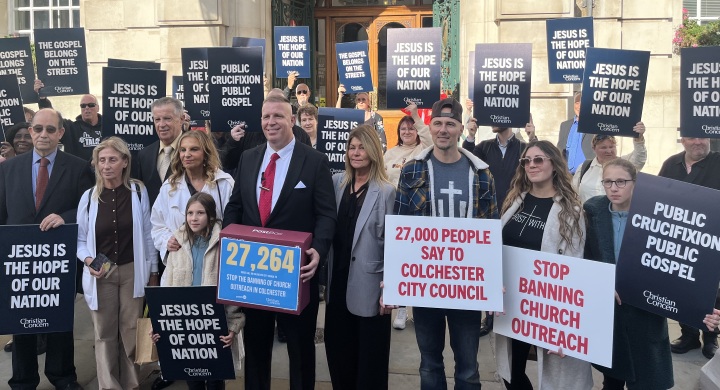
Since 2022, members of the church have gathered for around two hours each week to preach, sing hymns, distribute Christian literature and Bibles, and offer conversation and prayer to members of the public.
The church says its outreach has also included practical support for the local community. It regularly collects for a food bank, while church members have bought warm clothing for people in need and provided hot meals for homeless people.
The CPN orders the church to stop using a loudspeaker or amplified equipment and to stop what it describes as “engaging or intimidating behaviour” towards members of the public, which the church members categorically deny.
The CPN contains no geographical limit, volume threshold or expiry date, and does not define what this ‘behaviour’ is.
Breaching the notice is a criminal offence, meaning the church’s pastor and members could face prosecution if the council alleges that they have failed to comply.
Christian preaching content on trial
The church says the council’s intervention began with concerns about amplified sound but subsequently extended to the content of its Christian message.
A Community Protection Warning was issued in November 2025 following interventions by council wardens. The church says wardens demanded that its members stop or reduce amplification, despite the Public Spaces Protection Order applying in the area containing no prohibition on amplified sound.
The council later raised concerns about theological references to judgment and hell. The CPN alleges that “religious messaging” mentioning “hell” caused “harassment, alarm and distress” and says wardens had attempted to “educate” the preachers.
Lawyers supporting the church will argue that this represents a significant shift from addressing genuine concerns about noise to seeking to regulate the content of Christian doctrine expressed in public.
The church accepts that amplification was used and that some people complained about the outreach.
However, it strongly denies that its pastor or members have behaved aggressively, threateningly or unlawfully.
It says its outreach is livestreamed and recorded and that there is no evidence of its members threatening or harassing anyone.

‘The legal test has not been met’
In its appeal under section 46 of the Anti-social Behaviour, Crime and Policing Act 2014, the church will argue that the CPN is unlawful and should be quashed.
Its lawyers will argue that the council has failed to establish that the church’s conduct had a persistent or continuing detrimental effect on the quality of life of people in the locality, or that its conduct was unreasonable.
The church says its preaching takes place outside a closed retail unit rather than immediately outside active businesses. It argues that the council has produced no calibrated acoustic evidence demonstrating persistently excessive noise and no sufficiently specific evidence establishing harassment, threats or intimidation.
The appeal will also contend that the recurrence of lawful street preaching cannot automatically be treated as persistent anti-social behaviour. Disagreement with or offence caused by a religious message, the church argues, is not by itself sufficient to justify restricting it.
Lawyers for the church will say that the notice is vague, indefinite and disproportionate, particularly in its prohibition of undefined “engaging or intimidating behaviour”.
They will argue that describing biblical teaching on judgment or hell as intimidation fundamentally mischaracterises ordinary Christian evangelism and risks creating content-based censorship of protected religious speech.
The church contends that the notice interferes with its freedoms of religion, expression and peaceful assembly under Articles 9, 10 and 11 of the European Convention on Human Rights.
It will also argue that existing laws already provide the authorities with sufficient powers to deal with genuinely threatening behaviour, harassment, obstruction or excessive noise where the relevant legal thresholds are met.
Wider implications for Christian outreach
The case is believed to be the first known attempt to use a CPN in this way against the public ministry of an entire church, rather than against the conduct of a particular individual.
The church’s lawyers say it could set a dangerous precedent by allowing broad anti-social behaviour powers to be used not only to regulate the manner of street preaching, but also to restrict the substance of a religious message.
The Christian Legal Centre has previously supported churches and Christian preachers facing restrictions on public outreach elsewhere in the country.
In Uxbridge, a church successfully challenged restrictions imposed on its outreach ministry. In Aldershot, a local authority withdrew an application for an injunction that campaigners warned could have criminalised Christian street preaching and even the singing of Christmas carols.
Church challenges restrictions on Christian outreach
Pastor Stephen Clayden, of Bread of Life Community Church, said:
“This case goes far beyond a disagreement about the volume of a loudspeaker. It concerns whether a council can impose an indefinite and sweeping restriction on a church for peacefully sharing the Christian faith in public.
“We have preached the Bible peacefully in Colchester for years. We have harmed no one, and we strongly deny that any member of our team has behaved in a threatening or intimidating way.
“We have always wanted to engage respectfully with the people of Colchester. Our outreach includes offering prayer, practical help and hope to people in need. Many members of the public respond positively, even though we recognise that not everyone will agree with the Christian message.
“Freedom of speech and religion mean little if they protect only messages that nobody finds challenging or uncomfortable. Biblical teaching about judgment cannot simply be redefined as intimidation because someone objects to it.
“We respect the law, but we cannot and will not abandon the Great Commission. We hope the court will recognise that any genuine concerns can be addressed through clear and proportionate measures, rather than a vague notice that risks turning ordinary Christian outreach into a criminal offence.”
Andrea Williams, chief executive of the Christian Legal Centre, which is supporting the case, said:
“This appears to be an unprecedented attempt to use a CPN to control the ordinary public ministry of an entire church.
“The notice is breathtakingly broad. It prohibits all amplification, regardless of volume, place or circumstances, and even appears to ban ‘engaging’ with members of the public. It has no expiry date, yet breaching it could lead to criminal prosecution.
“Of particular concern is the apparent shift from complaints about volume to objections to the content of the Christian message. References to judgment and hell are part of historic, orthodox Christian teaching. The state cannot treat the expression of those beliefs as unlawful simply because some people find them uncomfortable.
“The law already provides authorities with powers to deal with genuine harassment, obstruction and excessive noise. What it must not do is create a special and lower threshold for restricting Christian preaching because its message is controversial or unwelcome.
“This hearing is an important opportunity for the court to uphold the fundamental freedoms of speech, religion and peaceful assembly, and to make clear that public authorities must act with precision, evidence and proportionality.”