The recent case of Christa Pike, whose execution failed despite the administration of lethal drugs, has raised serious questions about the reliability of the very substances commonly used in assisted suicide cases overseas. Isabel Jackson explores the reality that no lethal drug can guarantee the outcome campaigners promise.
The campaign to legalise assisted suicide relies on the promise that the drugs used to assist people to die will ensure a peaceful, dignified and controlled death for those that are terminally ill.
The public is often presented with this picture – that you’ll be able to take a harmless drug, fall asleep, and die without distress.
However, recent events in Tennessee put that narrative into question.
On 30 September, Christa Pike of Tennessee was scheduled to be executed by lethal injection. According to reports, she was given two doses of pentobarbital but survived and was taken to hospital in critical condition.
The incident is so serious that Tennessee Governor Bill Lee has suspended executions for at least the rest of the year to find out what went wrong.
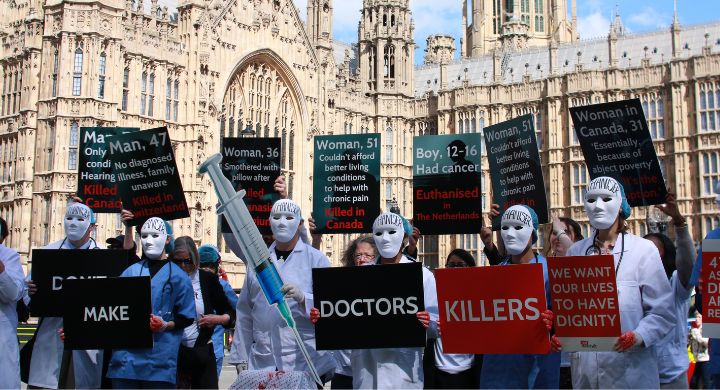
Humane?
The point is not that assisted suicide and the death penalty are the same.
But the drug behind both practices is a common factor, and in Switzerland, euthanasia clinic Dignitas uses Pentobarbital.
The significance of this comparison is revealed by the assumption that the use of these drugs always means a quick, predictable and humane death.
Reports suggest that execution staff in Christa Pike’s case struggled to establish intravenous access and that multiple needles were used before the drugs were administered.
Witnesses recounted that after initially remaining quiet, Pike cried out in pain and warned that something had gone wrong with the injection.
Despite the intention to bring about death, the injection did not.
And in a shocking turn of events, it has been reported that Pike has regained consciousness and is talking.
What was supposed to be a controlled procedure became a prolonged and distressing ordeal – one that Pike herself may well remember, along with all those who witnessed it.
Assisted suicide is not a simple, clean end
Just last month, a bill to legalise assisted suicide was voted down in the House of Commons.
Supporters often mention the supposed choice and control involved with assisted suicide, but looking at evidence in places where assisted suicide is already legal contradicts that ideal.
In evidence submitted to Parliament, Dr Calum MacKellar highlighted reported complications in Oregan, including seizures and vomiting. He also referred to cases where patients took hours to die, and one reported case in which a person took more than five days to die.
His conclusion was clear – “At present no quick and completely effective lethal drug exists.”
Some commentators have made a striking observation. If the sole objective was to achieve the quickest and most reliable death possible, there are methods far more certain than the drugs currently used in assisted suicide. Yet society recoils from such proposals because we instinctively recognise that dignity is about more than simply finding the most efficient way to bring about death. The question is not only whether a method can end life, but whether deliberately ending life should be seen as the answer to suffering in the first place.
This finding shows how, with no completely reliable lethal drug out there, no campaigner, doctor or legislator can truly guarantee a peaceful and painless death. The reality is that complications can occur, dying can be prolonged and the outcomes can differ significantly from what was expected.
The promise of a controlled death
Imagine a terminally ill patient choosing assisted suicide, believing it will be a calm and rapid process. Imagine family members gathering to say goodbye, expecting death to come within minutes.
If complications arise, if the drugs do not work as anticipated, or if dying is prolonged for hours or even days, the experience could be very different from the one they were promised by campaigners.
Imagine if a terminally ill patient were to choose assisted suicide with the understanding that it would be a calm and rapid process, with family members gathered to say goodbye and expecting a peaceful death to come in minutes. If complications arose and the drugs did not work as anticipated, or if dying was prolonged for hours or days, the experience would not be what they were promised at all.
Compassion is not measured by efficiency
As Christians we know that compassion is not measured by how efficiently society can bring about death. True compassion is shown through support and good quality palliative care. The dignity of a person does not depend on if they are healthy or not.
Every life has value, even during suffering.
Christa Pike’s botched execution is a reminder that death cannot always be controlled and go according to plan. Even in tightly regulated environments and the use of verified drugs to bring about death, the outcome can be unexpected.
Assisted suicide advocates can promise choice, but they can’t guarantee a peaceful death.
They can promise control but can’t eliminate the risk of complications.
When the consequence of getting it wrong is suffering at the very end of life, that is not a risk that should be brushed aside.
The warning form Tennessee is clear, that when society places its trust in lethal drugs, things can go badly wrong and it is the most vulnerable who so often face the consequences.