Tim Dieppe writes about his recent appearance on a Liberal Democrat Christian Forum panel
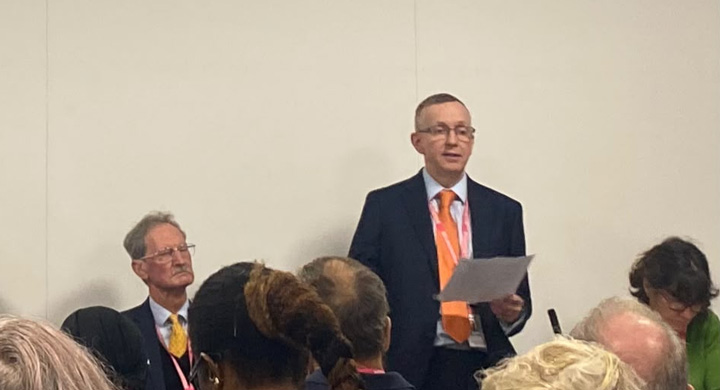
The Liberal Democrat Christian Forum (LDCF) hosted a fringe event at the Lib Dem Conference on Saturday entitled: How can Lib Dems challenge the rise of populism and Christian Nationalism?
I was invited to participate in the panel discussion, which I agreed to take part in with some trepidation since I was confident none of the other speakers would agree with my position.
Muslim member of the Lib Dem Christian Forum
On the panel was Mohammed Amin. Mohammed is a Muslim businessman, a former member of the Conservative Party and former chair of the Conservative Muslim Forum. Since 2019 he has been a member of the Liberal Democrats. I was told that he is a member of the Lib Dem Christian Forum (LDCF) notwithstanding the fact that he is a Muslim! This prompted me to check the publicly available constitution of the LDCF which contains no basis of faith. So, yes, a Muslim can be a member of the LDCF. I suppose this is where an ideology of inclusion leads?
The other panellists were Elizabeth Jewkes (Director of LDCF), Nathan Stilwell (Humanists UK), and Nigel Jones (LDCF member). The panel was chaired by Olivia Honeyman (chair of LDCF).
Introductory remarks
Each of the panellists was asked to present some introductory remarks.
Mohammed Amin went first, arguing that just as Islamism is not true Islam, Christian nationalism is not true Christianity. He quoted from various Bible passages about welcoming strangers and aliens to support his point.
Elizabeth Jewkes went next and I was pleased to hear her say that she was a Christian first, and a Lib Dem second! She then passionately denounced Reform and said that Lib Dems need to get more angry towards Reform. She referenced Jesus clearing the temple to support her point. She claimed that Christians in Reform are Reform first and Christian second!
Christianity has brought immense good to the nation
I was next up. I argued that Christianity has had an immense influence on this nation over centuries. It has shaped our laws, customs, calendar, music, art, architecture, language and poetry. I referenced Tom Holland’s book Dominion, Glen Scrivener’s The Air We Breathe and Bijan Omrani’s God is an Englishman, presenting evidence for the huge influence of Christianity on our culture. I agreed with Amin that Christian values have prompted us to welcome people from other nations. I did question Jewkes’s application of Christianity to calling for people to get more angry!
Christianity values freedom of religion, I said, in sharp contrast to Islamic states and hardline secular states. I concluded that Christian values are best for everyone and best for our nation. I therefore want this nation to be as Christian as possible, with laws and culture shaped by Christian values. As the Psalmist put it: “Blessed is the nation whose God is the Lord.” (Psalm 33:12).
Booed for saying marriage is good for society
These opening remarks were followed by a Q&A session from the audience. It was clear that my comments on marriage and family values were not well received by the audience.
One questioner asked how we should respond to claims that moral standards have declined in recent decades. The other panellists responded by denying the premise. They argued that morality has not declined at all. I responded by pointing out that when Queen Elizabeth II came to the throne, less than 5% of babies were born outside wedlock – a number that is now over 45%. Marriages are down and divorces are up. I noted that this is bad for society.
It was at this point that I got booed. It was clear that most people in the audience did not like what I was saying. I was a bit surprised to be booed at a Lib Dem Christian Forum event for saying that the decline in marriage over recent years is bad for society!
Everyone welcome
Another question was about how people find identity and belonging in society. I argued that identity is best found by becoming a Christian, and that belonging is best found in a local church. Nigel argued that all groups should welcome everyone, and Elizabeth said that we shouldn’t disagree with people – the same person who had said we need to be more angry about Reform! I couldn’t help interrupting to point out that members of Reform would not be welcome at the Lib Dem conference, and that they would disagree with members of Reform! I suppose this mentality of welcoming everyone is why they allow Muslims to be members of the Liberal Democrat Christian Forum.
Lib Dems want trans women in female spaces
Perhaps I should not have been surprised by the fairly hostile reception I received at the Lib Dem conference. On Monday the Lib Dems passed a motion in favour of allowing trans women to access female spaces. The motion states that “Trans women are women, trans men are men.” It claims that the EHRC code of practice is “discriminatory and unworkable.” This motion was passed with overwhelming support. Clearly, the example of the Darlington Nurses being forced to share a changing room with a biological man has no sympathy among the Lib Dems.
Lib Dems have discriminated against a Christian
It wasn’t that long ago that Tim Farron stepped down as leader of the Lib Dems following intense scrutiny of his Christian beliefs on sexual ethics. In a statement he said that he could no longer reconcile his strong Christian faith with his responsibilities as leader of a liberal party.
More recently, the party formally admitted that it unlawfully discriminated against former BBC journalist David Campanale on the basis of his Christian beliefs when he was deselected ahead of the last general election. Campanale is seeking damages of over £700k from the party for the loss of his political career. He argues that he was mocked and abused over his Christian beliefs and faced an organised campaign to remove him. The party has just this week quietly commissioned a review into how people of different religious beliefs are treated, though there has been no formal announcement about this. A Lib Dem source quoted by the Guardian noted that there has been no remorse and no apology to Campanale for the way he was treated.
Christians and the Liberal Democrats
Some of my colleagues attended the Reform UK conference where chief executive Andrea Williams spoke on a panel at a similar fringe event. For speaking there, Christian Concern received comments questioning whether we were associating with one particular party. The truth is that we will speak at any party conference we are invited to. A hostile response at this event does not change that. Credit to LDCF for inviting us. Christian Concern will also be represented at the Conservative Party conference this year. We are happy to receive invitations from other parties too.
Nevertheless, the kind of reception I received, along with the party’s recent treatment of Christians in its own ranks and its policy platform that refuses to recognise the differences between men and women, should give Christians serious pause for thought. Within the party, Christians need to consider whether they are influencing the party or whether the party is influencing them. And when the next election comes around, Christians really ought to consider whether they can, in good conscience, support a party that acts in these ways.