The Darlington Nursing Union has warned that the Equality and Human Rights Commission’s updated Code of Practice, which comes into force today, does not resolve the urgent question of how female NHS employees will have their workplace rights enforced.
In a letter to Health and Social Care Secretary Yvette Cooper MP, the union welcomes the new statutory guidance but stresses that it covers services, public functions and associations, not employers acting in their capacity as employers.
The nurses are demanding an urgent meeting with the Health Secretary to establish what the Government, NHS England and health regulators will do to ensure that equivalent, legally accurate workplace guidance is issued and enforced across every NHS trust.
It says that the Supreme Court has already clarified the meaning of sex under the Equality Act, and NHS bodies must follow that ruling now, irrespective of the gap in updated workplace guidance.
The absence of an updated Employment Code is not a licence for NHS trusts to continue applying policies based on an incorrect interpretation of the law.
In April 2025, following the For Women Scotland Supreme Court ruling, the Darlington nurses were promised ‘new rules for the NHS within weeks’ by then health secretary, Wes Streeting, but nothing has materialised to this day.
The updated EHRC Code explains how the Equality Act 2010 applies to services and public functions, including the provision of separate and single-sex services. It does not replace the EHRC’s Employment Code or provide a comprehensive new framework governing relationships between NHS employers and their staff.
The Darlington Nurses say this leaves a serious and immediate gap for female employees raising concerns about changing rooms, toilets and other intimate workplace facilities.
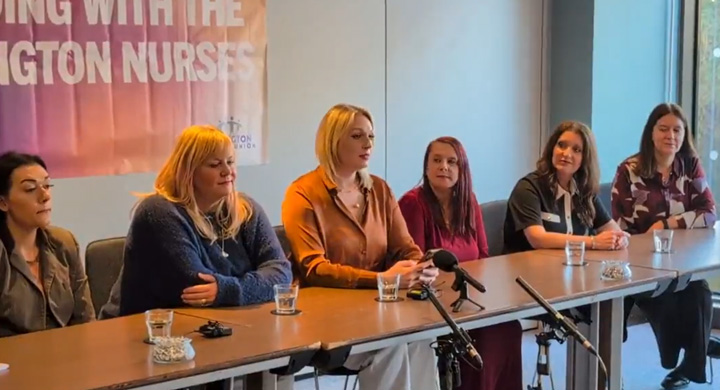
Darlington nurses forced into legal action
The union, supported by the Christian Legal Centre, was established after female nurses raised concerns about being required to share a changing room with a biologically male colleague at Darlington Memorial Hospital.
Rather than having those concerns addressed promptly, sensitively and lawfully, the nurses say they were subjected to treatment that ultimately forced them into Employment Tribunal proceedings.
In January 2026, the nurses secured a judgment that the union says confirmed that the treatment they experienced was unlawful and that their dignity and legitimate concerns had not been properly respected.
The nurses say they were also abandoned by established trade unions. Despite being fee-paying members, none of the main unions they approached was prepared to support them in defending lawful single-sex workplace facilities.
They consequently established the Darlington Nursing Union, providing an independent source of representation for nurses and healthcare professionals who may face comparable disputes.
Despite their legal success, the nurses say they continue to be investigated by the Nursing and Midwifery Council for speaking publicly about their experiences.
Urgent questions for Yvette Cooper
The EHRC describes the new Code as practical statutory guidance on how the Equality Act applies to services, public functions and associations. It does not create new legal obligations, but courts and tribunals may take it into account where relevant.
The Code reflects the Supreme Court’s clarification that the words “sex”, “woman” and “man” in the Equality Act refer to biological sex. It also affirms that people with the protected characteristic of gender reassignment remain protected against unlawful discrimination.
However, the Code is primarily concerned with organisations providing services or carrying out public functions. While an NHS trust may be governed by it when providing healthcare to patients, the Code does not comprehensively govern that trust’s separate role as an employer.
The Darlington Nursing Union says that distinction is crucial. Female nurses require clear guidance not only about the services delivered to patients, but about their own rights as employees using changing rooms, toilets and other workplace facilities.
The union is therefore calling on the Health Secretary to answer the following questions:
- Equivalent employment guidance: What guidance will govern the rights of NHS employees, given that the new Code principally concerns services, public functions and associations?
- Immediate NHS direction: Will the Government or NHS England instruct all trusts to review workplace changing rooms, toilets and other intimate facilities?
- Legal framework: How will NHS employers be required to apply the Equality Act 2010 alongside the Workplace (Health, Safety and Welfare) Regulations 1992?
- National consistency: Will binding or authoritative national standards prevent trusts adopting conflicting policies?
- Timetable: When must NHS organisations complete their policy reviews and confirm compliance?
- Monitoring: Which organisation will assess whether workplace policies and practices comply with the law?
- Enforcement: What consequences will follow where trusts maintain unlawful or legally inaccurate policies?
- Regulatory scrutiny: What role will the Care Quality Commission, NHS England and professional regulators play?
- Training: How will NHS leaders, human resources personnel and equality, diversity and inclusion teams receive accurate training?
- Protection for staff: What practical measures will prevent disciplinary action, harassment, victimisation or professional detriment against staff who raise legitimate concerns?
- Professional regulation: How will nurses and other regulated professionals be protected from unjustified referrals or investigations arising from lawful speech about workplace conditions?
- Updated Employment Code: Will the Government support the urgent publication of equivalent, updated employment guidance reflecting current equality law?
Previous ministerial engagement
The Darlington nurses met former Health Secretary Wes Streeting in October 2024 and maintained correspondence with him throughout their case.
Following the Tribunal judgment, the union says Mr Streeting recognised the seriousness of their experience and the need for NHS guidance to reflect the law correctly. A further meeting was being arranged to discuss the implications of the case and the forthcoming EHRC Code.
The nurses later sought to continue that engagement with James Murray and were due to meet the Department on 16 June.
They are now asking Yvette Cooper to honour the previous commitment.
“There remains a dangerous gap for women at work”
Bethany Hutchison, Darlington nurse and President of the Darlington Nursing Union, said:
“The EHRC Code of Practice is welcome, but it does not apply to employers acting in their capacity as employers. There therefore remains a dangerous gap between the clarity now being offered to service providers and the position of female employees who need protection in their workplaces.
“The Darlington nurses know from painful experience what happens when NHS institutions fail to respect the law, the dignity of female staff and legitimate concerns about privacy and single-sex facilities. We raised reasonable concerns but, rather than being listened to and supported, we were forced into a prolonged legal battle to establish rights that should have been protected from the outset.
“The question for the Government and NHS is now unavoidable: what equivalent employment guidance will be issued, who will ensure that trusts follow it, and what enforcement action will be taken when they do not?
“It is not enough to tell women that they have rights in principle. NHS employers need clear national direction on single-sex changing rooms, toilets and other intimate workplace facilities. Managers, human resources teams and equality departments must be trained to understand and apply the law correctly.
“We were also abandoned by the established trade unions. Despite being fee-paying members, none of the main unions we approached was willing to support us in defending these basic women’s rights. We were ultimately forced to establish the Darlington Nursing Union so that nurses and other healthcare professionals facing similar situations would have somewhere to turn.
“It is extraordinary that frontline nurses had to create their own trade union simply to obtain meaningful representation on matters of privacy, dignity and lawful single-sex provision.
“Women such as the Darlington nurses, Sandie Peggie and Jennifer Melle, and the Christian Legal Centre supporting us at every step, have shown immense courage, often at considerable personal and professional cost. But this cannot be the Government’s enforcement strategy.
“It cannot be right that responsibility for upholding the law is left to individual women who must risk their careers, reputations, livelihoods and wellbeing by challenging powerful public institutions. Nurses should not have to become whistleblowers, litigants or trade-union founders simply to secure compliance with the Equality Act and workplace law.
“We met Wes Streeting in October 2024 and maintained correspondence with him throughout our case. We were due to meet him again and subsequently sought to continue that engagement with James Murray. We are now asking Yvette Cooper to meet us as soon as possible.
“The Government must explain how it will ensure that the law is applied consistently across the NHS, what equivalent workplace guidance will be issued, how compliance will be monitored, and how staff who raise legitimate concerns will be protected.
“The Government now has an opportunity to ensure that other women are never put through what we experienced. It must provide national leadership, clear workplace direction and meaningful enforcement, rather than leaving ordinary women to uphold the law one costly case at a time.”
Andrea Williams, chief executive of the Christian Legal Centre, said:
Find out more about Darlington Nurses“The Darlington nurses should never have been forced to risk their careers, reputations and wellbeing to establish rights that should have been recognised from the beginning. When they raised reasonable concerns, the institutions that should have protected them failed.
“Established trade unions abandoned them, their employer did not listen, and they were left with no alternative but to pursue legal action. The Christian Legal Centre was privileged to stand alongside them and ensure their voices were heard.
“The Government must not use publication of the new Code to suggest that the work is complete. Unless equivalent and legally accurate employment guidance is issued, backed by national NHS policy and meaningful enforcement, female staff will remain exposed.
“NHS England and every NHS trust must be given clear instructions on workplace changing rooms, toilets and other intimate facilities. Human resources teams and equality, diversity and inclusion departments must receive accurate legal training. Regulators must also be prepared to intervene where institutions disregard the law or punish women for raising legitimate concerns.
“The Government cannot outsource the enforcement of women’s workplace rights to a handful of courageous nurses. We support the Darlington Nursing Union’s request for an urgent meeting with the Health Secretary and call for immediate action to close the workplace guidance and enforcement gap.”