Holly Baines reflects on her experience at the Church of England’s General Synod – where Christian Concern’s event on conversion therapy was targeted and where God’s design for marriage was debated
Every five years (called a quinquennium), the Church of England elects its General Synod, which is essentially the church’s equivalent of the House of Commons.
And as this quinquennium came to an end, it felt as if the sun was setting on the Church of England as a whole.
I am an outsider. I am not a Church of England member.
But I am a Christian, and I believe wholeheartedly in the Christian faith that the Church of England has historically upheld and still claims to do so today.
I attended General Synod for the first time to support Rebecca Bensted from the Christian Legal Centre and our Core Issues Trust/X-Out-Loud allies as we held a fringe event to explore the ramifications of a ‘conversion therapy’ ban, and highlight the importance of the gospel message of change, repentance and regeneration.
And I was astounded by what I saw.
Standing for the truth
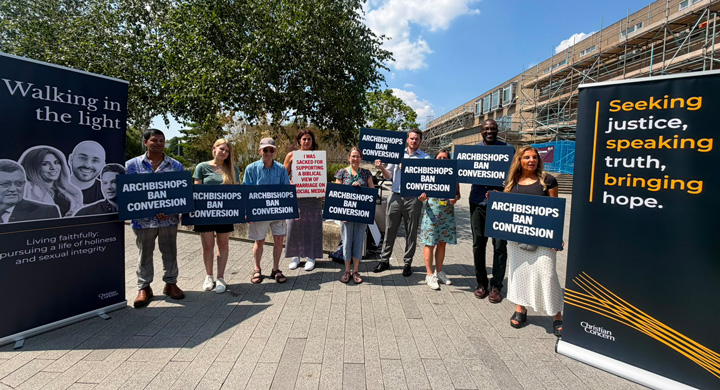
Ahead of our event, I had helped design the banners for a display which was meant to encourage Synod members to uphold the Bible’s teaching (which the Church claims to also believe) on sexual faithfulness.
It included pictures of Christians in different walks of life – married, single, engaged and ex-gay – who are seeking to live faithful, chaste lives that glorify God.
After liberal revisionists aggressively campaigned against a fringe event exploring those themes, the archbishops had considered shutting it down.
But instead, they only cancelled our display.
So, we stood outside Synod instead.
We arrived on Friday afternoon, with the sun blazing, to set up our banned banners outside the entrance and invite attendees to our fringe event on Monday morning.
Our mission was simple: to raise awareness about the archbishops’ ban on our stand about ‘conversion therapy’, and to highlight the importance of biblical, truthful support for those struggling with unwanted same-sex attraction.
First the security swiftly told us to leave the area, then they confined us to hold our banners at a small area across from the Central Hall where General Synod was meeting.
Both attendees and the higher security members showed clear disdain and oftentimes open hostility towards us as Christian Concern staff.
Because we were visibly supporting biblical marriage, we were also banned from watching Stephen Cottrell’s ‘Archbishop’s Address’ from the public gallery.
Although we were able to successfully challenge this decision, the message was clear: the Church wanted to censor and ostracise us and our beliefs, at all costs.
As someone who is not very familiar with the Church of England and has never witnessed the hostility in-person, it was an eye-opening and disheartening experience.
From being accused of ‘not being Christians’ to ‘harassing and abusing’ other Christians simply because of our support for biblical marriage and sexual ethics, we were clearly the unwelcome outsiders.
In reality, the aggression and hatred was only going in the other direction.
Why ban consensual conversations and support?
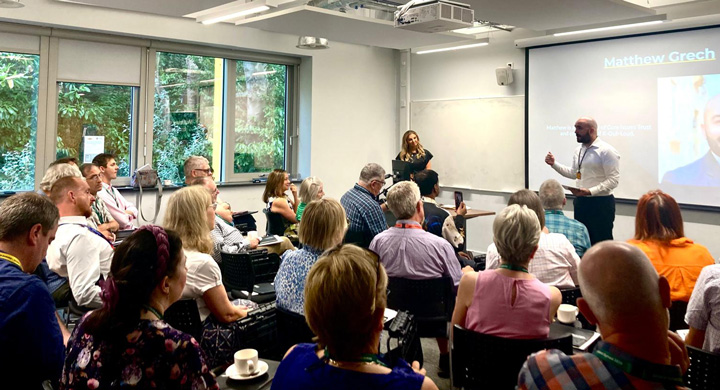
However, our Synod fringe event was well received and attracted a significant number of attendees.
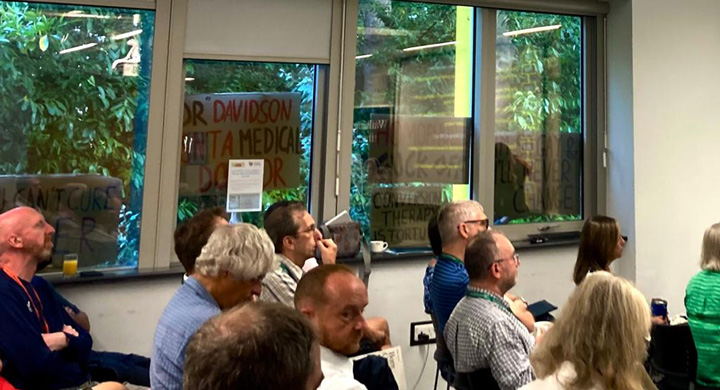
It also attracted several student protesters who held up hostile and vulgar signs against the windows and entrances. They even started banging on the glass windows during the middle of Andrea’s presentation.
But for those of us in the room, this opposition only reinforced the importance of protecting freedom of speech, open debate, and the ability to access support and information.
Matthew Grech gave an inspiring testimony of the change possible in Christ, and shared his unwavering dedication to truth, in the face of years of denied justice and hostility for the gospel.
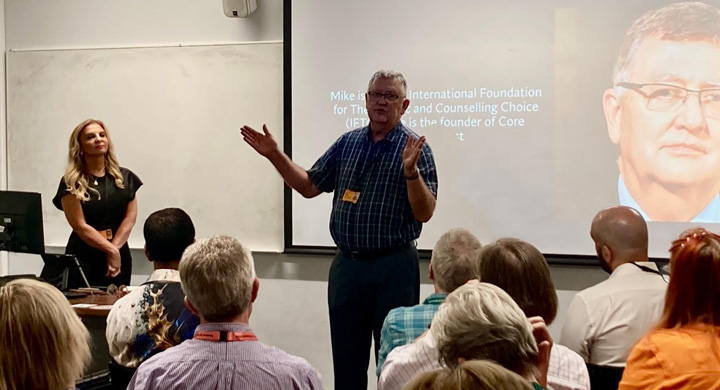
His co-worker at Core Issues Trust, Dr Mike Davidson, also shared his own testimony, and how he was blacklisted for his work to give ex-gays a voice and to provide them with essential support.
And Andrea’s analysis of the proposed ‘conversion therapy’ ban exposed how this law would censor not only therapeutic support, but also simple conversations, testimonies, and even the essence of the gospel.
Sam’s powerful story of coming to faith and finding healing and hope in the gospel, as well as his dedication to standing for truth despite the open hostility towards him, was inspiring.
And in a beautiful picture of the complete renewal that Christ offers, Matthew’s fiancée Hollie was present to support him throughout the event.
Together, these stories showed how crucial it is that we preserve consensual conversations about sexuality, holiness, and God’s call for radical transformation.
And it also exposed the deep injustice faced by those like Matthew, Mike and Sam, both from within the Church and our culture as a whole.
They don’t deserve to be silenced
These Christians have experienced so much hurt and hostility for their biblical convictions, and now the Church and our Government are actively censoring and ostracising their stories simply because they don’t fit the narrative of being ‘born gay’.
They don’t deserve to be silenced for their beliefs and their experiences.
The Church should not only be supporting them but enabling them to share their testimonies and give this hope to others who are also facing unwanted same-sex attraction.
But instead, the Church is shutting them down at every step, making it clear that they are not welcome within the Church of England’s narrative for sexuality and gender.
This must change.
An unexpected, but most-welcome, win for truth
Throughout the General Synod debate, the lack of clarity was astounding.
Many members’ speeches used ‘Christianese’ terminology to bolster an ideology that completely contradicts biblical teaching.
Promoting and sharing the gospel with the lost, pursuing holiness and truth, and loving others were all used to justify silencing biblical truth, demeaning ex-gay Christians, and openly opposing God’s design for marriage and the gospel call to change.
But the Bible is clear: marriage is a life-long relationship between a man and a woman, and no amount of emotion or ‘sympathy’ can change the fact that this is the best design for us as human beings.
Sitting in the public gallery, the disdain for our row was palpable.
But we watched the debate, we prayed hard, and we continued encouraging each other that the truth was still worth standing for, regardless of the opposition.
The original motion was explicitly anti-Christian and directly flouted God’s design for marriage and us as men and women.
And although the amended version was slightly better, it still upheld the narrative that obedience to God’s clear commands are something good Christians can legitimately disagree on. For example, the final version of the motion called Synod to:
(c) recognise a legitimate range of theological perspectives, held in good conscience, across the Church of England, on the right ordering of committed, faithful, intimate same-sex relationships, and;
(d) recognise that this includes views that affirm and views that reject the position that there are no fundamental objections to being in such a relationship and that such a relationship can be entirely compatible with Christian discipleship and ministry.
It applied an ‘agree to disagree’ mentality to an issue that is, at its core, a gospel issue and one that the church should have complete clarity and consistency about.
I was certain that the faithful Christians in Synod would lose, yet God intervened and the motion in its final form was unexpectedly voted down by the bishops.
This is cause for gratitude and yet, the work is far from over.
The abandonment of the gospel
I knew that the Church is often marked by apathy.
I knew it was riddled with compromise and a loss of biblical values and convictions.
And I knew the leadership hierarchy is full of those unqualified to be Church leaders – both on moral and theological stands.
But what shocked me was the intensity of hatred and vitriol that many senior members of the Church displayed towards us simply because of the convictions we hold.
What was clear is that they do not only despise us and all that we stand for, but they also despise Christ.
They claim his name and the proclamation of the ‘gospel’, and yet reject the notion of sin, holiness, or repentance.
If we are not free to call sin ‘sin’ and to expose the reality of what repentance means – to turn away from sin – how can we call people to Christ?
Being honest about what God calls sin is a gospel issue.
And if we call good evil, and evil good, then we have lost the essence of the gospel and nullified the need for repentance and the hope of change.
After all, Christ’s death was necessary to save us from our sins and to make us new creations (2 Cor 5:17), living new lives marked by holiness.
What point is there in Christ’s death if we are not called to repentance and change through it?
What need was there for Christ to die if we are not sinners in need of a Saviour, but merely humans pursuing love in whichever diverse and legitimate ways we choose?
Where to from here?
Our beliefs are still ostracised within the Church.
You only have to look at how the Church treated Bernard Randall for his incredibly reasonable sermon on sexuality and traditional Christian beliefs, to see that they view conservative Christians as the enemy.
Christians with testimonies of overcoming same-sex attraction are still branded ‘abusers’ and actively dismissed.
And Christ’s teaching on sexuality, holiness, and even the gospel is overwhelmingly ignored and censored by those who have the greatest duty to uphold it.
We stand up on these issues because we love people, and the Christians I was with over the weekend are truly driven by compassion and a deep-rooted gratitude to and love for Christ.
They are some of the kindest people I have met and they were filled with genuine care for those who have been blinded and harmed by radical sexual ideologies.
When facing intense opposition, the common theme I heard was how deeply saddened they were to see so many held captive by a destructive movement that they themselves had been able to escape by the grace of God.
Throughout the weekend they were faithfully praying not only for the event, but also for the protestors, for Synod members, and for each other.
They are people moved to speak up, not because of a desire to be controversial, but because of their love for others and for Jesus.
And yet, they are branded ‘safeguarding risks’ for upholding official Church teaching.
As the quinquennium comes to an end, it’s more clear than ever that the Church of England is in a desperate state.
She has abandoned Scripture, and now she is facing the consequences.
Only if she once more returns to the authority of God’s word and boldly reclaims the true gospel will we see the change and renewed holiness that we so long for.
Our beliefs about marriage and sexual ethics are not unique and they should not be controversial.
This has been the conservative Christian perspective, throughout history, and conservative Christians must be bold enough to stand by it.
The General Synod elections offer the chance for a new dawn.
Maybe, just maybe, there is still a chance to save the Church of England.
But the only hope is for faithful Christians within the Church to rise up, to celebrate biblical teaching, and to boldly align themselves with the truth about marriage, sexuality, and change through the gospel.