The Supreme Court of the United Kingdom has granted permission for a group of independent Christian schools, parents and pupils to appeal the Government’s decision to impose VAT on independent school fees, ensuring that the high-profile legal challenge will now be heard by the country’s highest court.
Lord Reed, Lord Hamblen and Lord Richards confirmed that permission to appeal has been granted on one of the central grounds of challenge, proportionality, recognising that this aspect of the case raises an arguable issue requiring consideration at the highest level.
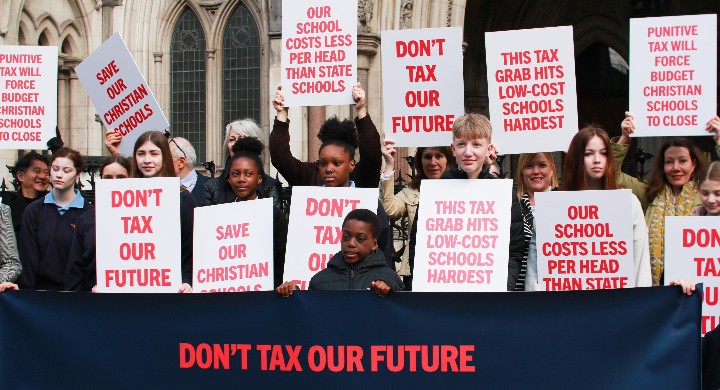
The case is supported by the Christian Legal Centre and brought by independent Christian schools across the UK, including Emmanuel School in Derby, The Branch Christian School in Yorkshire, The King’s School in Hampshire, and Wyclif Independent Christian School in South Wales, including parents and even pupils.
They argue that the Government’s VAT policy disproportionately impacts Christian schools and the families who choose them, particularly those of modest means.
While permission has been limited to “ground 4” of the appeal, this issue lies at the very heart of the case.
It concerns whether the Government’s policy strikes a fair balance between its stated objectives and the real-world consequences for affected schools, parents and children.
The schools’ lawyers contend that the 2026 Court of Appeal ruling placed insufficient weight on the tangible harms caused, including financial strain on families, disruption to children’s education, and risks to the viability of schools, while giving undue weight to administrative convenience and public finance considerations.
The appeal will therefore give the Supreme Court the opportunity to examine whether the proportionality test was properly applied and whether the policy goes further than is justified.
A key feature of the challenge is that the VAT measure applies as a blanket policy, without allowing for individual circumstances. The schools argue that this lack of flexibility fails to account for families who choose Christian education for religious reasons, those already financially stretched, pupils settled in their schools, and institutions whose sustainability is under threat.
The case also raises wider concerns about fairness. The appellants argue that it is disproportionate to single out parents who are not using the state system, despite contributing through general taxation to state education, and then requiring them to shoulder an additional financial burden.
Another significant issue is the absence of any transitional arrangements. The policy was introduced without safeguards for children already part-way through an academic year or stage of education, leading to disruption and uncertainty for families who had made long-term commitments.
This development marks a significant step forward in a case with far-reaching implications for education, religious freedom, and parental choice across the United Kingdom.
While the outcome remains to be determined, the Supreme Court’s decision confirms that the challenge raises serious and arguable questions requiring full consideration.
Analysis reported in The Times this week highlighted that since the introduction of a 20 per cent charge on school fees, more mid-sized independent schools than usual have begun to buckle. Across the independent sector, including special educational needs schools, closures rose from 58 in 2024 to 71 in 2025. (see further analysis in notes to editors)
Caroline Santer, Headteacher at The King’s School, Hampshire, said:
“We are encouraged that the Supreme Court will now examine this case properly. The VAT policy is already forcing families into heartbreaking decisions and putting schools like ours under severe pressure. This appeal is about whether the law properly recognises the real impact on children, families and the communities we serve.”
Stephen White, a father from Bradford who has structured his family’s entire life around accessing an affordable Christian education, warns that this tax misrepresents and punishes families like his:
“This case has always been about ordinary families like mine. We live simply and make sacrifices so that our children can be educated in line with our Christian beliefs. This policy forces us into an impossible choice, and I’m thankful the Supreme Court will now consider whether that is really fair.”
Jill Holt, Headteacher at The Branch Christian School, added:
“Most of our parents are hardworking families who have made sacrifices to give their children a Christian education. The addition of VAT places an impossible burden on many of them. We hope the Supreme Court will recognise how damaging this policy is in practice.”
Michelle Daniells, Founder and CEO of the Association for Families of Independent Schooling (AFIS), which has also joined the case, said:
“For many families, choosing a faith-based education is not a luxury but a deeply held conviction. Policies like this risk narrowing genuine parental choice and increasing disruption for children. The Supreme Court now has an important opportunity to consider whether the balance has been struck correctly.”
Andrea Williams, Chief Executive of the Christian Legal Centre, said:
“At its heart, this challenge is about whether the state can impose a blanket policy that disproportionately harms families who are simply seeking to educate their children in accordance with their Christian faith. This is about fairness, freedom, and ensuring that the power of the state is exercised within proper limits.”