Islam and free speech are colliding in Britain’s parliament. Tim Dieppe, Head of Public Policy at Christian Concern, examines a letter from 27 MPs demanding the equalities watchdog investigate Reform UK, and asks whether it amounts to a new blasphemy code.
A group of 27 MPs have written to the Equality and Human Rights Commission (EHRC) to ask for a “formal investigation” into Reform UK for alleged Islamophobia.
The letter has been signed by 26 Labour MPs and one former Labour MP who is now independent. The lead MP on the letter is Afzal Khan, who is the Labour MP for Manchester Rusholme. Khan has been a prominent campaigner for the notorious APPG definition of Islamophobia, which was found to be in conflict with the Equality Act for its conflation of racism with criticism of Islam. Khan persuaded the GMB Union to adopt the APPG definition, and in 2019 he asked then Prime Minister Theresa May when the Conservatives would adopt the APPG definition. He lists a whole catalogue of his work campaigning about Islamophobia on his website.

‘Islamophobia’
In March, the government rightly abandoned the APPG definition of Islamophobia in favour of formally adopting a definition of ‘anti-Muslim hostility’, which is not without its problems.
The signatories to this letter appear not to have noticed that the government has adopted a new term and an official definition. The letter persists in using the term ‘Islamophobia’ no less than five times, and makes no mention of the government’s official definition of anti-Muslim hostility.
Letter alleges racism against Muslims
The APPG definition said that:
“Islamophobia is rooted in racism and is a type of racism that targets expressions of Muslimness or perceived Muslimness.”
I wrote a report for the Free Speech Union which outlined all the various problems with this definition, not least that Islam is not a race, and that therefore it is wrong to describe Islamophobia as a type of racism.
Nevertheless, the letter to the EHRC alleges that “a number of Reform UK politicians and members make comments that are clearly racist and discriminate against ethnic minorities, and in particular, Muslims.” So, the letter appears to be using the APPG definition of Islamophobia and assuming that criticism of Muslims, or even of the Islamic faith is racist. This is precisely why the APPG definition was ruled to be in conflict with the Equality Act. Islam is not a race. Criticism of Islamic beliefs or practices is not racist. But these MPs don’t seem to have understood this yet.
Letter ignores existence of anti-Muslim hostility definition
The letter makes no reference to the recently adopted official definition of anti-Muslim hostility. Perhaps these MPs do not agree with the definition? Or would they rather promote the APPG definition?
We are left to wonder.
What the letter does allege is that Reform MP politicians have breached the Equality Act 2010 by discriminating against people based on their religion or ethnicity. That’s the same Equality Act that the APPG definition of Islamophobia was found to be in conflict with. The letter does not allege that Reform members have contravened any definition of Islamophobia or anti-Muslim hostility. It alleges that they have breached their obligations under the Equality Act.
Specific allegations not known
While the main text of the letter has been published on X, the letter refers to an appendix which has not been published at the time of writing. This appendix is said to contain “a list of examples” which they claim shows that “there is a clear problem of widespread Islamophobia and racism towards Muslims demonstrated by sitting Members of Parliament and councillors representing Reform UK.” Note the point about “racism towards Muslims” made again, even though Islam is not a race.
Objecting to mass ritual prayer in Trafalgar Square cited as Islamophobic
While we do not know the specific allegations, Sky News reported that Nigel Farage was said to be Islamophobic for his criticism of the mass Muslim prayer event in Trafalgar Square in March, and for suggesting that such events should be banned from taking place at historic British sites.
Shadow Justice Secretary, Nick Timothy MP kicked up a fuss about the Trafalgar Square ritual prayers by describing it as “an act of domination”, and saying it “shouldn’t happen again”. He explained that the Islamic call to prayer declares that there is no god but allah, and Muhammad is his messenger. I commented at the time that Nick Timothy was right. The public call to prayer is an act of domination. A Muslim Imam, Dr Taj Hargey publicly stated that he agreed with Nick Timothy on this and agreed that mass Muslim prayer should be banned from public spaces. One wonders whether these MPs believe that this Imam is Islamophobic?
Reform responds
Sky News reports that the letter also criticises statements made by Reform MPs Sarah Pochin, Suella Braverman, and Lee Anderson, as well as Reform members of the Scottish Parliament and the Welsh Senedd.
A spokesperson for Reform is reported as saying: “We stand by our comments. We will not be intimidated.”
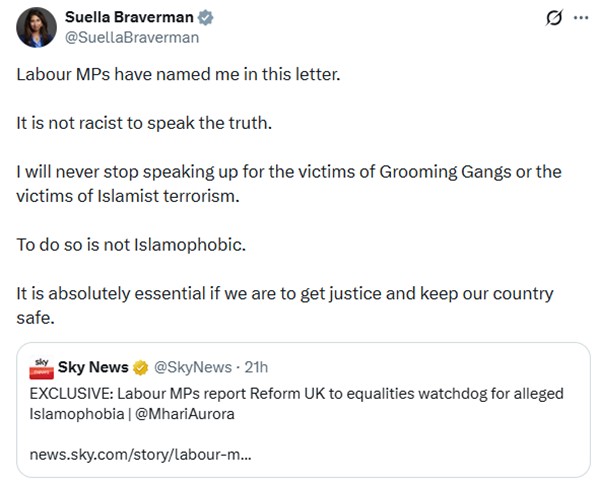
Suella Braverman MP responded on X:
“Labour MPs have named me in this letter. It is not racist to speak the truth. I will never stop speaking up for the victims of Grooming Gangs or the victims of Islamist terrorism. To do so is not Islamophobic. It is absolutely essential if we are to get justice and keep our country safe.”
Lee Anderson MP also posted saying: “I stand by every word.”
An attack on freedom of speech
Alleging that criticisms of Islam or of Islamic practices are Islamophobic and in breach of the Equality Act is clearly an attempt to shut down criticism of Islam. Politicians, of all people, must be free to say what they think. It is quite shocking and disturbing that a group of MPs are effectively calling for the EHRC to enforce a kind of blasphemy code on politicians in relation to Islam.
Who would have imagined just a few decades ago that there would be heated political debate about what can or cannot be said about Islam. The fact that this discussion is even taking place shows how far we have come and how quickly Islam is gaining political influence. The adoption of an official government definition of anti-Muslim hostility was a significant step towards the Islamisation of Britain. This letter reporting MPs to the EHRC for statements about Islam is another.