The Leader of the Opposition and Conservative Party, Kemi Badenoch MP, has written to the Nursing and Midwifery Council (NMC) raising serious concerns about its continued pursuit of fitness‑to‑practise investigations against nurses who have already been vindicated by courts and employment tribunals, including the Darlington nurses and Christian nurse Jennifer Melle.

Kemi Badenoch MP meets with the Darlington Nurses and Jennifer Melle
Despite winning their employment tribunal in January, four Darlington nurses face potential investigations, while Jennifer Melle has two ongoing investigations. NMC investigations can last as long as three years and can lead to professionals losing their careers.
Both high profile cases have been very high profile and supported by the Christian Legal Centre from the beginning.
After meeting with the nurses, today, in a strongly worded letter, Kemi Badenoch has questioned whether the nursing regulator is acting in line with settled law on biological sex and warned that weak or ideologically driven complaints are being allowed to hang over nurses’ careers for years.
“The Supreme Court made clear over a year ago that sex in law refers to biological sex,” Badenoch wrote, and “That must guide how regulators uphold and apply the law. Failure to reflect this clarity risks legal error and unjust treatment of staff.”
She added: “It is clear, from the number of frontline nurses pursued for doing their jobs and subsequently vindicated in court, that the system is misfiring. The NMC, as the independent regulator, is responsible for ensuring it is put right. I am therefore writing to ask specifically why you continue to pursue investigations into the four Darlington nurses and Jennifer Melle which appear inconsistent with both the tribunal outcomes and the settled legal position on biological sex.”
Four Darlington nurses reported
Badenoch called for the immediate dropping of the investigations into four Darlington nurses, Bethany Hutchison, Lisa Lockey, Annice Grundy and Tracey Hooper, who were reported to the NMC after speaking out about being required to undress in front of a male colleague who identifies as a woman, under an NHS policy.
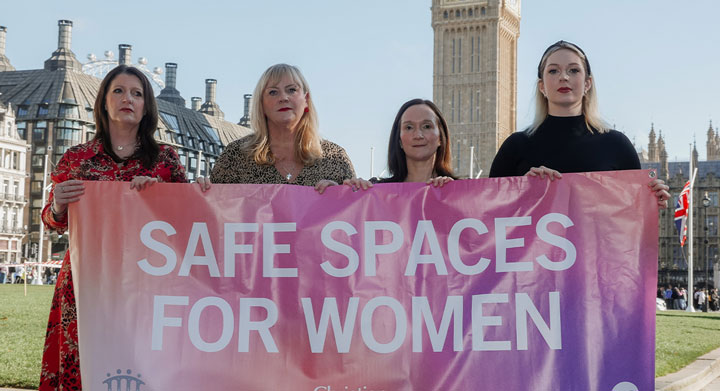
The Darlington Nurses advocate for single-sex spaces outside Parliament
In January, an Employment Tribunal ruled that the nurses had been subjected to harassment and discrimination under unlawful policies and that they were right to raise concerns about privacy, dignity, and safeguarding.
Despite this, complaints focusing not on patient care but on what the nurses said publicly to the media triggered potential NMC investigations that remain ongoing.
“The Tribunal found they were subjected to harassment and discrimination under unlawful policies and were right to speak out,” Badenoch said, and added: “Your investigations into the four Darlington nurses should be dropped in light of their exoneration. The Tribunal found they were subjected to harassment and discrimination under unlawful policies and were right to speak out. It is therefore unclear what misconduct is now being alleged. The complaints (focused on what the nurses said rather than the care they provided) are weak and spurious and should not be used to silence frontline nurses.”
Speaking to the media a ‘protected act’
Crucially, the Tribunal ruled in January that the Darlington nurses’ decision to speak to the media constituted a “protected act” under section 27 of the Equality Act 2010.
In a detailed legal analysis, the Tribunal confirmed that providing information to the media about alleged discrimination, harassment or victimisation remains protected, even where the disclosure is public, politically contentious, or intended to place pressure on an employer or public authority.
The Tribunal made clear that statutory protection does not evaporate because a disclosure attracts publicity. The law protects substance, not institutional convenience.

The Darlington Nurses gather ahead of their Employment Tribunal hearing in Newcastle
It acknowledged that the nurses deliberately placed their concerns in the public domain, anticipated media scrutiny, and understood that publicity might offer a degree of protection. Their campaigning was therefore not unlawful and employees do not forfeit legal protection simply because their case attracts attention.
Two cases against Jennifer Melle
Jennifer Melle’s case followed a strikingly similar trajectory.
After being disciplined for declining, on Christian and clinical grounds, to use a paedophile patient’s preferred gender identity, Jennifer was reported to the NMC by Epsom and St Helier University Hospitals NHS Trust as a ‘potential risk’ to the public and reputation of the NHS.

Jennifer Melle meets Kemi Badenoch MP
After taking legal action and speaking to the media about her experiences, Jennifer was again reported to the NMC for an alleged ‘data breach’ and then suspended for 10 months.
Following significant media and political pressure on the Trust, however, at a disciplinary hearing in January, the Trust dropped this case against Jennifer and allowed her to return to full duties. Jennifer was cleared of wrongdoing, reinstated to her role, and her employment tribunal claim settled.
Despite this, she continues to face the two NMC investigations which might not be resolved for years.

Jennifer Melle returns to work after more than 10 months suspension
Jennifer has described this time as the ‘darkest in her life’ and spoken about how the experience has impacted her and her family. She has also spoken about how the Royal College of Nursing refused to help her in her hour of need.
‘Cases point to a wider problem’
Badenoch wrote. “The two cases against Jennifer Melle should also be dropped. No nurse should face regulatory action for accurately describing biological sex or for speaking under whistleblowing protections. Her Trust has already found no wrongdoing and reinstated her. The fact that she was subjected to racial abuse while carrying out her duties raises a serious question as to why the NMC chose to pursue an investigation against her, rather than step in earlier to support her and uphold her right to work safely and without harassment.”
Concluding the letter, Badenoch said: “Taken together, these high-profile cases point to a wider problem: how many more nurses are being silenced, or left fearful for their livelihoods, for objecting to being required to undress in front of a man, or stating biological reality in a clinical setting?
The NMC’s independence from government places a greater responsibility on it to act proportionately, to filter out bad-faith or ideologically driven complaints at an early stage, and to ensure that nurses are not penalised for holding lawful beliefs grounded in biological fact.”
She added: “I would welcome clarity on how these cases are considered to meet the threshold for regulatory action, particularly in light of the Tribunal findings. It is difficult to see how matters of this nature fall within fitness to practise. On that basis, there is a clear risk to public confidence. Pursuing such cases suggests a regulator focused on policing language and belief, rather than protecting patients and supporting staff.”
‘Frightening for every nurse’
Jennifer Melle said: “My employer has acknowledged that I did nothing wrong, and the allegation that I breached confidentiality has fallen away. Yet I am still being pursued by the NMC for speaking out.
“That is frightening, not just for me, but for every nurse who may one day need to raise concerns about patient safety, conscience, or abuse. Regulators should be protecting whistleblowers, not punishing them.”
Bethany Hutchison, President of the Darlington Nursing Union, said:
“We were completely vindicated by the Tribunal, including for speaking openly to the media about what was happening to us. Yet despite that clear ruling, the NMC investigations still hang over our heads like a shadow.
“It is deeply distressing to remain under regulatory threat after being found to have acted lawfully and courageously. Nurses should never be punished for telling the truth about discrimination and safeguarding concerns.”
Commenting on Badenoch’s intervention, Andrea Williams, Chief Executive of the Christian Legal Centre, said:
“Kemi Badenoch’s letter exposes what our clients have been experiencing for years: a regulator that is failing to apply the law and is allowing itself to be used as a weapon against nurses who speak truthfully and act with integrity. These cases are not about patient safety or professional standards, they are about enforcing ideological conformity.
“The Darlington nurses and Jennifer Melle have already been vindicated, yet they remain trapped in cruel, drawn‑out investigations that threaten their livelihoods. The NMC must urgently drop these cases and comply with the Supreme Court’s ruling on biological sex.”
Find out more about Darlington NursesFind out more about Jennifer Melle