Darius Sandhu comments in light of the Westminster Hall debate on last year’s Supreme Court ruling, that women are to be legally defined by their biological sex
Westminster Hall is a living museum, with the whole Parliamentary estate having been the heart of British power for over a thousand years.
It therefore made for an interesting backdrop in this week’s Westminster Hall debate on the For Women v Scottish Ministers Supreme Court ruling, which attempted to re-establish biological reality in law.
So, I couldn’t help but notice the irony that Members of Parliament were about to debate a truth which has been self-evident for longer than the historic walls that surrounded us.
Sat just ahead of me in the public gallery were the formidable nurses who have been a key part of this debate – our brilliant Darlington Nurses and Jennifer Melle – and the For Women team. Together, they showed once again that there is a huge impact and cost for those who raise their head above the parapet to state simple biological truths.
The human cost of government inaction
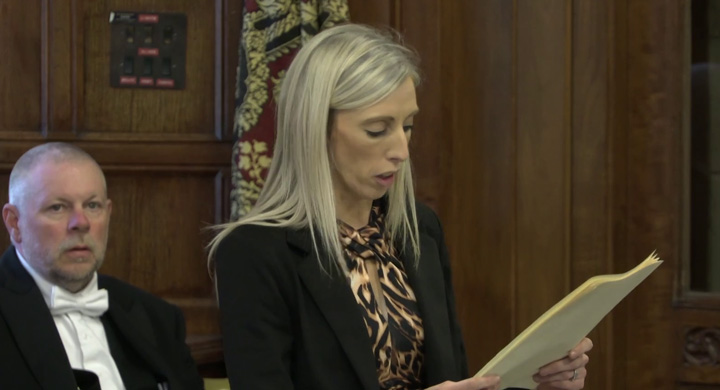
Carla Lockhart MP, who convened this debate, set the stage with a powerful opening statement that reminded those present that the Supreme Court had already done much of the heavy lifting, by clarifying that “woman” in the Equality Act refers to biological sex. She reminded MPs that the ruling of the Supreme Court was clear and that the delay sits at the feet of the Government.

Lockhart further highlighted that Secretary of State for Health Wes Streeting, who has met with the Darlington Nurses, has not yet acted. One year after the judgment we are still waiting for him, “…to introduce new guidance specifically for the NHS. Last April, he promised that it would be published within weeks. The silence is deafening.” It is indeed.
Someone who has been a key voice on this – initially from the Labour Party’s backbenches – is Rosie Duffield MP, who spoke clearly about how there were “women now in government who have always been on my side in secret gender-critical groups but do not have the courage to speak up when in government.”
Many people from workplaces across society do not agree with what is happening but are afraid to speak up. If this is the reality of MPs, and we know that Duffield has had some horrid experiences, imagine the pressure on countless other nurses, teachers and other workers.
We must note that the Government started the week with a poor attempt at softening any blows from the anniversary week, sharing a bland statement about how they will release guidance in May once the local elections are over. I think Rosie Duffield said it best when she bluntly called this a “delay tactic”.
Are they waiting for an opportunity for it to be buried – or are they waiting for a post local election reshuffle to avoid the blame?
365 days on: still no clarity in practice
However, not all speeches recognised the arguments so clearly put forward. Marie Goldman MP gave a baffling speech and at one point stated that she struggles “…with the idea that, at the moment, it is the sign on the door that is preventing someone from causing harm to women.”
Goldman seems to miss the fundamental point that, if the rules are clear, then women can make legitimate complaints about breaches of the rules. As things stand, women like the Darlington Nurses run the risk of being put through disciplinary procedures if they question someone’s presence in their private spaces.
In an intervention, Goldman even attempted to deconstruct the reality of common sense, likening it to the geocentric model of the solar system, saying that “common sense doesn’t always hold true forever.”
This bizarre comparison was met with confused faces not just among those in the debate but those in the gallery too. Jim Allister MP aptly retorted, “I do not think that was ever common sense, and if that is the depths to which the hon. Member has to stoop to try and find an argument, it is a very ineloquent commentary…”
But as soon as the debate went out into orbit, we were thankfully brought back to earth by Claire Coutinho MP, another vocal champion of the Darlington Nurses and Jennifer Melle.
Coutinho gave a damning assessment of the Government’s current position, describing it as “publication purgatory,” while also being firm that it is simply “dither and delay.”
She further called out the Government’s “red-herring” of local elections by pointing out that “the Government made an announcement on potholes yesterday, but they cannot make an announcement on the importance of women’s rights.”
As Minister Olivia Bailey MP rose to her feet in response, I couldn’t help but note the irony as she first spoke with her hands in her pockets.
Her speech again repeated the line of how the code will be published in May; another delay for this Government as it keeps its hands in its pockets.
Thankfully, the close of the debate returned to Carla Lockhart who reminded us of the core of what’s happening:
“it is time that this wokeness and ideology was kicked into touch. A woman is an adult human female, and women across the UK deserve to be protected.” Firm words that could be welcomed by the brave women in the gallery, who we should always remember are the heart of this debate.
Ultimately, we must remember that though this Supreme Court ruling was a victory, it remains a victory as yet unfulfilled. And as Rosie Duffield stated earlier in the debate, there’s a clear message to the Government: “women are watching…”