The Christian Legal Centre’s Pavel Stroilov, who fled Russia in 2003 after his research into the USSR put his life and freedom in danger, warns of President Putin’s real motivation behind the war on Ukraine.
This article was first published in Christian Today and has been republished with permission.
A few years ago, Vladimir Putin infamously remarked that, in the event of a nuclear war, the Russians “will get into the paradise,” while their enemies “will just peg out” – to the laughter and applause of a sycophantic international audience.
For all his pretence of being a champion of ‘Christian values’, this seems to be the depth of his moral theology. These days, indeed, it looks like he has understandably despaired of making it to paradise in some other way, and is wondering whether the nuclear shortcut is his only chance.
There have been those who have taken Putin’s pseudo-Christian rhetoric at face value, and even portrayed his invasion of Ukraine as a religious war. I do not agree. Like many secular rulers before him, Putin wants religion to give guarantees of paradise to his soldiers; but he does not much care which religion it is.
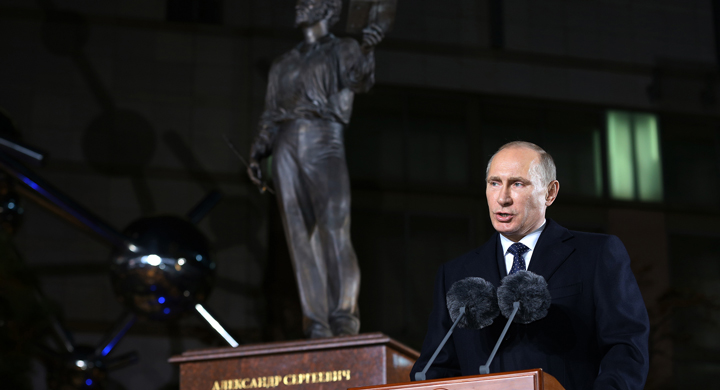
Photo by: Global Panorama
Despite the shameful servility of Patriarch Kirill, for theological reasons, he has been unable to offer a clear guarantee – only a mandatory prayer circulated to all dioceses yesterday. However, Putin had better luck with some of his Islamic servants.
Last Friday, the day after the invasion began, Putin’s puppet dictator of Chechnya, Ramzan Kadyrov (whose cruelty is legendary even by Russian standards), staged a parade of thousands of Chechen troops in Russian uniform in front of the biggest mosque in Chechnya. Addressing the troops, Kadyrov said that they are defending Islam, and are ready to join “any special operation in any territory” to “protect the security of Russia.”
This Monday, Kadyrov’s puppet Mufti of Chechnya Salah Mezhiyev declared a jihad against Ukraine, with assurances that Muslims killed on the Russian side would “certainly become Shahids.” He declared that Muslims had a ‘duty’ to fight on the Russian side “for the Koran and for the Prophet.” The same day, Kadyrov himself made a similar statement: “Don’t try to hinder us. We won’t stop. We are under orders. We are on a jihad.”
Kadyrov’s troops have since been seen in Ukraine, and some of them have been killed. This Thursday, Kadyrov published a bizarre blog post claiming that his troops had captured “the biggest military base in Ukraine” (which he did not identify), having defeated “whole regiments of Nazis,” and were impatient to advance on Kyiv. In another fake news post, he claimed that casualties were limited to just two people among his troops.
The origins of Kadyrov’s regime lie in Russia’s wars against Chechnya in 1990s and 2000s – an earlier example of Putin’s military aggression and genocide on which the West turned a blind eye at the time. The narrative is not dissimilar to the present war in Ukraine. Like Ukraine, Chechnya declared its independence following the collapse of the USSR in 1991, to the dismay of KGB revanchists in Moscow. Chechnya was picked as the first target in their grand re-conquest of the Soviet empire. Russia invaded in 1994, encountered fierce resistance, and eventually had to sign the Peace Treaty of 1997, effectively recognising Chechnya’s independence and pledging to “forever abandon the use of force, or threats of force” to resolve any conflicts. Putin’s clarion call in his rise to power in 2000 was to reverse Russia’s defeat in Chechnya by a new invasion; he did so at the price of a prolonged and cruel war and a series of genocidal ‘cleansing operations’ (‘zachistkas’) in every Chechen town and village.
Just like today Putin today portrays his invasion of independent Ukraine as a ‘special operation’ against ‘neo-Nazis’, 20 years ago he portrayed his genocidal war on Chechnya as a ‘special operation’ against Islamist terrorists. No doubt, there were terrorists among Chechens, just like there are neo-Nazis among Ukrainians (and most European nations); but that was not and is not the whole truth, to put it mildly.
The elected government of independent Chechnya, which still survives in exile, has been clear in its condemnation of terrorist attacks, and suspicious of foreign jihadist preachers (known in Chechnya as “green commissars”) as Russian agents.
The Chechen government in exile has now offered Ukraine a military agreement to enable Chechens living in Europe to fight against Putin’s forces in Ukraine. Its London-based prime minister, Ahmed Zakayev, now tells me: “The statements by the Russian Muftiate about jihad on Ukraine are crazy nonsense which contradicts Islamic principles. The Muftiate in the USSR was restored by Stalin at the same time as the Russian Orthodox Church, was has been tightly controlled by the KGB ever since. So-called Kadyrov’s troops are in reality Putin’s troops, and their participation in the invasion of Ukraine is a war crime.”
Kadyrov’s father, Ahmad Kadyrov, was himself the Chief Mufti of Chechnya during the First Chechen War in 1990s; he dramatically switched sides and offered his services to Russia at the outbreak of the Second Chechen War in 2000. Putin rewarded Kadyrov Sr. by making him a puppet president of Chechnya. After his assassination, he was succeeded by his brutal son Ramzan, whose rule of terror in Chechnya became legendary, and whose troops have become Putin’s loyal guard deployed wherever he wants to terrify an enemy – from Ukrainians to peaceful protesters in Russian cities.
Having began his conquest of Chechnya under the guise of fighting Islamist terrorists, Putin has ended up setting up an authoritarian jihadist Islamic Republic under Russian control. This gives us a hint as to what he will do if he is allowed to win his war against those he calls Ukrainian neo-Nazis.